
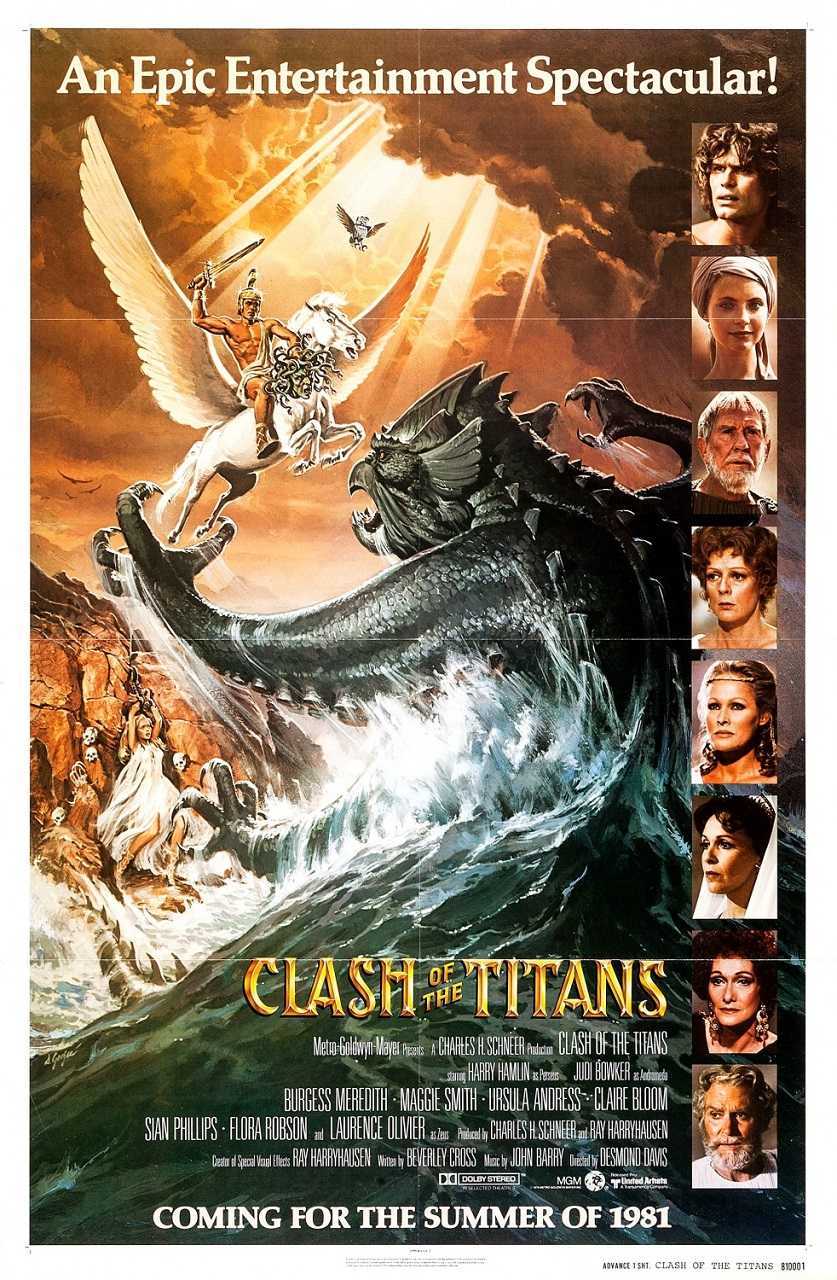
USA. 1981.
Crew
Director – Desmond Davis, Screenplay – Beverley Cross, Producers – Ray Harryhausen & Charles H. Schneer, Photography – Ted Moore, Music – Lawrence Rosenthal, Stop Motion Animation – Ray Harryhausen, Special Effects – Colin Chilvers, David Knowles & Brian Smithies, Art Direction – Frank White. Production Company – MGM.
Cast
Harry Hamlin (Perseus), Judi Bowker (Andromeda), Laurence Olivier (Zeus), Burgess Meredith (Ammon), Maggie Smith (Thetis), Claire Bloom (Hera), Neil McCarthy (Calibos), Sian Phillips (Cassiopeia), Susan Fleetwood (Athena), Jack Gwillim (Poseidon), Tim Piggott-Smith (Thallo)
Plot
The god Zeus gives birth to a son Perseus by a mortal woman. The goddess Hera is angered when Zeus punishes her mortal son Calibos with deformity and retaliates by transporting Perseus far away from his home to Joppur. There Perseus falls for the beautiful Princess Andromeda, the former betrothed of Calibos. To become a suitor, he must solve a riddle that Andromeda gives or join all other failed suitors and be burned at the stake, a curse that has been placed on Andromeda by Calibos. Using a helmet of invisibility and a captured Pegasus, Perseus follows Andromeda’s sleeping doppelganger to the marshlands where Calibos lives and overhears as she receives the current riddle that Calibos gives and returns to successfully answer it. Their marriage is announced. When Andromeda’s mother Cassiopeia foolishly boasts that Andromeda’s beauty surpasses that of the goddess Thetis herself, the wrathful Thetis appears, demanding the sacrifice of Andromeda within 30 days or else she will loose the Kraken on the city. And so Perseus must set out on a quest to find a means of destroying the Kraken.
In the 1950s and 60s, stop-motion animator Ray Harryhausen was the equivalent of what Industrial Light and Magic and the Weta Workshop are today. Harryhausen became a cult figure with stop-motion animated vehicles like The 7th Voyage of Sinbad (1958), Jason and the Argonauts (1963), One Million Years B.C. (1966) and The Golden Voyage of Sinbad (1973). Ray Harryhausen’s creations of mythical creatures and use of stop-motion animation was unparalleled and he became one of the few special effects men to become a star.
Clash of the Titans was also the biggest budgeted of Ray Harryhausen’s films, something that allows him to bring in a name cast from the British film industry to play the immortals – although, most of these have more marquee value than they do screen time, with Ursula Andress getting a total of two lines, for example.
Sadly, Harryhausen’s work has not aged well beyond the mid-1970s. The resurgence of fantasy with Star Wars (1977) eclipsed and overshadowed Harryhausen. Clash of the Titans was Harryhausen’s only attempt to make a film in the post-Star Wars era. Certainly, the influence of Star Wars on Clash of the Titans is undeniable – most notably in the character of the mechanical owl Bubo, which has been all but outrightly stolen from R2D2.
Clash of the Titans was a return to the Greek mythological adventure that Harryhausen successfully conducted in Jason and the Argonauts – and to such extent, Harryhausen has brought back his Jason scriptwriter Beverly Cross. Clash of the Titans was a modest success when it came out; unfortunately, Harryhausen has not adjusted to the type of filmmaking of the post-Star Wars era. Ray Harryhausen’s films belong to the type of 1950s historical spectacle that specialised in stagey historical surroundings, stolid actors and characters. The appeal in most of Ray Harryhausen’s films was the spectacle of his special effects creations. The new era only tended to show up these dramatic deficiencies.
The period dialogue is stilted. More importantly, Clash of the Titans is not great Harryhausen. The effects creations are nothing amazing – there are no standout sequences such as the skeleton fights in 7th Voyage and Jason, or the Kali duel in Golden Voyage. The one exception is the encounter with the Medusa, which is directed with fine suspense and atmosphere.
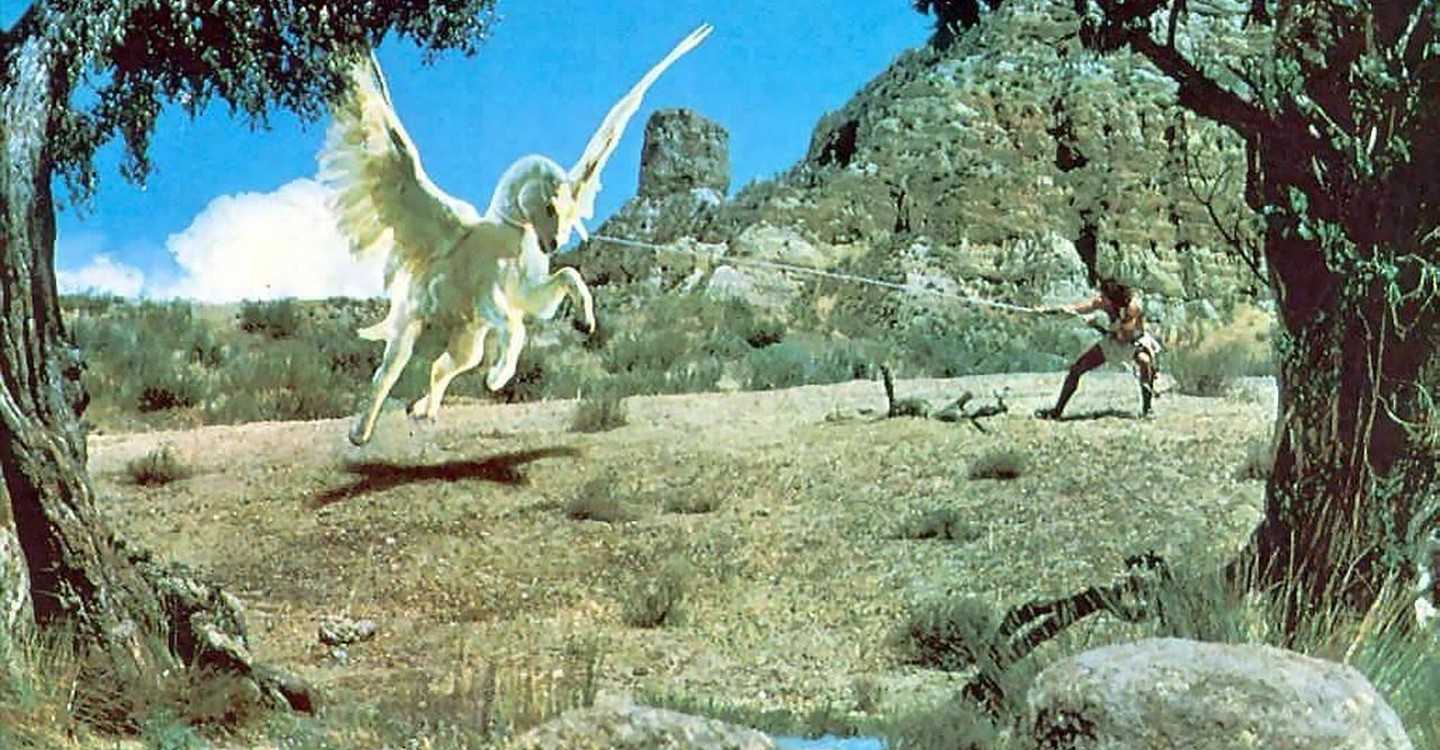
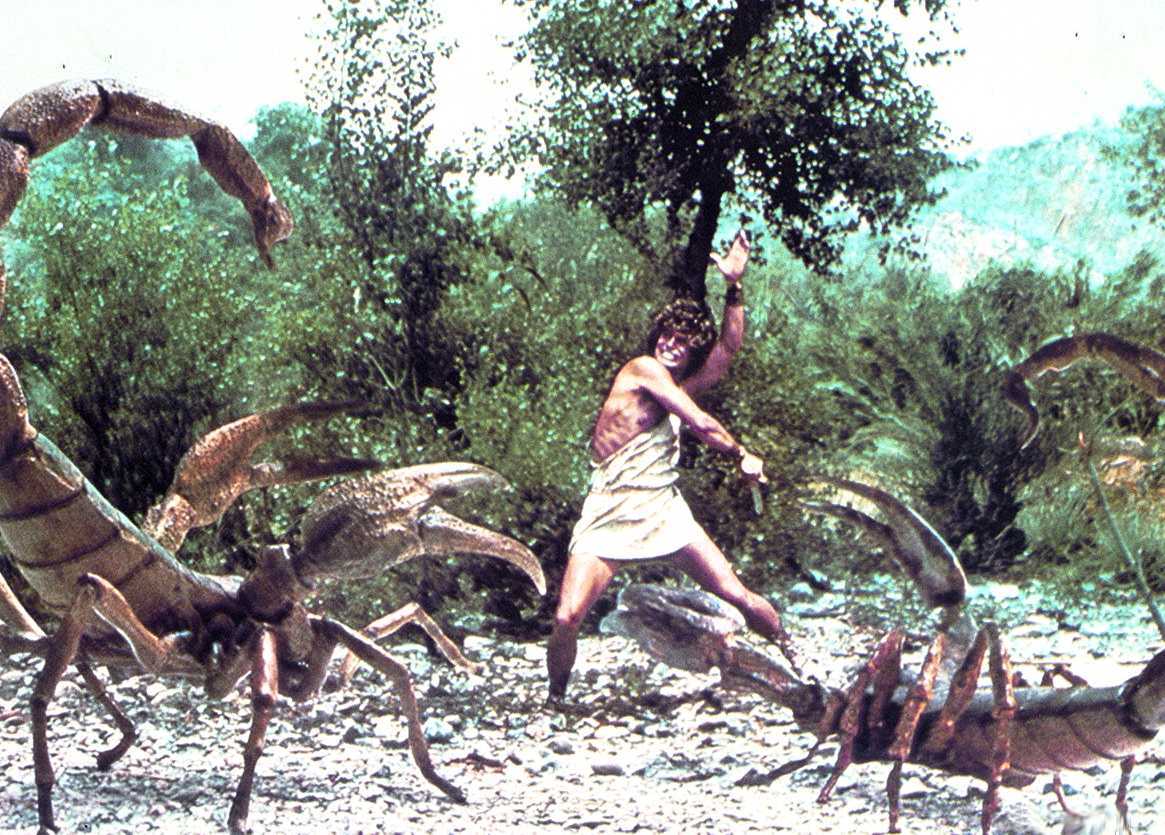
On a wider level, Ray Harryhausen’s special effects have not dated well. There are grainy matte plates and obvious cuts between actor and model, between white horse and stop-motion animated pegasus. This is most obvious in the scenes with the troupe fighting a horde of giant-sized scorpions. The stop-motion animation of the tauntauns and the Imperial Walkers in the previous year’s The Empire Strikes Back (1980) is far superior to anything Harryhausen conducted here, even though Harryhausen was a thirty year veteran in the field and Industrial light and Magic were the relative newcomers.
The same year as Clash of the Titans, Industrial Light and Magic also provided the effects for the stunning Dragonslayer (1981) wherein they devised a new form of stop-motion animation called Go-Motion. Ray Harryhausen’s stop-motion techniques relied on a model making one movement per frame resulting in the characteristic jerky gait familiar to stop-motion animation, whereas Go-Motion had a model making multiple movements per frame resulting in much more fluid form.
Although, Clash of the Titans was a much greater success than Dragonslayer at the box-office, Go-Motion paved the way for the future. And, of course, with the arrival of CGI in the 1990s, stop-motion animation became an almost entirely obsolete form of filmmaking. In 1982, Harryhausen announced plans for a new stop-motion animation film called Force of the Trojans but in the end he instead announced his retirement and Clash of the Titans proved to be his last film.
Clash of the Titans (2010) was a remake where Harryhausen’s effects were upgraded with lavish CGI. This also led to a sequel with Wrath of the Titans (2012).
Ray Harryhausen’s other films are:– The Beast from 20,000 Fathoms (1953), the granddaddy of all atomic monster films; the giant atomic octopus film It Came from Beneath the Sea (1955); the alien invader film Earth Vs. The Flying Saucers (1956); the alien monster film 20 Million Miles to Earth (1957); The 7th Voyage of Sinbad (1958); The 3 Worlds of Gulliver (1960); the Jules Verne adaptation Mysterious Island (1961); the Greek myth adventure Jason and the Argonauts (1963); the H.G. Wells adaptation The First Men in the Moon (1964); the caveman vs dinosaurs epic One Million Years B.C. (1966); the dinosaur film The Valley of Gwangi (1969); and the two Sinbad sequels The Golden Voyage of Sinbad (1973) and Sinbad and the Eye of the Tiger (1977). Ray Harryhausen: Special Effects Titan (2011) was a documentary about his work.
Trailer here