


(O Convento)
Portugal/France. 1995.
Crew
Director/Screenplay – Manoel de Oliveira, Story – Agustina Bessa-Luis, Photography – Mario Barosso, Music – Sofia Gubaidulina & Toshiro Mayuzumi, Production Design – Ze Branco & Ana Vaz de Silva. Production Company – Mandragoa Filmes/Gemini Films/La Sept – Cinema.
Cast
John Malkovich (Professor Michael Padovik), Catherine Deneuve (Helene Padovik), Luis Miguel Cintra (Baltar), Leonor Silveira (Piedade), Duarte D’Almeida (Baltazar), Heloisa Miranda (Berta)
Plot
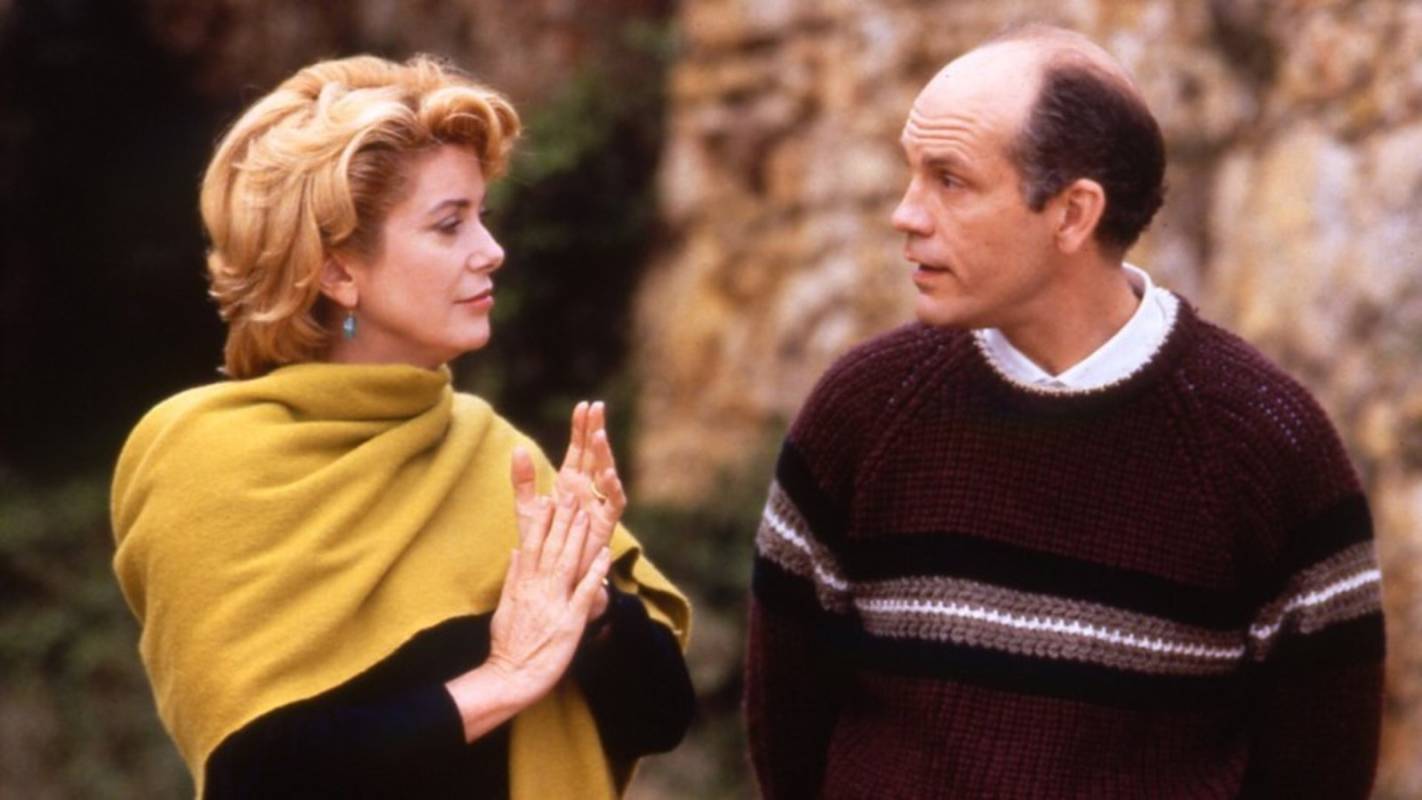
American professor Michael Padovik and his French wife Helene arrive at a convent in Portugal. Padovik is seeking evidence in the convent’s library for his thesis that Shakespeare was Spanish. He is attracted to the beautiful and pure-hearted librarian Piedade. The curator Baltar, who also claims to be The Devil, tries to seduce the irritated Helene. She demands that he prove his professed love by disposing of Piedade.
The Convent is a variation on the Faust story. At least it might be. In fact, it is extremely hard to tell what it is meant to be about. Certainly, Goethe’s Faust figures prominently and passages of it are read throughout. The swarthy Luis Miguel Cintra hovers sinisterly in the background and at one point claims to be The Devil, although there is no way of telling if this is meant literally or not. There is an innocent soul – the piercingly beautiful and virtuous Leonor Silveira – who appears to come to a tragic end. Beyond that not much is clear.
What appears to happen is that John Malkovich’s wife (Catherine Deneuve) makes some sort of diabolic agreement with Luis Miguel Cintra to be rid of Leonor Silveira to whom Malkovich is attracted. We see a scene where Leonor Silveira tells Luis Miguel Cintra she desires him rather than John Malkovich but then she runs away to a part of the forest Cintra has earlier told Catherine Deneuve contains an abyss. He yells after her and the scene then cuts to a later point where Leonor Silveira has vanished. Whether the abyss was real or allegorical is left unclear.
The film reaches an ambiguously happy ending with John Malkovich and Catherine Deneuve walking off down the beach arm in arm, apparently reconciled, maybe due to Deneuve’s diabolical contract with Luis Miguel Cintra, then again maybe not. The end credits spell the vagueness and ambiguity out with the statement that their bodies were found burned in the forest, although there were also reports that they were found living in Paris, although just as equally the word of the observing fisherman cannot be trusted.
The French cultural critic Jean Beaudrillard made the observation that the ultimate postmodernist building would be one that has no entrances. By like analogy the ultimate postmodernist film would surely be one that tells a story that operates on a set of rules that are never conveyed to the audience. The Convent is very much that. The plot is all loose ends and uncertain metaphors that never cohere into a clear direction or any overall roadmap. This sort of thing can often be utterly pretentious but here it proves somewhat fascinating.
Director Manoel de Oliveira invests the landscape and the grounds of the decaying convent with a brooding mysteriousness. His camera focuses on empty landscape far longer than is necessary for mere scenography, as though if we look at bleak stretches of beach long enough we might find some meaning in them. There is an intensive violin score, which adds much.
Portuguese born Manoel de Oliveira became the oldest director in the world, enjoying the peak of his career from his seventies onwards, he still directing films over the age of 104, just before his death in 2015 at the age of 106. His one other venture into genre material was the ghost story The Strange Case of Angelica (2010) made when he was 102 years old.
Trailer here