
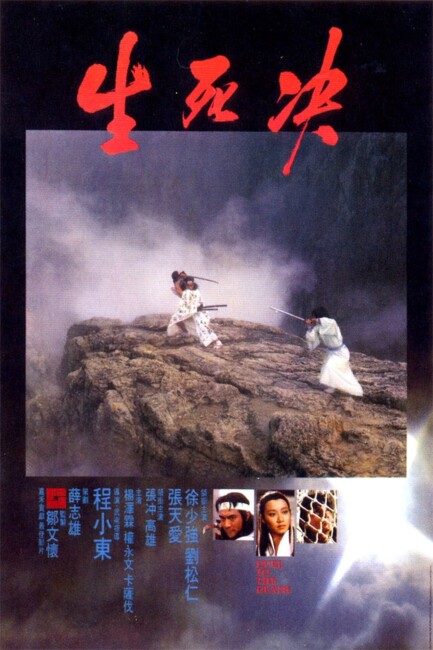
(Xian Si Jue)
Hong Kong. 1983.
Crew
Director – Ching Siu-Tung, Screenplay – Ching Siu-Tung, David Lai & Manfred Wong, Producer – Raymond Chow. Production Company – Golden Harvest.
Cast
Damian Lau (Ching Wan), Norman Tsui Siu-Keung (Hashimoto), Flora Cheung (Sheng Nan), Eddie Ko (Kenji)
Plot
The arrogant Japanese send the ninja swordsman Hashimoto to the Shaolin schools in China to issue a challenge for supremacy of technique. Ching Wan is chosen to represent the school in the challenge. In the course of preparing for the duel, Ching Wan discovers that the son of the man who is the host of the fight is in fact a girl. The two become attracted. At the same time, various parties seek to sabotage the contest.
Duel to the Death was an early entry in Hong Kong’s Wu Xia flying swordsman cycle. It even predates Zu: Warriors from the Magic Mountain (1983), the film that propelled the genre into high gear and popularised Hong Kong martial arts fantasy. It was also the first film from director Ching Siu-Tung who made arguably the two finest entries examples of Wu Xia – A Chinese Ghost Story (1987) and Swordsman II (1992) – and who has directed action scenes on just about every major Hong Kong fantasy action film. (See below for Ching Siu-Tung’s other genre films).
It is interesting to make contrast between Duel to the Death and later entries in the cycle. Duel to the Death is filled with all the manic mid-air battles that became a regularly established part of the cycle. It is also more story driven, something later entries would substantially eschew. There are familiar elements like the crossdressing theme – the girl who poses as a boy and crosses swords with the best of them. (In a theme that was also a part of Ching Siu-Tung’s Swordsman II, considerable anti-Japanese sentiment forms a major part of the film).
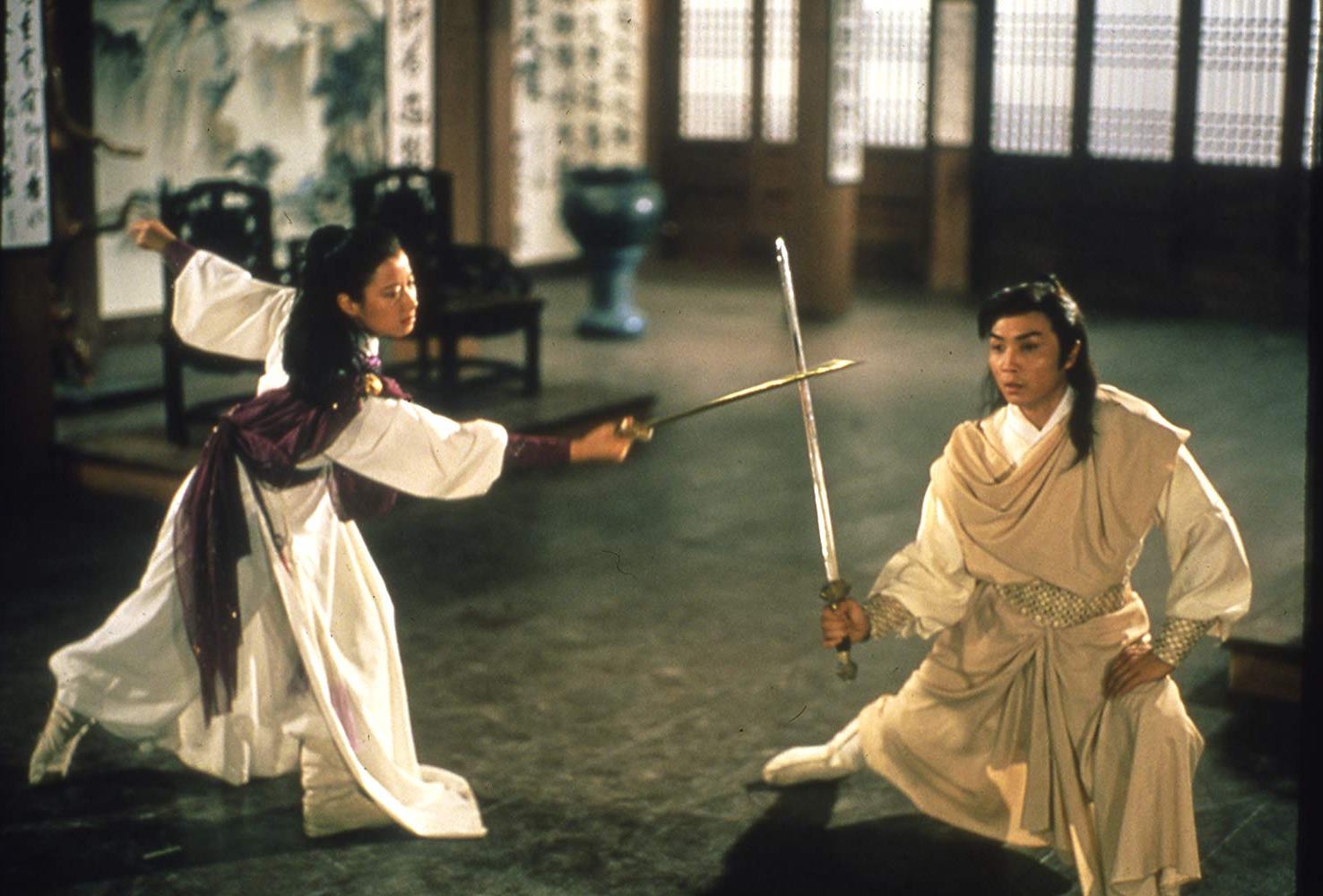
There are many of the wildly fantastical elements that make these films so much fun – madcap nunchuka battles, ninjas flying in on squadrons of kites, and one classic moment of pure lunacy where one of the heroes faces a giant samurai that splits up to form a squad of naked female ninjas. There is also a strong comedy element such as the inscrutable guru who swings through the trees like a monkey and comes accompanied by a talking parrot.
On the minus side, the film is slower than expected and Ching, primarily an action director, seems disinterested in the non-action scenes. Particularly unsatisfying is the climax – the entire film builds up to the big showdown between the two heroes but Ching inexplicably stops at the point where the two finally face one another on a beach.
Ching-Siu Tung’s other genre films are:- The Witch from Nepal/The Nepal Affair (1985), A Chinese Ghost Story (1987), A Chinese Ghost Story II (1990), A Terracotta Warrior (1990), A Chinese Ghost Story III (1991), New Dragon Gate Inn/Dragon Inn (1992), Swordsman II (1992), The Heroic Trio (1993), The Heroic Trio II: Executioners (1993), The Mad Monk (1993), Swordsman III: The East is Red (1993), The Scripture With No Words (1996), The Sorcerer and the White Snake (2011) and Jade Dynasty (2019). Siu-Tung is also known as an action choreographer par excellence and has coordinated sequences on films like Shaolin Soccer (2001), Invincible (2001), Hero (2002), House of Flying Daggers (2004) and In the Name of the King: A Dungeon Siege Tale (2007).
Full film available here