

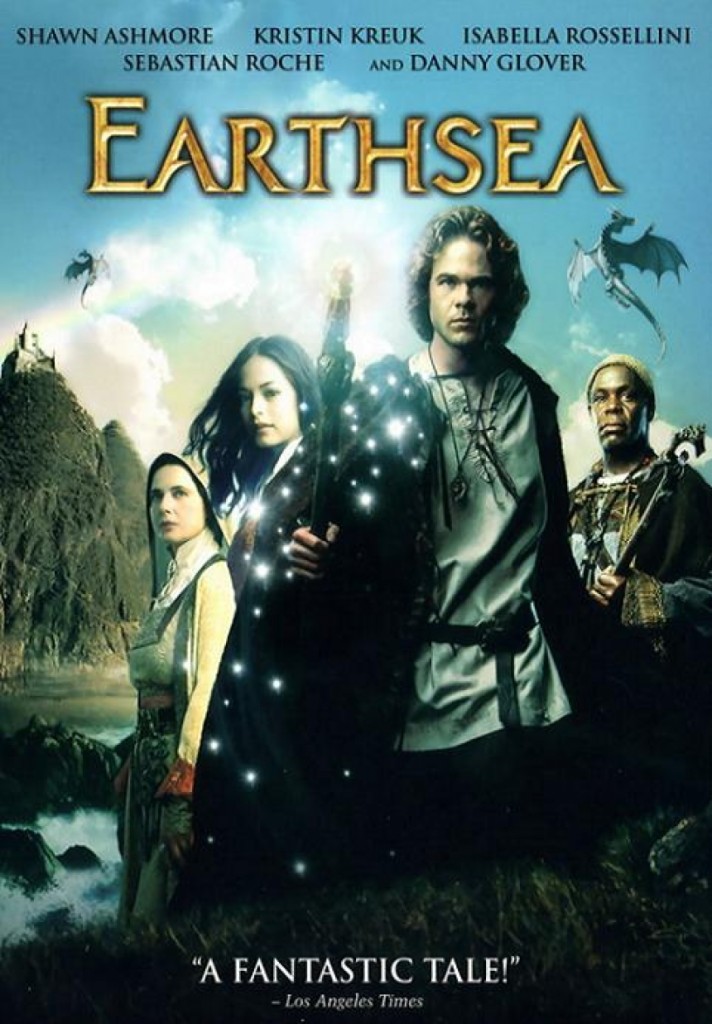
USA. 2004.
Crew
Director – Robert Lieberman, Teleplay – Gavin Scott, Based on the Novels A Wizard of Earthsea and The Tombs of Atuan by Ursula K. Le Guin, Producers – Matthew & Michael O’Connor, Photography – Steve Danyluk, Music – Jeff Rona, Visual Effects Supervisors – Eric Grenaudier & Lee Wilson, Visual Effects – Anthem Visual Effects (Supervisor – Sebastian Bergeron) & Stargate Digital Vancouver, Special Effects Supervisor – Tim Storvick, Makeup Effects – WCT Productions (Designer – Bill Terezakis), Production Design – Michael Joy. Production Company – Sci-Fi Channel/Hallmark Entertainment/Bender Brown Productions.
Cast
Shawn Ashmore (Ged/Sparrowhawk), Kristin Kreuk (Tenar), Isabella Rossellini (Thar), Danny Glover (Ogion), Sebastien Roche (King Tygath), Jennifer Calvert (Kossil), Christopher Gauthier (Vetch), Mark Hildreth (Jasper), Alan Scarfe (Arch Magus), David Ward (Dunain), Alessandro Juliani (Skiorch), Mark Acheson (The Gebbeth), Erin Karpluk (Diana), Emily Hampshire (Rosa), Peter Kent (Voice of Dragon)
Plot
The land of Earthsea is made up of an archipelago of 1001 islands. In the Village of Ten Elders on the island of Gont, the blacksmith’s son Ged wants to be a magician. Meanwhile, Tygath, the king of the Kargides from the isle of Atuan, receives a prophecy that a wizard will be his undoing and sends his troops forth out across the archipelago to find the wizard. As the Kargide warriors invade Gont, Ged conjures a mist that drives them away. Afterwards the magus Ogion takes Ged as an apprentice and gives him the true name of Sparrowhawk. Meanwhile, Tygath has seduced Kossil, a handmaiden of the sisterhood that guards the Tombs of Atuan. Tygath wants to obtain the secrets to unlock the gates of the tombs that imprison The Nameless Ones to obtain the secret of immortality. Kossil plots to poison the high priestess Thar and succeed her but Thar confounds this by appointing the bright young Tenar as her successor. Ged leaves Ogion and becomes an apprentice at the school for magicians on the isle of Roke. During a competition, Ged seeks to best a rival by conjuring the dead, only to inadvertently unleash a gebbeth shadow creature. He is forced to leave the school and ventures out into Earthsea. He is pursued by the gebbeth, which seeks to possess him and kills all it encounters. At the same time, Ged dreams of Tenar and realises that the end of his quest may lie in the Tombs of Atuan.
Ursula K. Le Guin (1929-2018) is celebrated as one of the great writers of science-fiction and fantasy, and possibly the finest woman writer in the genre. Le Guin has won numerous Hugo and Nebula Awards for novels like The Left Hand of Darkness (1969) set on a planet where the inhabitants change sex; The Lathe of Heaven (1971) about a man whose dreams end up altering reality; the novella The Word for World is Forest (1972, expanded to a novel 1976) about the despoliation by colonists of an alien society whose entire world consists of a forest; and The Dispossessed (1974), which offered a depiction of a society based on anarchist principles. Some of Ursula Le Guin’s most famous books have been the Earthsea series, which consists of A Wizard of Earthsea (1968), The Tombs of Atuan (1971), The Farthest Shore (1972) and two belated follow-ups – Tehanu: The Last Book of Earthsea (1990) and The Other Wind (2001), as well as Tales from Earthsea (2001), a series of short stories set around the locale. The Earthsea series takes place in an archipelago of 1001 islands and concerns itself (principally) with the wizard Ged and his rise from novice to archmage.
The Earthsea tv mini-series was mounted as a co-production between the US Sci-Fi Channel and Hallmark Entertainment, who have been responsible for a number of often excellent adaptations of classic works of literature and fantasy. (See below for Hallmark’s other genre credits). The mini-series combines both A Wizard of Earthsea and The Tombs of Atuan into one story. Ursula Le Guin made the decision to sign over the rights as she had been impressed by Hallmark’s mini-series Dreamkeeper (2003) about American Indian myths and the producers represented that they had Lord of the Rings co-writer Philippa Boyens onboard. However, after seeing the finished production, Le Guin protested heavily at the adaptation and issued several online statements that were heavily damning of the changes that had been made to her work. In particular, Le Guin was scathing about director Robert Lieberman’s claiming to speak on her behalf in an interview in saying that he was being true to her themes of the harmony between paganism and wizardry and between belief and unbelief, themes that Le Guin said were never in the book.
Ursula Le Guin’s biggest upset appears to be the issue of race. In the books, Earthsea was a land of people who had identifiably different coloured skins – the hero Ged has red-brown skin, for instance. (This was Le Guin making a point of breaking away from the automatic preference that most fantasy unconsciously sides with in creating lands that are populated primarily by white people). However, the mini-series has been cast with standard Caucasian actors, with the exception of the African-American Danny Glover.
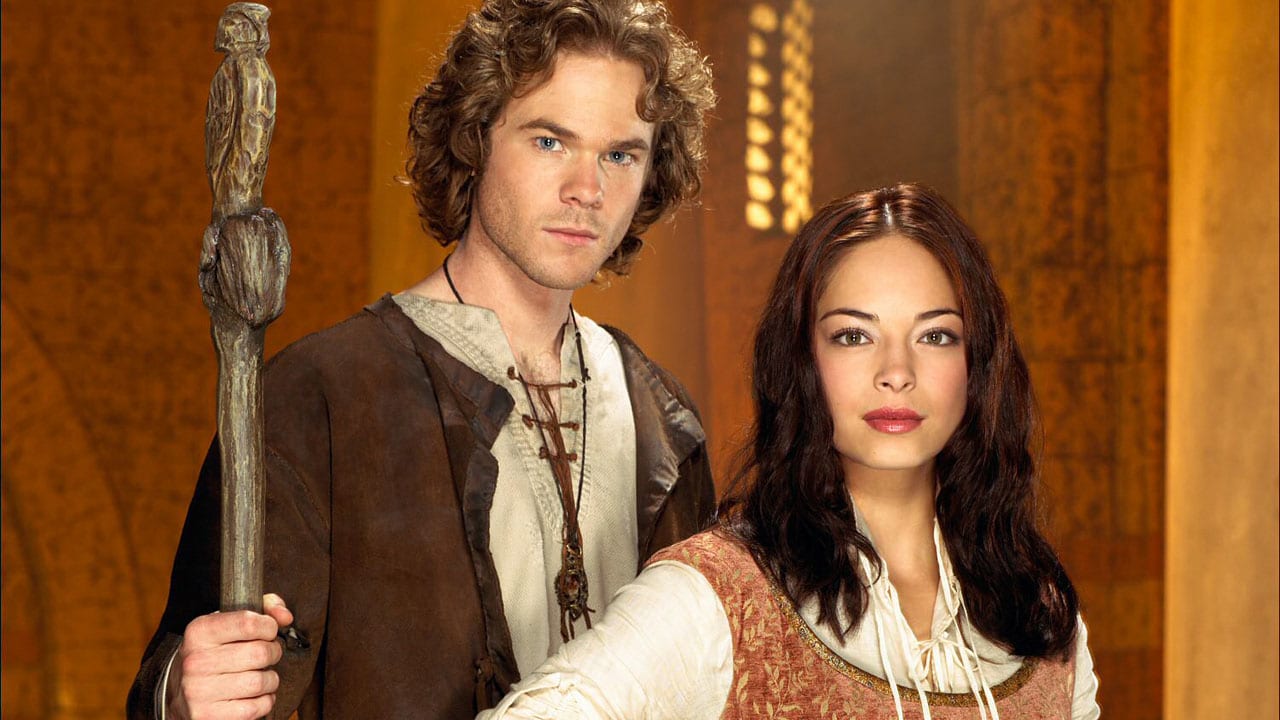
There are a great many other changes between the mini-series and the books. Most notably, the scriptwriter has screwed up and named the central character Ged and has him given the true name of Sparrowhawk, rather than vice versa as Le Guin had it in A Wizard of Earthsea. The changes are most notable when it comes to the adaptation of The Tombs of Atuan. In the novel, Tenar traps Ged inside the lightless tombs where he must use his magic to stay alive and avoid discovery by The Nameless Ones. During his imprisonment, a slow friendship grows between he and Tenar and at the end he helps her escape from a life of ritual service. In the book, the priesthood is not as benevolent as seen in the mini-series; the tombs are not lit by torches every few metres but are entirely in the dark; and there is no political chicanery and sexual jealousy at the forefront of the story.
It is safe to say had their not been the recent box-office successes of fantasy films like The Lord of the Rings trilogy – The Lord of the Rings: The Fellowship of the Ring (2001), The Lord of the Rings: The Two Towers (2002) and The Lord of the Rings: The Return of the King (2003) – and the Harry Potter series – Harry Potter and the Sorcerer’s Stone/Harry Potter and the Philosopher’s Stone (2001) et al – then it is unlikely that there would have been an Earthsea. Though Ursula Le Guin’s book was there way before and predates either of the film series, Earthsea cannot help but feel like it is drawing from these – trying to create another epic fantasy a la Lord of the Rings and in particular borrowing the notion of the wizard’s school from Harry Potter (even though it was likely that A Wizard of Earthsea was what inspired J.K. Rowling to create Hogwarts). Though Ursula Le Guin was there first, the Earthsea mini-series is so unimaginatively staged that it seems no more than a poor trend jumper.
There is no genuine magic to the mini-series. Rather than sing with the sweep of epic fantasy in the way that Peter Jackson’s The Lord of the Rings does, Earthsea feels exactly like tv filler. In the books, Ursula Le Guin expended a great deal of time creating a world with a depth and culture but nothing of this survives in the mini-series. All the elements in the mini-series are played exactly as though they are clichés from the sword-and-sorcery genre. Even beyond seeming like poor sword-and-sorcery, Earthsea is shabbily and indifferently directed. The character of Tygath is all hackneyed evil dark lord posturing – the scenes with Sebastien Roche running around grabbing people by the throat and bawling threats are such cliché villainy that they instead emerge as camp and with zero threat. The Gebbeth, which in A Wizard of Earthsea is supposed by Ged’s dark shadow self, looks like no more than a cheapo demon out of some bad horror film. The dialogue is dreadfully clunky and often excruciatingly bad. It is filled with grating anachronisms like when Ged asks his stepmother: “What’s the spell going to be today?” to be told “Actually, I was just making myself a salad for lunch.” Or lines like “The doors are impenetrable,” “You should have asked for your money back.”
Many of the backgrounds – the castles on islands, the whole of Atuan, the magical wave the Arch Magus creates – look like cheap and obvious digital effects. The wizards all have fake beards. The single decent set is the giant pillar surrounded by candles that guards the gates of the Tombs of Atuan. Shawn Ashmore seemed a promising young actor in X2 (2003) but his lead performance here only has a wooden handsomeness to it.
Goro Miyazaki, son of animator Hayao Miyzaki, subsequently made the anime Earthsea film Tales from Earthsea (2006), which was adapted from The Farthest Shore and parts of Tehanu. This is a beautiful film that captures the essence of Ursula Le Guin’s writing far more than anything in the mini-series does. The only other film adaptations of Ursula Le Guin’s works are The Lathe of Heaven, which has been twice filmed as the the tv movies, The Lathe of Heaven (1980) and Lathe of Heaven (2002), although James Cameron’s Avatar (2009) uncreditedly steals much of Le Guin’s book The Word for World is Forest. Ursula Le Guin also wrote an episode for the Canadian sf series Starlost (1973).
Director Robert Lieberman also made the interesting supposedly true life alien abduction film Fire in the Sky (1993) but most of his work has been in television with the other genre likes of the futuristic cyber-thriller Net Force (1999), the alien invasion mini-series Final Days of Planet Earth (2006) and the disaster mini-series Eve of Destruction (2013), as well as the Torture Porn film The Tortured (2010).
Hallmark’s other works of genre note are:– the sf mini-series White Dwarf (1995), The Canterville Ghost (1996), Gulliver’s Travels (1996), Harvey (1996), the Christmas musical Mrs Santa Claus (1996), Murders in the Rue Morgue (1996), the children’s horror Shadow Zone: The Undead Express (1996), the medical thriller Terminal (1996), The Odyssey (1997), the cloning thriller The Third Twin (1997), 20,000 Leagues Under the Sea (1997), the monster movie Creature (1998), Merlin (1998), the sf film Virtual Obsession (1998), Aftershock: Earthquake in New York (1999), Alice in Wonderland (1999), Animal Farm (1999), A Christmas Carol (1999), the tv series Farscape (1999-2003), Journey to the Center of the Earth (1999), The Legend of Sleepy Hollow (1999), The Magical Land of the Leprechauns (1999), Arabian Nights (2000), the modernised Hamlet (2000), Jason and the Argonauts (2000), Prince Charming (2000), the mini-series The 10th Kingdom (2000) set in an alternate world where fairy-tales are true, the medical thriller Acceptable Risk (2001), The Infinite Worlds of H.G. Wells (2001), Jack and the Beanstalk: The Real Story (2001), The Monkey King/The Lost Empire (2001), My Life as a Fairytale: Hans Christian Andersen (2001), Snow White (2001), the series Tales from the Neverending Story (2001), the fantasy adventure Voyage of the Unicorn (2001), the Sherlock Holmes film The Case of the Whitechapel Vampire (2002), Dinotopia (2002), The Hound of the Baskervilles (2002), the Christmas film Mr St. Nick (2002), the Christmas film Santa Jr (2002), Snow Queen (2002), the modernised A Carol Christmas (2003), Children of Dune (2003), the American Indian legends mini-series Dreamkeeper (2003), the children’s monster film Monster Makers (2003), Angel in the Family (2004), A Christmas Carol (2004), 5ive Days to Midnight (2004) about forewarning of the future, Frankenstein (2004), King Solomon’s Mines (2004), the Christmas film Single Santa Seeks Mrs. Claus (2004), Dinotopia: Quest for the Ruby Sunstone (2005), Hercules (2005), the thriller Icon (2005), Meet the Santas (2005), Mysterious Island (2005), the disaster mini-series Supernova (2005), The Curse of King Tut’s Tomb (2006), the alien invasion mini-series Final Days of Planet Earth (2006), Merlin’s Apprentice (2006), the bird flu disaster mini-series Pandemic (2006), the disaster mini-series 10:15 Apocalypse (2006), the psychic drama Carolina Moon (2007), the psychic drama Claire (2007) and the ghost story Something Beneath (2007).