

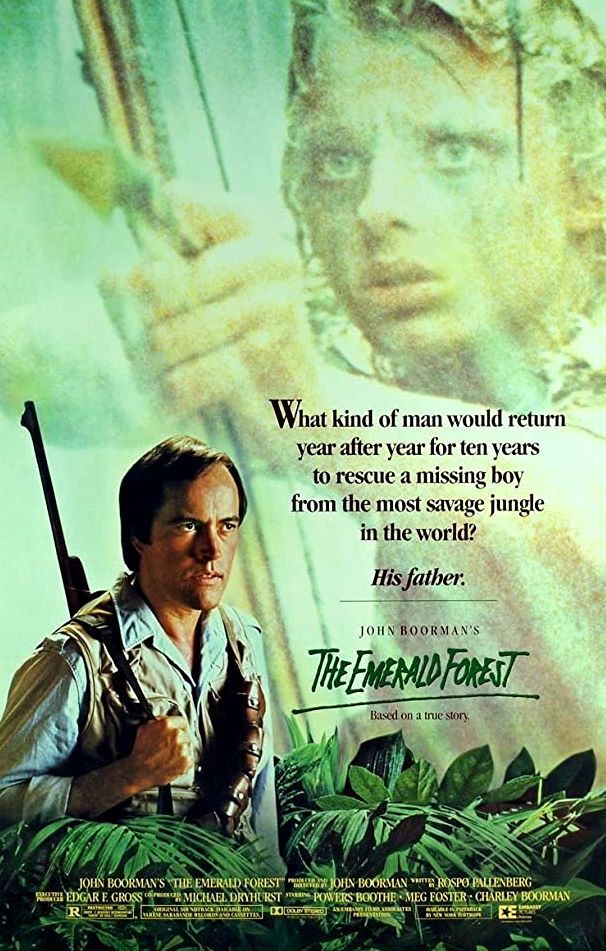
UK. 1985.
Crew
Director/Producer – John Boorman, Screenplay – Rospo Pallenberg, Photography – Philippe Rousselot, Music – Brian Gascoigne & Junior Homrich, Miniatures Supervisor – Phil Stokes, Special Effects Supervisor – Ralph Salis, Special Makeup – Peter Frampton, Production Design – Simon Holland, Tribe Choreography – Jose Possi. Production Company – Christel Films.
Cast
Charley Boorman (Tomme/Tommy Markham), Powers Boothe (Bill Markham), Rui Polonah (Chief Wanadi), Dira Paes (Kachiri), Meg Foster (Jean Markham), Eduardo Conde (Uwe Werner), Ariel Coehlo (Padre Leduc), William Rodriguez (Young Tommy)
Plot
Engineer Bill Markham is overseeing the construction of a dam project in Brazil. His young son Tommy momentarily wanders off into the jungle while playing, only to be abducted by natives. Bill spends the next ten years searching for Tommy. He mounts an expedition into a remote part of the Amazon to search amongst the tribes there. Contact with the Fierce People tribe goes hostile and Bill flees pursued by hunters and he is startled to encounter Tommy at a waterfall. Ever since he disappeared, Tommy has been living among the Invisible People tribe who have never encountered Western civilization before. Tommy has adjusted to the Invisible People’s ways and culture, including taking a native girl as wife. Bill is drawn between leaving Tommy there or bringing him home and eventually decides on the former. At the same time, Bill’s dropped semi-automatic rifle is found by the Fierce People who desire its power. They strike a deal with local traders to capture the Invisible People’s women, including Tommy’s wife, in trade for guns and ammunition. The women are then placed into prostitution. Tommy’s only choice is to venture back to civilization and enlist his father’s help in rescuing the tribe’s women back.
John Boorman is always a director of great interest. Boorman emerged in the late 1960s/early 70s with acclaimed films like Point Blank (1967), Hell in the Pacific (1968), Leo the Last (1970) and particularly the prototypic Backwoods Brutality classic Deliverance (1972), which had Boorman nominated for a Best Director Academy Award. John Boorman’s work throughout the 1970s and 80s was wildly uneven – vying between moments of brilliance with films like Deliverance and Excalibur (1981) – and those that collapsed into abject pretension – Zardoz (1974), Exorcist II: The Heretic (1977). Following his childhood memoir Hope and Glory (1987), which was nominated for Best Picture and Best Director at the Academy Awards, Boorman’s career has been sporadic, although he has still made a number of worthwhile films such as Beyond Rangoon (1995), The General (1998), The Tailor of Panama (2001) and The Tiger’s Tail (2006).
Many of John Boorman’s earlier films radiate with a mysticism – Boorman is frequently concerned with the mystical relationship between man and nature. In particular, The Emerald Forest brings out many of the underlying themes that drove Deliverance. Over both films, there hangs the presence of a man-made dam that is diverting a river from its natural course and is seen as a symbol of modern progress corrupting the natural environment. Both films are also about white men moving out of their comfort zone in civilization and undergoing a nightmare journey into the wilderness that eventually proves a dramatically life-transforming experience.
The Emerald Forest is a beautifully directed film. The locations are superbly photographed and John Boorman manages to capture a sense of cultural authenticity in the native rituals. Boorman and his crew ventured into the jungle around various parts of Brazil and cast real natives in the roles. During these scenes, Boorman invests the Invisible People with a genuine mysteriousness, which is no more magically demonstrated than the first scene where they hide camouflaged in the jungle only feet away from where Powers Boothe stands and then reach out still unseen to caress young Tommy’s face with a feather.
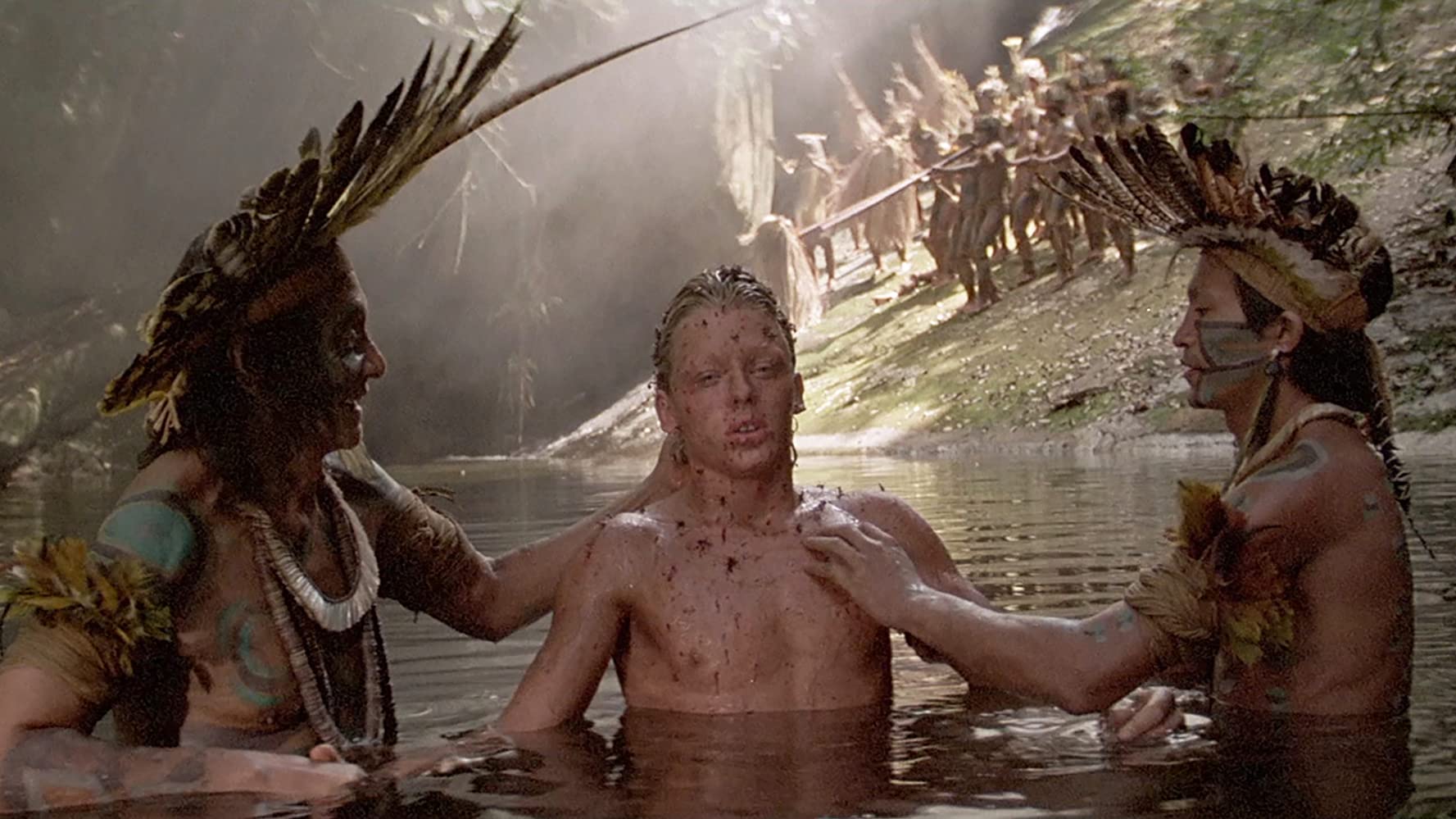
Yet for all that you are admiring The Emerald Forest as a beautifully directed film, it feels moribund on a story level. While a better-made film technically and stylistically, The Emerald Forest‘s sympathies are not any different from Italian schlock films like Deep River Savages (1972) and Cannibal Ferox (1981). It feels as though John Boorman’s regular screenwriter Rospo Pallenberg does no more than recycle the cliches of white men meet the natives films, overlaying them with a heavy dose of modern environmentalist concern about the despoliation of the rainforest.
The Emerald Forest‘s conflicts seem like cliches – white men bring guns and alcohol and brutally exploit the natives, civilization and the inexorable march of progress destroys the rainforest, while the simplicity of the natives lifestyle is portrayed with something that borders on the utopian in its uncontaminated purity. (That said, one should be mindful that The Emerald Forest was first film to bring up the issue of environmentally endangered Amazonian rainforest).
The upshot of the film seems to be a black-and-white dichotomy that essentially says that civilisation is bad and that native culture is infinitely superior in its untouched innocence. Indeed, The Emerald Forest is a film that is not unlike Forrest Gump (1994) and its naive belief in the superiority of looking at the world through the eyes of the simple-minded. At no point do some of the advantages that civilisation might offer enter into the film’s frame of reference – that modern medicine may be superior to a life where health problems could only be dealt with by herbal remedies, that having a police force or army might be of some advantage when dealing with marauding enemy tribes trying to enslave your women.
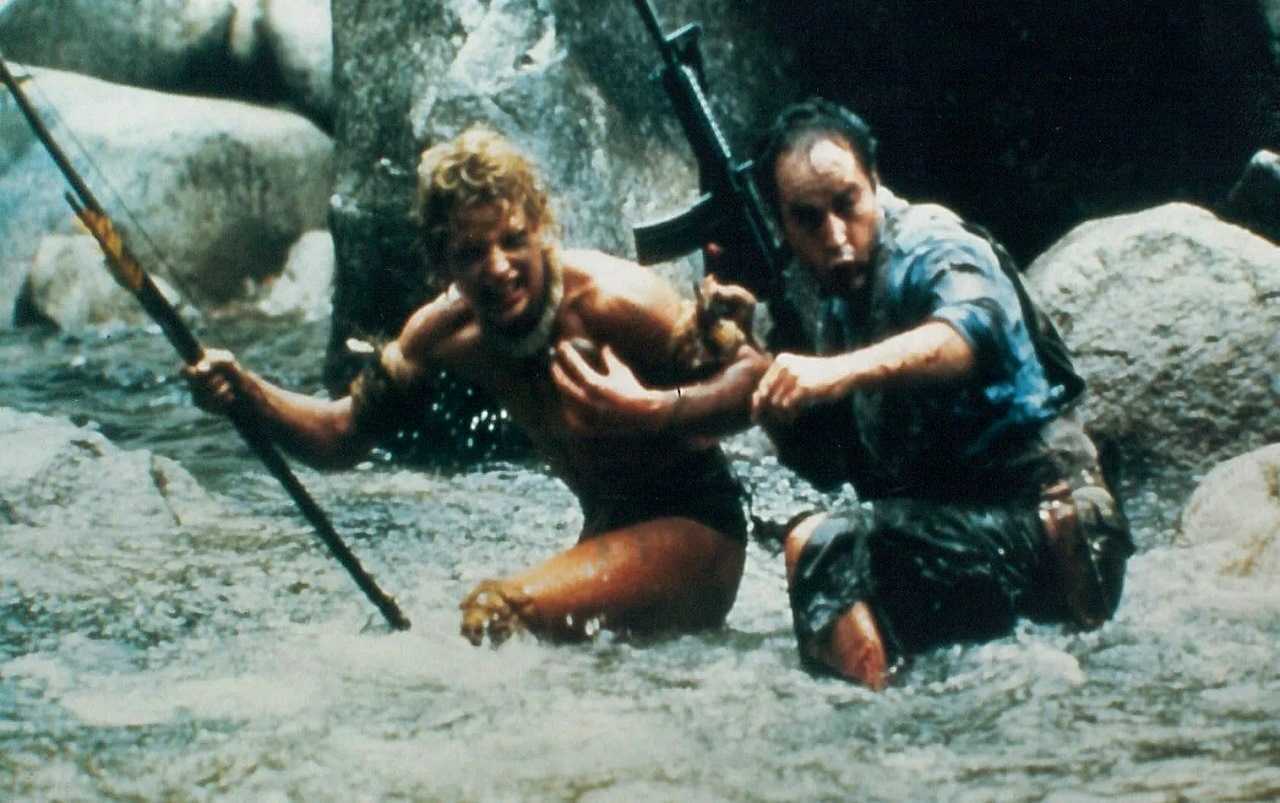
There is the odd image where the natives encounter civilization and we see things through their eyes – their viewing the edge of the forest as the Edge of the World, seeing that the logging operations are tearing the skin off the Earth and wondering why the world is getting smaller. These moments offer an interesting and uncliched outlook but there is not nearly enough of this to the film.
The opening credit for The Emerald Forest also makes the claim that the film is based on a true story. The film was apparently based on an article that appeared in the Los Angeles Times in the early 1980s and concerned a father whose son was abducted by natives tribes and rediscovered ten years later, although there has been some doubt placed on whether this story was true or made up. When it comes to the magical realist ending, which pushes The Emerald Forest over into fantasy, with frogs being conjured up to create a rainstorm that floods and brings down the dam, one realizes that John Boorman is ultimately spinning a tall tale with his true story claim.
John Boorman’s other genre films:– the Backwoods Brutality film Deliverance (1972); the pretentious sf film Zardoz (1974); Excalibur (1981); Exorcist II: The Heretic (1977); and the doppelganger film The Tiger’s Tail (2006). Boorman also produced the children’ film Dream One (1984). In more recent years, John Boorman has interestingly announced plans for conducting an animated version of The Wonderful Wizard of Oz.
Trailer here