


USA. 1945.
Crew
Director – John Cromwell, Screenplay – DeWitt Bodeen & Herman J. Mankiewicz, Based on the Play by Sir Arthur Wing Pinero, Producer – Harriet Parsons, Photography (b&w) – Ted Tetzlaff, Music – Roy Webb, Music Supervisor – C. Bakaleinikoff, Special Effects – Vernon L. Walker, Art Direction – Carroll Clark & Albert S. D’Agostino. Production Company – RKO Radio Pictures.
Cast
Dorothy McGuire (Laura Pennington), Robert Young (Oliver Bradford), Herbert Marshall (John Hillgrove), Mildred Natwick (Abigail Minnett), Hillary Brooke (Beatrice Alexander), Spring Byington (Violet Price), Richard Gaines (Freddy Price)
Plot
Blind composer John Hillgrove premieres a symphony that he has composed in honour of Oliver Bradford and Laura Pennington. Afterwards he tells their story. The homely but kind-hearted Laura obtained a housekeeping job at a Cornwall cottage that had been left by its owner to be used by married couples. There she befriended Air Force officer Oliver Bradford who came to the cottage, hiding from everybody his face, which had been badly scarred in combat, and sunken into self-loathing. When Oliver’s family tried to force him to see them, the only way for him to stay free was for he and Laura to marry. However, their marriage of convenience soon became one of love where they discovered that the accumulated love of the cottage allowed them to see one another without flaw.
The Enchanted Cottage (1921) was a play by Arthur Wing Pinero, a popular British playwright between the 1870s and 1930s who was even knighted. The play enjoyed some success internationally and travelled across to Broadway. Its theme of a magical cottage where lovers can see past each other’s imperfections with the eyes of love connected with audiences of the day. It clearly held a resonance in the post-World War I era where there would have been many soldiers returning to civilian life with battle wounds.
There was an earlier silent film version of the story, The Enchanted Cottage (1924) and a modern colour remake The Enchanted Cottage (2016). In the original, the story centres around a serviceman from World War I but variously in the film versions the location is moved to the USA and the wars updated to World War II and the Afghan War.
The film is an old-fashioned weepie melodrama, It is the sort of film that could have only been produced in the 1940s. Everything is wound up to a ludicrously melodramatic extreme – the tone alternates between either wailing self-pity and ridiculous self-sacrifice to absurd little homilies on the saving power of true love.
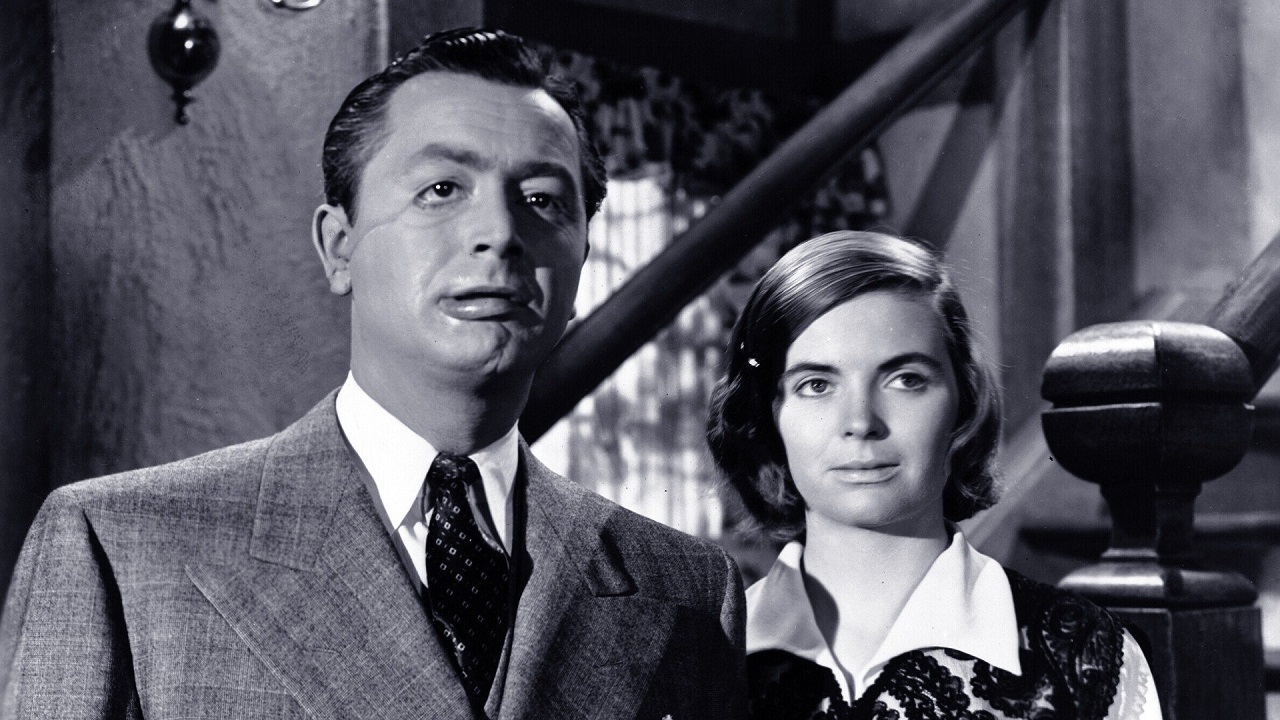
Yet somehow or another it all works in a schmaltzy way, although the end explanation about how the other person becomes perfected in the other’s eyes because they see ‘through the eyes of love’ is pure tosh. The transformation scenes are well handled – the careful balance between whether the transformation is real or not is no surprise when one sees the name of DeWitt Bodeen, the author of Cat People (1942) and a number of Val Lewton’s ambiguously psychological horror films listed on the credits.
Dorothy McGuire’s self-sacrificing performance is hard-going, but Robert Young plays with a self-pitying harshness that is not too bad. The best performance comes from Mildred Natwick who blends both sternness and genteel in what would otherwise be a throwaway role.
The film is made on the cheap – the painted backdrop of the rest of the burnt house is painfully obvious. The film can never make up its mind where its location is meant to be – it gives the appearances of being on the English coast but the coastline is never seen in anything other than painted backdrop, while accents waver wildly between American and English.
Trailer here