
Crew
Directors – James Algar, Samuel Armstrong, Norman Ferguson, Jim Handley, T. Hee, Wilfred Jackson, Hamilton Luske, Bill Roberts & Paul Scatterfield, Screenplay – Joe Grant & Dick Heumer, Producer – Walt Disney, Music Supervisor – Edward H. Plumb. Production Company – Disney.
Cast
Deems Taylor (Himself), Leopold Stokowski (Himself)
Plot
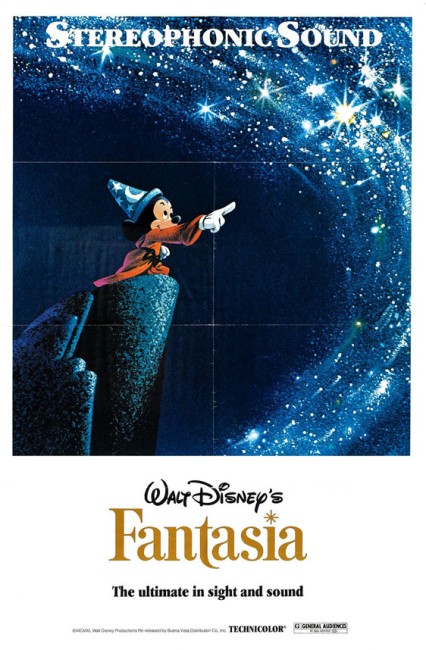
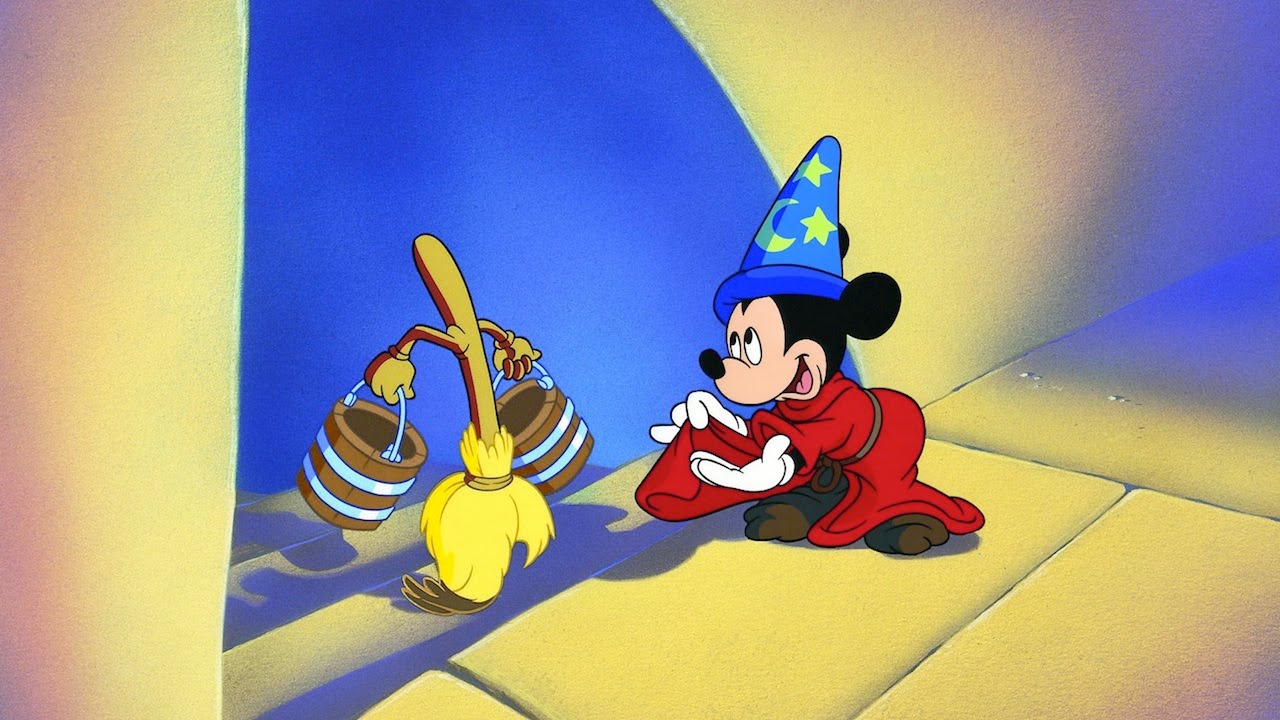
Conductor Deems Taylor tells how ‘Fantasia’ has been designed to portray the images one might imagine accompanying pieces of music. Toccata and Fugue in D Minor:- The instruments of the orchestra take on lighted life and become a profusion of abstract images. The Nutcracker Suite:- is a dance of fairies, small animals and plant life. The Sorcerer’s Apprentice:- Mickey Mouse, an apprentice to the sorcerer Yensid, seeks an easy way out of his duties by borrowing his absent master’s magic hat and animating a broom to carry water for him. However, he falls asleep as the broom fills the water to overflowing. Trying to stop the broom, he hacks it up with an axe, only for each piece to take on a life of its own. The Rite of Spring:- The story of the beginning of life on the Earth, passing through the development of simple and then more complex cellular organisms to the emergence and death of the dinosaur. The Pastoral Symphony:- A day in the life of happily frolicking creatures from Greek mythology – pegasi, centaurs and fauns as they bathe, frolic and fly, while up in the clouds an angry Zeus tosses lightning bolts. Dance of the Hours:- At a 14th Century doge’s palace, ostriches, hippos and crocodiles engage in a bizarre dance. Night on Bald Mountain and Ave Maria:- On a mountaintop, a giant demon squats, calling up the demons from Hell and the spirits of the dead from their graves for an orgy of insanity.
Made at the very height of Disney’s artistic capabilities, Fantasia was a unique experiment. It grew out of Disney’s Silly Symphony shorts of the previous decade where Disney and conductor Leopold Stokowski had come together with the idea of setting classical music to animation. They began work on The Sorcerer’s Apprentice as a short in 1938 but the ambition of the project eventually outgrew the limitations of a short subject and so Walt Disney came up with the idea of building an entire film out around it. Fantasia was the result.
In its marriage of music to visuals, the Disney team were able to create a film entirely freed of narrative, animation in the purest, most artistic sense. Many – this author included – consider Fantasia to be Disney’s single animation masterpiece. The surprise about the film is that when it came out it was a failure. The Disney team was forced to recalculate their ambitions and go back to more conventional forms of filmmaking. It is only through re-release, particularly during the 1960s where it gained a reputation as a ‘head’ film – one best seen under the influence of marijuana – that Fantasia began to gain the stature it has today.
But what an experience it is. Disney were making ‘head’ films quarter-of-a-century before anyone coined the term (and judging from the dance of the mushrooms the potential for such was not something they were entirely unaware of). Each sequence has as varied a number of directors and each comes with a supreme and astounding beauty.
There is Rite of Spring, which begins with an awe-inspiring pan across the galaxy and solar system and down into the turbulent and terrifying yet ultimately poignant life of the dinosaurs; or The Nutcracker Suite with its dance of fairies leaving tiny trails of light across spider webs.
The loveliest of the segments is the The Pastoral Symphony, which is charmingly staged as a bacchanal with pegasi proudly taking to the air, cherubim tending coyly mating centaurs and Zeus violently tossing thunderbolts from behind black clouds as tiny creatures below run to find cover, to the beautiful end image of the sun being drawn across the horizon by Helios the chariot-driver and Selene sweeping the Earth beneath the cape of night.
The Dance of the Hours segment is the film’s most eccentric episode, tossing in a mind-boggling array of lumbering hippos, gangling ostriches and slinking crocodiles in a parody of choreographed dance routines, ending as a hippo pulls the porticoes framing the segment down on top of itself and is left trapped beneath.
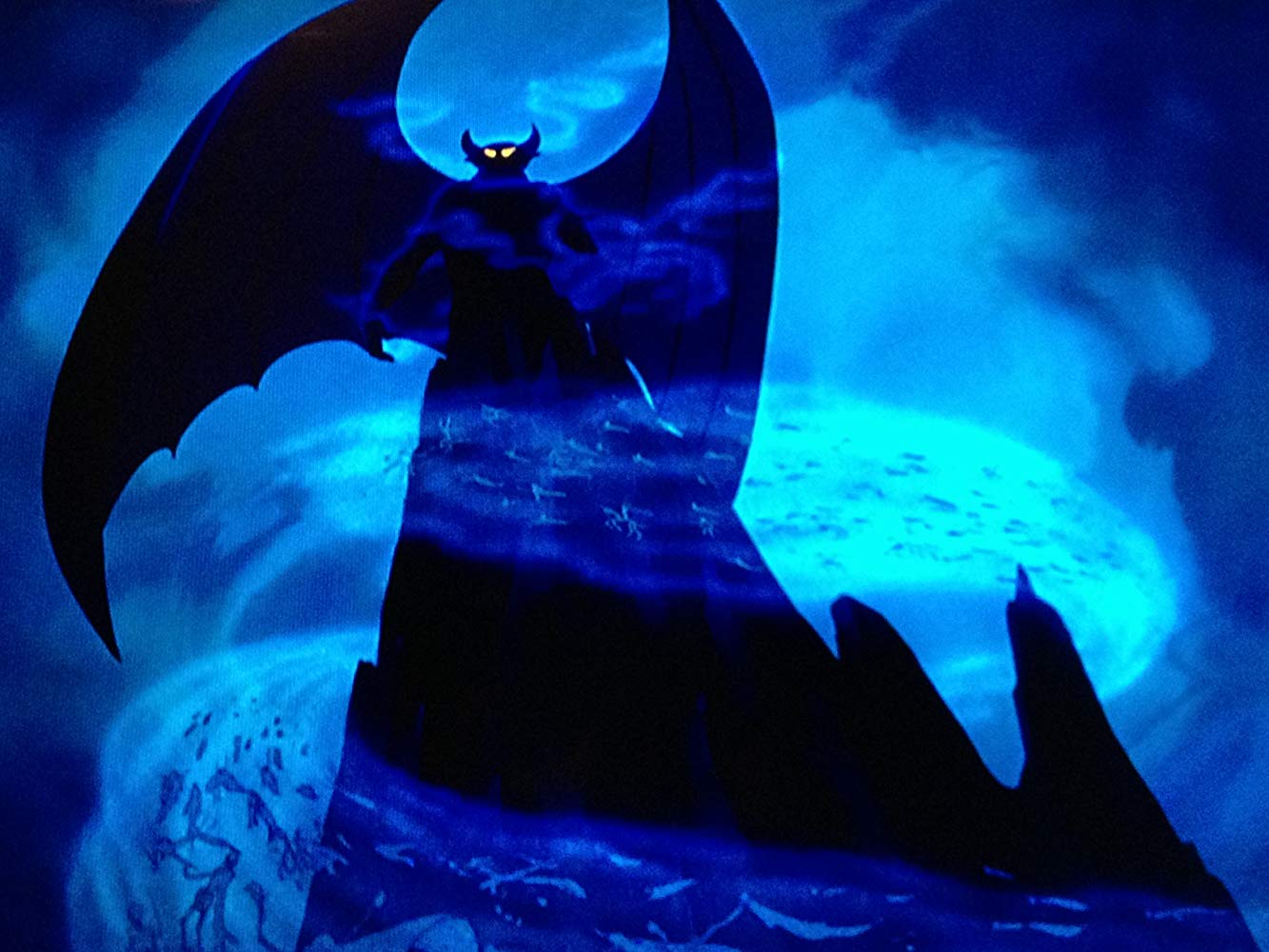
Finally, there is the Night on Bald Mountain segment, which could well stand as the greatest of all horror films with its nightmare onslaught choreographed by an evilly smiling demon that sits atop a mountain, reaching down across an innocently sleeping town, warping the shape of things in the path of its shadow as it draws the spirits of the dead up from the graves and gallows and opens up Hell in a vast trail of screaming nightmare shapes, all winding their way back up to its grinning visage; before it finally folds its wings with the arrival of dawn; and then to the aching strains of Ave Maria, a line of tiny hooded figures carrying glowglobes emerges in slow, single-file out of the dawn and pass through the forest to worship. It is an awesome, incredibly violent episode.
For the conservative family values that Disney films have since come to embody, Fantasia is surprisingly the most overtly sexual of all Disney animated films. The fishes and fairies in The Nutcracker Suite cavort in mating dances and seem to take on male/female identities; while the The Pastoral Symphony features frolicking centaurs and bathing nudes (although this segment then proceeds to turn them into shrinking violets and stockily chiselled males as though not sure what to do next). For a time though, Fantasia was the one Disney film that stretched up beyond fairy-tales, children’s fables and talking animals to show just what animators could do with the medium when they were given the chance.
Fantasia 2000 (1999) was a disappointing sequel. The Sorcerer’s Apprentice segment later became the basis of a live-action film The Sorcerer’s Apprentice (2010). The charming Allegro Non Troppo (1978) is a spoof. The animated brooms later made a guest appearance in Who Framed Roger Rabbit? (1988).
Trailer here