

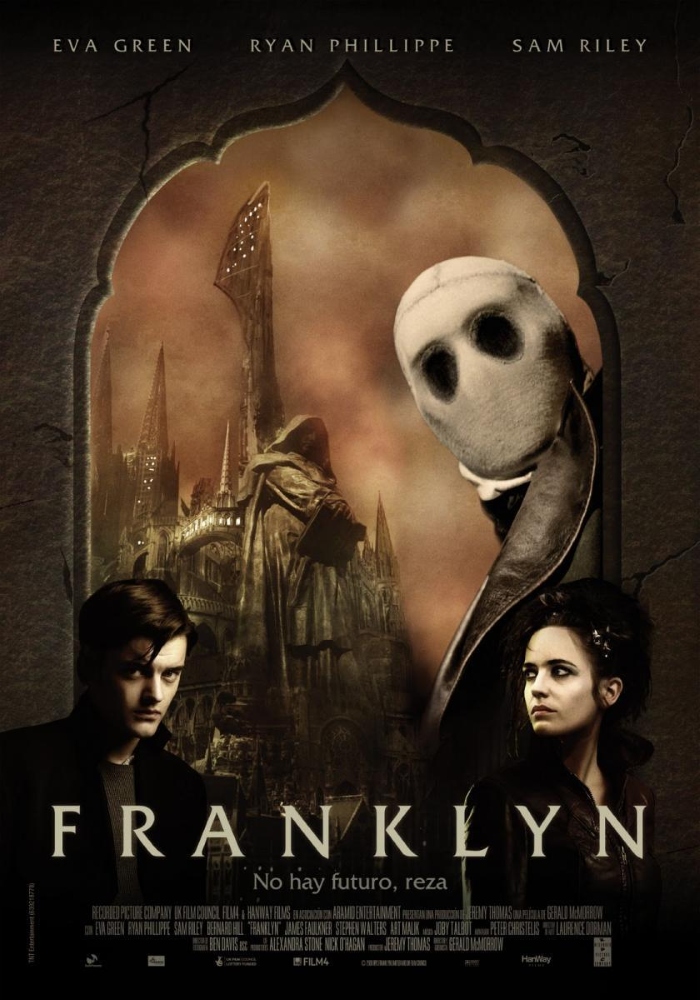
Crew
Director/Screenplay – Gerald McMorrow, Producer – Jeremy Thomas, Photography – Ben Davis, Music – Joby Talbot, Visual Effects Supervisors – Richard Briscoe & Ryan Cook, Visual Effects – Double Negative, Additional Visual Effects – Cube Effects (Supervisor – Jeno Udvardi), Machine FX (Supervisors – John Lockwood & Steve Street) and Smoke & Mirrors, Special Effects Supervisor – David Harris, Makeup Design – Wakana Yoshihara, Production Design – Laurence Dorman. Production Company – Film 4/The UK Film Council/HanWay Films/Recorded Picture Company/Aramid Entertainment.
Cast
Eva Green (Emelia Bryant/Sally), Sam Riley (Milo), Bernard Hill (Peter Esser/The Individual), Ryan Philippe (Jonathan Preest/David Esser), Susannah York (Margaret Bryant), Stephen Walters (Wormsnakes/Bill Wasnik), James Faulkner (Pastor Bone/Dr Earlle), Art Malik (Tarrant), Richard Coyle (Dan), Georgia MacKenzie (Teri), Stuart McQuarrie (Gavin Clunes)
Plot
In Meanwhile City, everyone is required to have a religion. Jonathan Preest is one lone man who has no faith. Hidden behind a mask, he scours the city’s street life searching for the enigmatic The Individual who heads the cult known as Duplex Ride. The Individual killed a young girl who was client of Jonathan’s and he is determined to kill The Individual in return. In contemporary London, Milo cancels his plans to get married. Dissatisfied, he sets out looking for his childhood friend Sally who remains the love of his heart. Meanwhile, Peter Esser has come to London in search of his son, a mentally ill Iraq War veteran who has disappeared on the streets. Elsewhere, Emelia Bryant repeatedly commits suicide in different ways but always calls an ambulance to save her before doing so, all the while filming everything on video as a project for her art class.
Franklyn is an interesting film that did almost no business when it came out. Despite a number of reasonably high-profile names in the cast, it did little in UK theatrical release, played at a variety of film festivals and went directly to dvd in the US. It may simply be that it defies any easy labelling and could not be pigeonholed for mass-market release. The significance of the title Franklyn is never explained anywhere throughout, for instance.
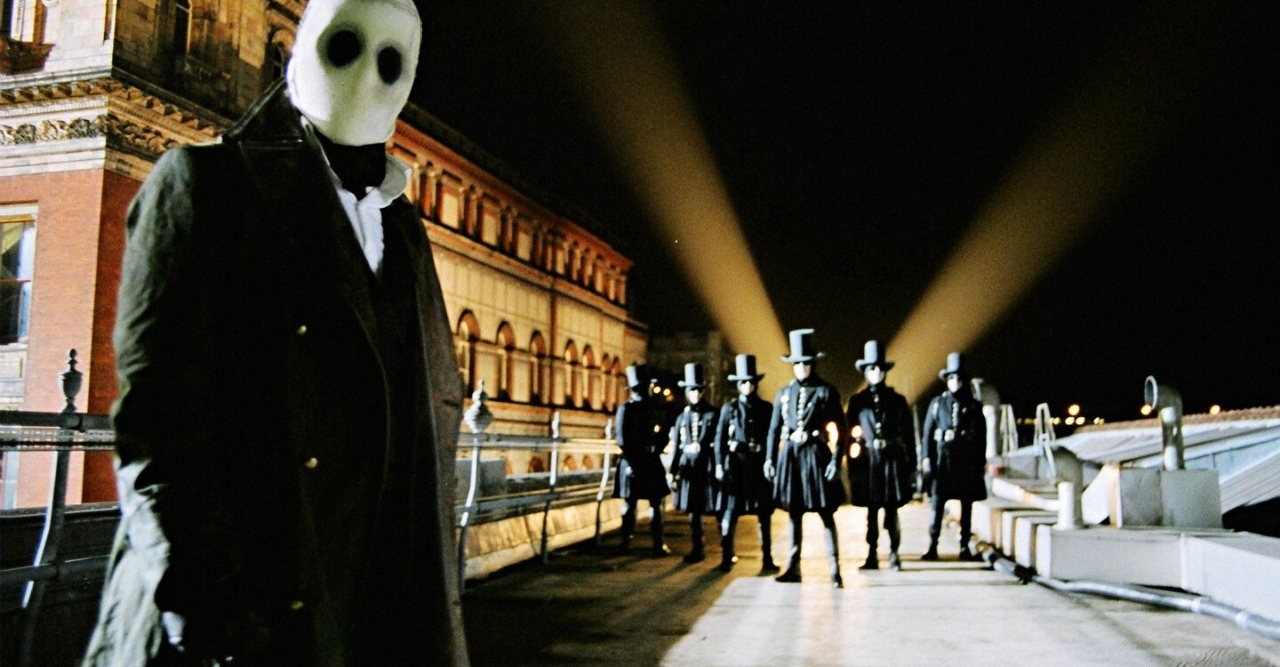
At first glance, Franklyn appears to be a dystopian science-fiction or fantasy film. One was constantly being reminded of the dark future England of V for Vendetta (2006) and its masked insurrectionist hero stalking through the underworld on a mission of revenge. (Or perhaps something of the 2000 AD comic-strip Nemesis the Warlock). The world that Gerald McMorrow creates here is a fascinatingly stylised one where religion dominates seemingly irrespective of what one believes; where the security forces comes dressed in Jacobean costumes with masks, top hats and dark glasses; of streets teeming with a profusion of masked people; and where the architecture seems to be all cathedrals.
There are some amusingly satirical touches – the various religions include Seventh Day Manicurists and one based around the instructions for washing machines. The character of Jacob Preest could be another V – indeed, the world we are in could very much be the world of a graphic novel. One wishes that this world had been explored more than it is – it would have been fascinating if these scenes had been expanded to take up a full story rather than exist as one strand of a multi-part story.
Confusingly however, these scenes are interwoven with three other stories:- Eva Green and her attempts to film her own suicide attempts as an art school project; Sam Riley and his search for the ideal love from childhood; and Bernard Hill who has come to the city searching for his mentally ill son. In confusing contrast to the dystopian scenes, which seem to be set in the future or some alternate world, these all appear to be taking place in contemporary London.
To add to the confusion, characters turn up in different roles in different stories – Eva Green plays both the troubled art student and Sam Riley’s childhood love; Stephen Walters turns up as both the informant in the future and a charity kitchen worker who gives Bernard Hill directions to find his son; Art Malik plays the task master in the future and a social worker in the present; other characters like the woman at the help desk, the man in the dominoes hall and James Faulkner’s pastor all turn in similar roles in different stories.
It is puzzling trying to make sense of the four strands of story and work out what is going on and what the connections are meant to be. Eventually everything neatly dovetails together in an ending where all four stories coincide. [PLOT SPOILERS] Here it turns out that Jacob Preest is the mentally ill son that Bernard Hill is searching for. Suddenly, in a turnabout not unakin to Afraid of the Dark (1991), we realise that the religious dystopia is in fact the world that goes on inside his mentally ill mind, which has been constructed as an allegorical rebellion against his father’s beliefs and anger at the father’s culpability in the death of his sister. Meanwhile, in a Fight Club (1999)-esque twist, Sam Riley’s childhood love is revealed to have been an imaginary companion that exists only inside his mind.
[PLOT SPOILERS CONTINUE] All the other strands knit together:- Ryan Philippe’s missing son has been hiding upstairs from Eva Green’s flat; Philippe bursts into her flat and goes to shoot Bernard Hill as he sits in the cafe across the street, which is the same place that Sam Riley has agreed to meet his imaginary girlfriend. Eva blows up her gas oven (which she has set up as part of another of her suicides) to stop Ryan Philippe and, as she walks out the conflagration, Sam Riley thinks he is meeting the girl of his dreams at last. It proves fascinating, if far too contrived to play into the 00s fad for left field twist endings.
The performances are all well above average. The one surprise is Ryan Philippe who turns up sporting a British accent as the missing son. Sam Riley – the great find as Ian Curtis in Control (2007) – is in a more regular part here. However, the show is won over by Eva Green, one of the most talented and beautiful actresses of the moment. Her role consists largely of a full flight of pre-Raphaelite tragedy, at which she performs fabulously. The scenes where she imitates her mother (Susannah York) in a psychiatrist’s office during the opening moment show some bitingly on-target acting on her part.