
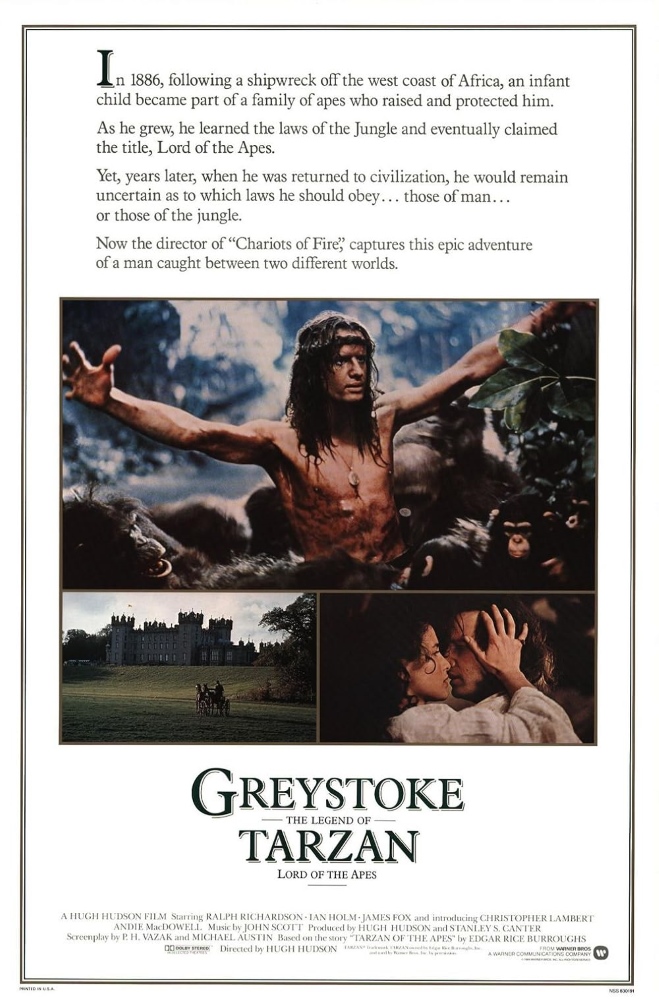
UK. 1984.
Crew
Director – Hugh Hudson, Screenplay – Michael Austin & P.H. Vazak [Robert Towne], Based on the Novel by Tarzan of the Apes by Edgar Rice Burroughs, Producers – Hugh Hudson & Stanley S. Canter, Photography – John Alcott, Music – John Scott, Visual Effects – Albert Whitlock, Special Effects – Peter Hutchinson, Makeup Effects – Rick Baker, Production Design – Stuart Craig, Primate Choreography – Peter Elliott. Production Company – Warner Brothers.
Cast
Christopher Lambert (John Clayton/Tarzan), Andie McDowell (Jane Porter), Ralph Richardson (6th Earl of Greystoke), Ian Holm (Capitaine Philippe D’Arnot), John Wells (Sir Evelyn Blount), James Fox (Lord Esker), Eric Langlois (Tarzan Age 12), Paul Geoffrey (Lord Jack Clayton), Cheryl Campbell (Lady Alice Clayton)
Plot
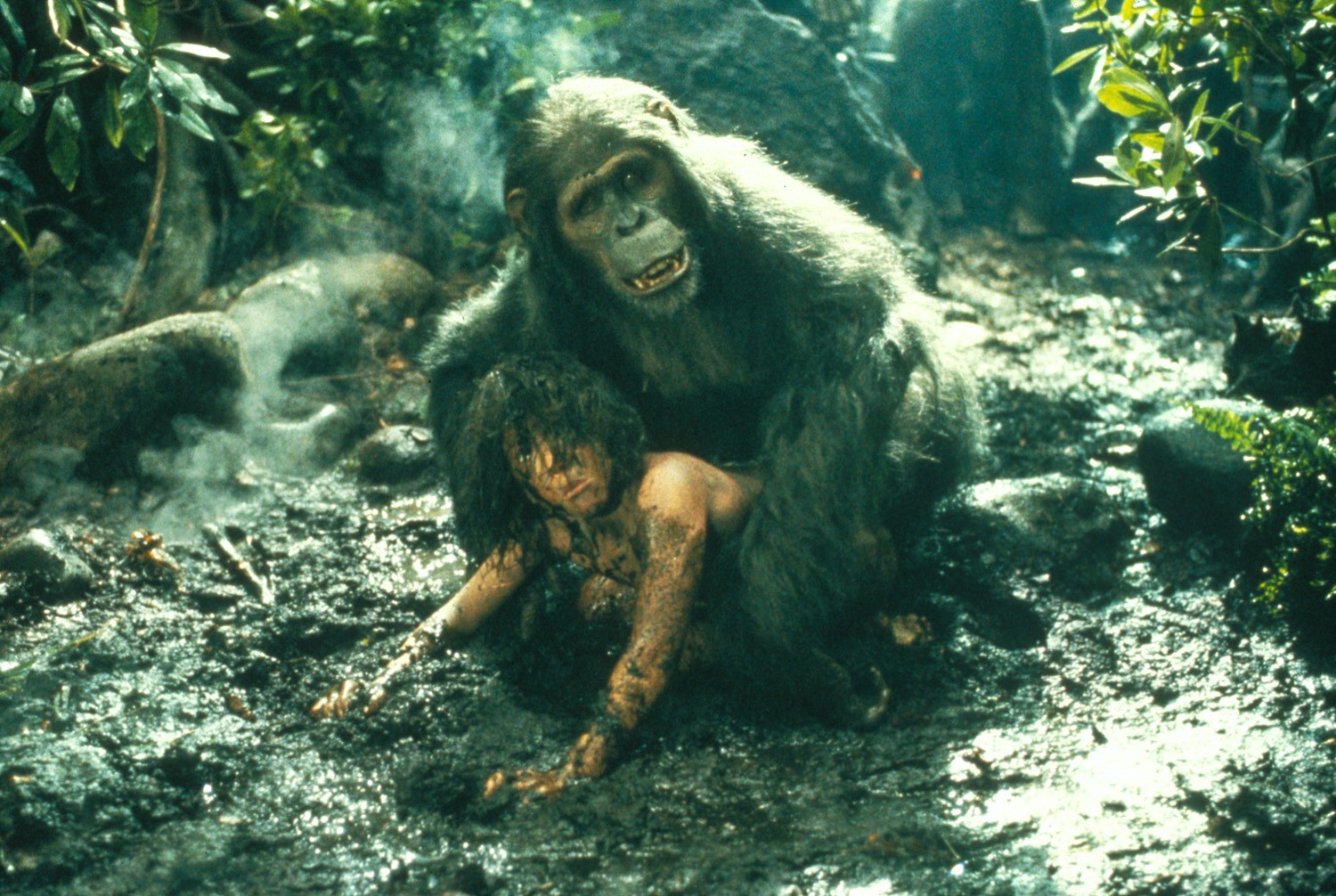
Jack Clayton, heir to the earldom of Greystoke, is shipwrecked on the coast of Africa with his pregnant wife. She gives birth to a son John but soon after they are both killed by apes. The apes take and raise the abandoned infant child. Twenty years later, now grown into a young man, John is found living among the apes by the explorer D’Arnot. D’Arnot teaches Clayton (or Tarzan) to speak English and brings him back to the Greystoke estate in Scotland. There his savage instincts cause both upset and amusement among turn-of-the-century Victorian society. This is also where Tarzan encounters the beautiful Jane Porter.
Edgar Rice Burroughs’ novel Tarzan of the Apes (1912) was first published in All-Star magazine and then in book form in 1914. With it, Burroughs created one of the great pulp characters of the 20th Century. Edgar Rice Burroughs published twenty-three further Tarzan books but the wider public fascination with Tarzan began in the movies, starting with Elmo Lincoln’s silent essayal in Tarzan of the Apes (1918) and reaching its height with Tarzan the Ape Man (1932) starring Johnny Weissmuller, the first of a long-running series where the role passed through the hands of various athletes.
The classic Tarzan film wound its way to an end in the mid-1960s, the period after which the films’ mythic version of colonial Africa started to become outmoded and the public wearied of such black-and-white heroes. Tarzan did undergo a makeover in the 1980s and beyond – with various new directions sought such as the softcore Tarzan the Ape Man (1981); in resurrecting Tarzan as a long-haired eco-warrior in the tv series’ Tarzan (1991-2) and Tarzan (2003); in much more fantastical adventures – Tarzan: The Epic Adventures (1995-6); and as a Disney cartoon with Tarzan amid talking animals in Tarzan (1999).
Of all these reconstructions of the Tarzan myth, the most fascinating was Greystoke: The Legend of Tarzan, Lord of the Apes here. The project was originally conceived in 1975 by screenwriter Robert Towne, who was riding on the success of his award-winning screenplays for The Last Detail (1973), Chinatown (1974) and Shampoo (1975). For a time, Towne touted Greystoke as his own directorial debut but had the project taken away from him after the flop of his first directorial effort Personal Best (1981).
Greystoke remained an on/off project for several years, before being inherited by Hugh Hudson, flush from the runaway success of Chariots of Fire (1981), which won the 1981 Academy Award for Best Picture and had Hudson nominated as Best Director. Robert Towne was not happy with Hugh Hudson’s approach and had his name taken off the script, instead substituting the name of his dog P.H. Vazak (only for the script for Greystoke to be nominated for an Oscar). [Alas, Hugh Hudson’s career has not fared well following Greystoke – he bottomed out with the big flop of Revolution (1986) and has since only made intermittent efforts such as I Dreamed of Africa (2000), his last film to date].
Hugh Hudson and Robert Towne’s innovation with the Tarzan story was to treat it with absolute seriousness and assiduously avoid any of the pulp adventure aspect of the Edgar Rice Burroughs stories and especially the Johnny Weissmuller films. Out has gone the pidgin English dialogue, the chimpanzee sidekicks, the Jane’s in leopard-skin bikinis, the creeper-swinging heroism, the cosy mimicry of a nuclear family in treehuts and the constantly recycled adventure plots about greedy explorers, native tribes and lost cities. Back in comes Tarzan’s aristocratic heritage and the use of the John Clayton name. Indeed, where other Tarzan films focused on adventure and completely excised the aristocratic heritage, Greystoke plays up the aristocratic heritage and minimises the adventure angle. It does seem ironic that a writer like Edgar Rice Burroughs whose prose was crude and unhoned and who was paid by the word could end up with such a reverentially artistic treatment. The film is overlong and slightly ponderous but there is the wonderful sense that it is delving behind the myth, recasting it and elevating it to art. What better honour could ever be afforded for a pulp novelist like Edgar Rice Burroughs?
The film makes a number of changes to the original book. Most peculiarly, we never hear Tarzan referred to as Tarzan anywhere throughout. The opening sections are a very accurate copying of the essence of the opening of the book. There are minor differences in that Claytons are shipwrecked rather than stranded after a shipboard mutiny. Subsequently however, we get all the scenes with the building of the treehut, the death of parents, the adoption of the infant Tarzan by the ape mother Kala, his discovery of the child’s primer, he picking up the knife and seeing his reflection in a pool, none of which have been depicted on screen since the 1918 Elmo Lincoln film.
The principal difference is that the film eliminates the Porter expedition to Africa, which takes up the second half of the book. It does keep the character of D’Arnot who teaches Tarzan to speak – in fact, this is the only appearance of D’Arnot in any Tarzan film. All the other films pump up the meeting between Tarzan and Jane after the Porter expedition arrives in Africa – contrarily, this version moves the meeting with Jane to after the point that D’Arnot takes Tarzan back to civilisation (something he never visits until the last chapter of the Burroughs book). Her father has been written out of this version and she is now an orphan. The film also incorporates the character of Billings who was introduced in the 1918 film but casts him in a different role.
The first half of the film follows the book very accurately but the second half goes off at a tangent, exploring the way in which Tarzan is brought back to civilisation. We get a whole other story that Edgar Rice Burroughs never conceived about Tarzan encountering polite turn of the century British society. In terms of set dressings, score, the cast assembled – top English acting names like Ralph Richardson, James Fox, Ian Holm – Greystoke resembles far more of a Merchant Ivory costume drama about the British upper-classes than it does any of the pulp adventure stories of Burroughs or the previous films. Tarzan’s primitiveness is used to make contrast with aristocratic British society. We see how he becomes both a figure of primitive fascination and equally is condescended to – his lack of manners upsets a very formal dinner party, yet at same time he also shows them up, feels grief and upset at seeing animals hunted to be mounted, kept in cages and stands up to defend an intellectually handicapped servant from being beaten.
The ultimate message of Greystoke is the same one as in King Kong (1933) – that civilisation kills the primal majesty of the Noble Savage. Here we see Tarzan as the limnal being – one who is caught between two worlds, reaches the pinnacle of British society (inherits an estate and title) but because of his primitive nature is not at home there and is only truly himself when he returns to the jungle. It also seems to be a story about how Tarzan is at heart a lonely, abandoned orphan wherever he goes and how everyone he meets, from his parents, his ape mother, his grandfather and the ape he befriends in UK, end up dying on him.
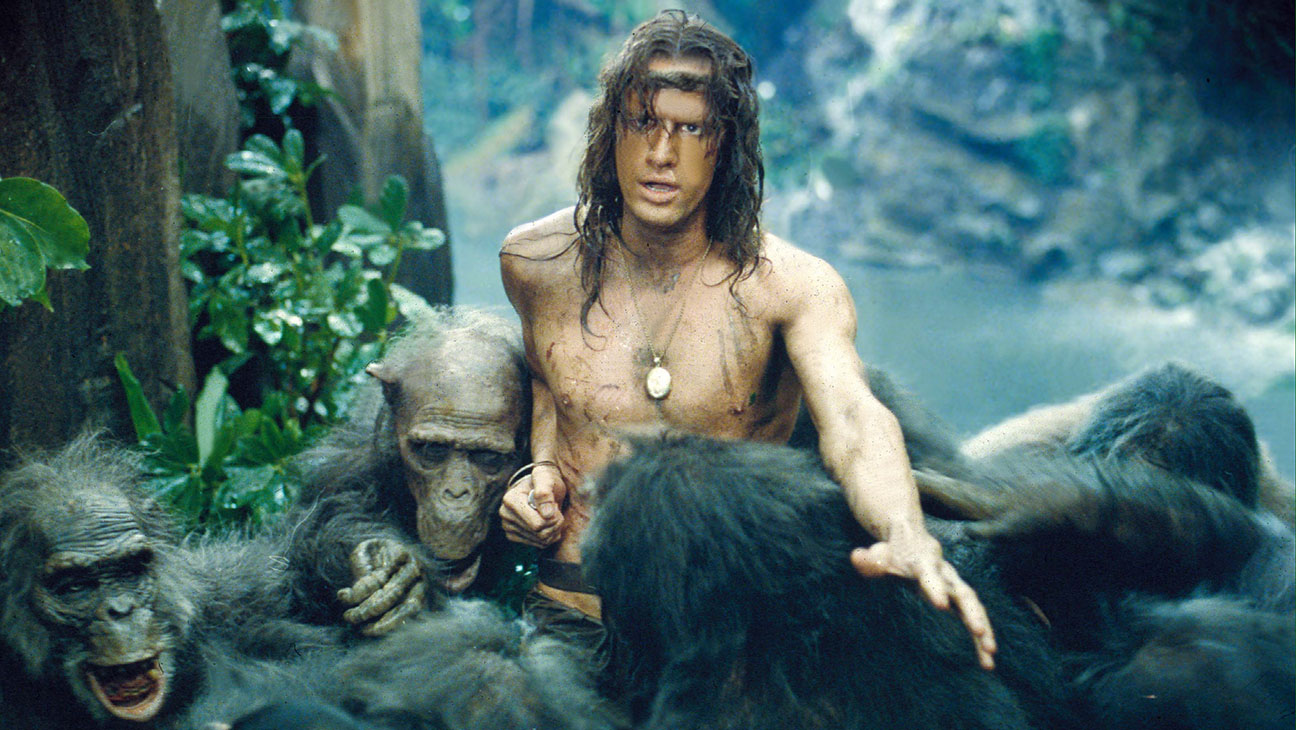
The film has some fine casting, something that succeeds in investing the last half with considerable warmth. Greystoke was Christopher Lambert’s first English-language film. In the decades since, Lambert has established himself as an action actor of limited range. Here though, there is something appealingly irresistible to his screen presence. He has a freshness and incredible handsomeness and manages to win you over with his charms when he does something as simple as break out into a smile. He has an athleticism rather than a body-builder physique, something that one suspects would have been commended by Edgar Rice Burroughs (who was not happy with the casting of burly Elmo Lincoln in the 1918 film).
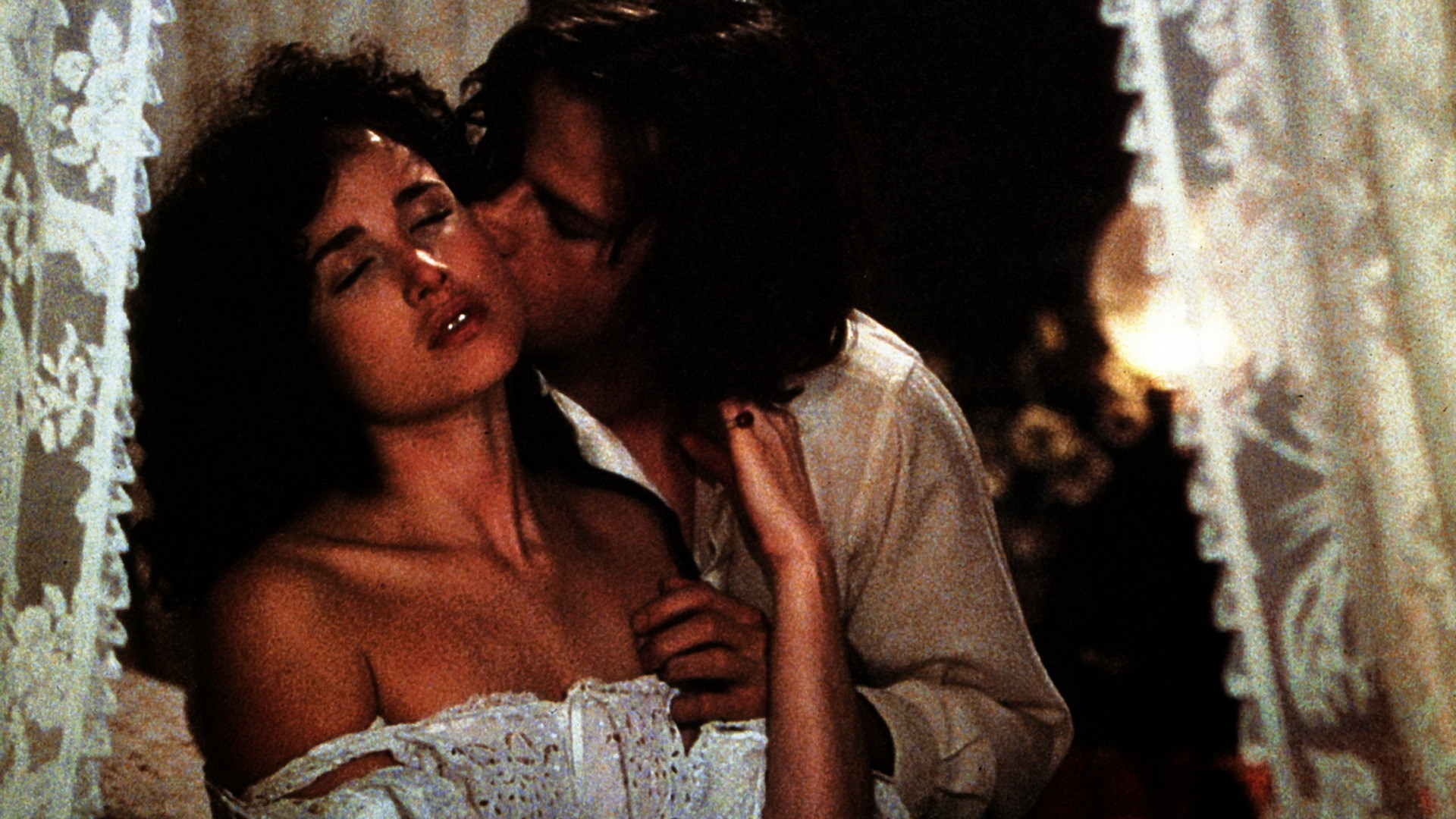
Andie McDowall is cast as Jane and plays with a regal sensuality. Subsequent to the film, Andie McDowell became a romantic A-list star and what is noticeable about seeing Greystoke in retrospect is that her natural, distinctive Southern accent has been redubbed for an English accent (purportedly by Glenn Close). The scene-stealer of the film is Ralph Richardson in a wonderful performance as the boyishly eccentric Earl. This was Richardson’s last performance and he deservedly won an Oscar nomination.
Part of the problem with the earlier adaptations of the Burroughs book is their elimination of Tarzan’s childhood and starting the story with his meeting with Jane – one has always suspected that one of the reasons for this is that because the technology of the period was unable to convincingly portray the apes as characters. Probably the most striking aspect about this film are the ape-suits from Rick Baker, which seem indistinguishable from the real thing. The film goes to extraordinary lengths to be able to portray the apes, both shooting in the Cameroons (making it one of the few Tarzan films to actually go on location in Africa) and employing a primate body-language specialist to get the simian behaviour right.
The other screen adaptations of the Burroughs novel are:– Tarzan of the Apes (1918), the silent Elmo Lincoln version; Tarzan the Ape Man (1932), the classic version with Johnny Weissmuller who went onto appear in a further eleven Tarzan films; Tarzan the Ape Man (1959) starring Denny Miller; Tarzan the Ape Man (1981), a softcore version featuring Bo Derek; Tarzan (1999), the Disney animated version; and the motion-captured animated Tarzan (2013) starring Kellan Lutz.
Trailer here