
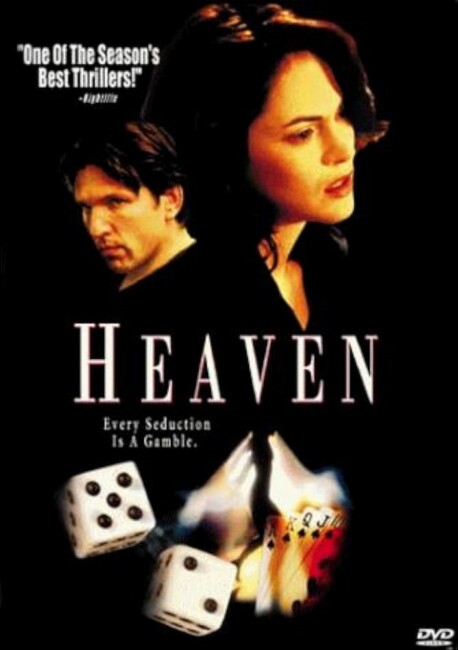
Crew
Director/Screenplay – Scott Reynolds, Based on the Novel by Chad Taylor, Producer – Sue Rogers, Photography – Simon Raby, Music – Victoria Kelly, Visual Effects – Weta Ltd (Supervisor – Richard Taylor), Special Effects Supervisor – Steve Ingram, Prosthetics – Andrew Beattie, Vance Hartwell & Richard Taylor, Production Design – John Girdlestone. Production Company – Midnight Films.
Cast
Martin Donovan (Robert Marling), Danny Edwards (Heaven), Richard Schiff (Stanner), Joanna Going (Jennifer Marling), Patrick Malahide (Dr Melrose), Karl Urban (Sweeper), Barry Spring (Webber), Jeremy Birchall (Tree), Clint Sharplin (Nicely), Michael Langley (Sean Marling)
Plot
Robert Marling is burned out after the recent separation from his wife Jennifer. She is suing him for custody of their son Sean, accusing him of being a gambling addict. Unknown to Robert, Jennifer is sleeping with his psychologist Dr Melrose who is providing her with information that Robert tells him in confidence. Robert then saves Heaven, a transsexual stripper who works for his poker buddy, nightclub owner Stanner, from being beaten up by two thugs. Heaven, also a patient of Melrose, is able to see things that are about to happen. She gives Robert information that allows him to win big in his poker game with Stanner. Things come to head as Jennifer ruthlessly prepares to win the custody battle and Robert and Heaven become caught up in Stanner and the thugs’ attempt to burn the club down for insurance money.
New Zealander Scott Reynolds made his directorial debut with The Ugly (1997), a derivative and pretentious serial killer thriller that felt like Reynolds was determined to use every showoff trick in the cinematic arsenal to catch attention in his first directorial outing. Heaven was Scott Reynolds’ second film. Subsequent to Heaven, Reynolds did make the excellent psycho-thriller When Strangers Appear (2001), although appears to have disappeared off the radar since then, last seen having contributed additional dialogue to the New Zealand-shot Korean Wu Xia Western The Warrior’s Way (2010). Having seen both of these others before seeing Heaven, it was interesting trying to predict which way Heaven would fall.
Certainly, Heaven does not start out particularly interestingly. Scott Reynolds serves up a contorted plot of jealousies and betrayals, amid banal battles over Martin Donovan’s divorce, his fight for child custody and various subplots concerning his psychiatrist Patrick Malahide sleeping with his wife and club owner Richard Schiff’s double-dealings. It looks more like a petty crime/slice of life drama than a genre film. Indeed, the same setting could almost be the set-up for one of the black comedies of director Hal Hartley in which star Martin Donovan regularly appears.
As the various plots start to unfold eventually though, by about the halfway point, Heaven starts to become interesting. Scott Reynolds has restrained his stylistic experiments tightly within the framework of a story – and they work all the better for it. There is considerable ingenuity to Reynolds’ non-linear editing. The story is elliptically told, often in flashbacks and flash-forwards, or where Reynolds lets us think that Heaven’s visions are part of the narrative, and sometimes where we are deceptively and misleadingly given only partial glimpses of scenes. There are some very clever scenes where people narrate flashbacks and we move from the teller telling the story to one person to cut back to the person they are talking about sitting where the listener was.
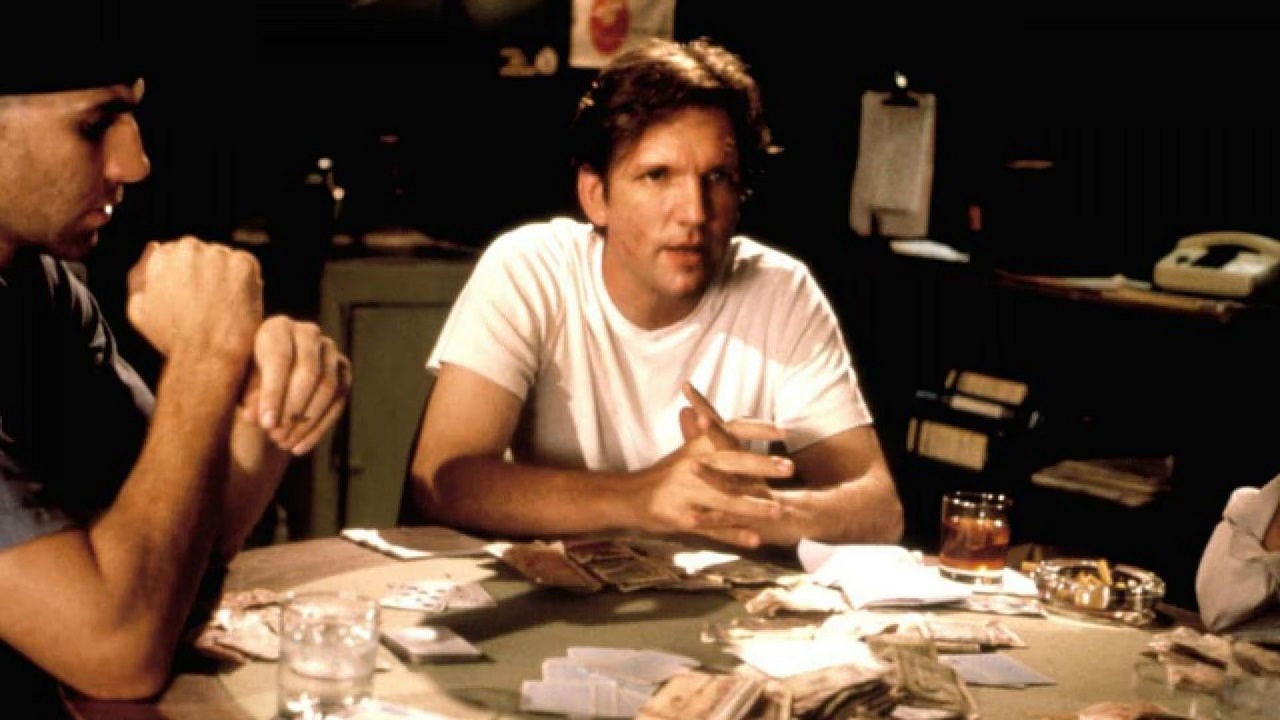
The film becomes particularly interesting when we start to see the prophecy about the gambling game falling into place, something that Reynolds handles with a good deal of suspense. The film reminds considerably of Don’t Look Now (1973) and Nicolas Roeg’s games of synchronous symbolism there – although where Roeg played games with flashes of visual colour, Scott Reynolds plays games with synchronous crosscut editing, letting us see an image and then the same image falling into place later in the film. The editing schemes in the film are quite daring.
It is curious to wonder what audience Scott Reynolds seemed to think he was making Heaven for. The film is surprisingly enough backed by major US distributor Miramax. Reynolds casts three minor American actors – Martin Donovan, Joanna Going and Richard Schiff – and one Brit – Patrick Malahide – in the central roles and fills the rest of the parts out with Kiwi locals, including a then unknwon Karl Urban. Not too surprisingly, the range of accents is bizarrely all over the place. You are not sure if Scott Reynolds has intended the film for local markets or international – certainly the international actors use a number of Kiwi colloquial references that shows that the film has not entirely been shaped for American consumption.