
Crew
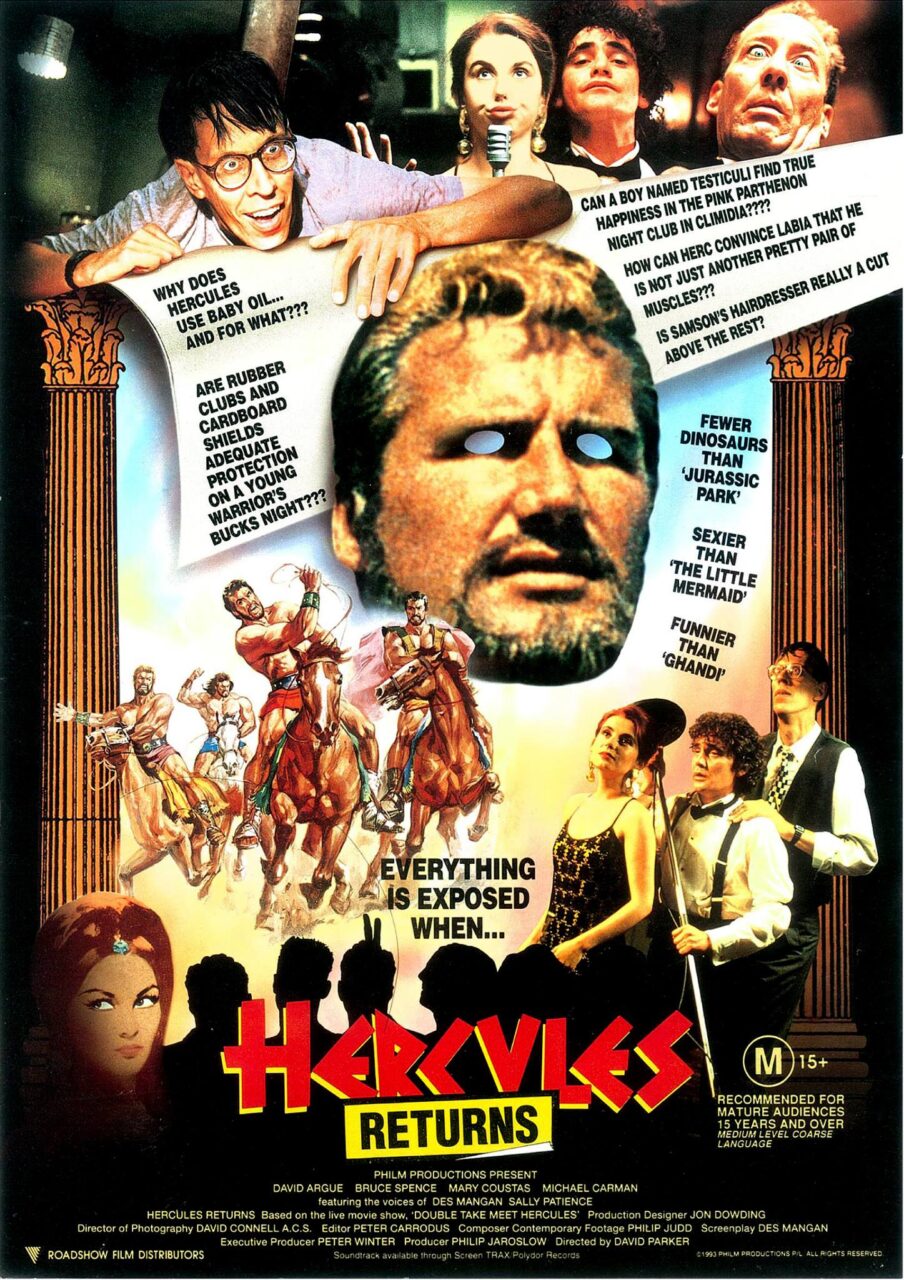
Director – David Parker, Screenplay – Des Mangan, Based the Live Movie Show Double Take Meets Hercules, Producer – Philip Jaroslow, Photography – David Connell, Contemporary Footage Music – Philip Judd, Production Design – Jon Dowding. Production Company – Philm Productions.
Cast
David Argue (Brad McBain), Mary Coustas (Lisa), Bruce Spence (Sprocket), Michael Carman (Kent), Voices of Des Mangan and Sally Patience
Plot
Brad McBain quits his job working for a cinema multiplex chain, disliking his boss Kent’s money-hungry attitude. He finds an old abandoned cinema and decides to open it as a friendly, more intimate theatre. He has the idea of opening with the last film to screen there, which turns out to be an Italian Hercules film. However, on the opening night they find that Kent has sabotaged them by delivering an unsubtitled print of the film. And so Brad and his staff are forced to improvise all the voices themselves.
This Australian film has been developed out of the live comedy theatre gimmick of dubbing spontaneously off-the-cuff comic lines over old films and tv shows. This was several years before the fad was popularised by the tv series Mystery Science Theater 3000 (1988-99, 2017-8) – this site finds that shows habit of ridiculing less technically sophisticated films deplorable and has refused to watch any of the episodes.
Former radio DJ Des Mangan and Sally Patience form such an Australian cabaret called Double Take. Here their comic send-up of the Hercules films has been adapted into a film itself, using one of the films from the old 1960s Italian peplum cycle featuring the adventures of brawny musclemen. The original film in question was Hercules, Samson and Ulysses (1964).
The Italian Hercules films were well in need of a good send-up and all the bubbling homo-eroticism beneath them certainly needed brought out into the open. However, the result is an extraordinarily crass film. Hercules Returns plumbs the lowest of the Australian penchant for vulgar, lowbrow humour – all jokes about vomiting, beer, dubbed-in farts and the like. The characters are all morons who speak in high-pitched squeaky voices. The homo-erotic joke is something that gets overplayed to the point of being offensive. There are few films that have been so thuddingly and persistently moronic in their approach.