
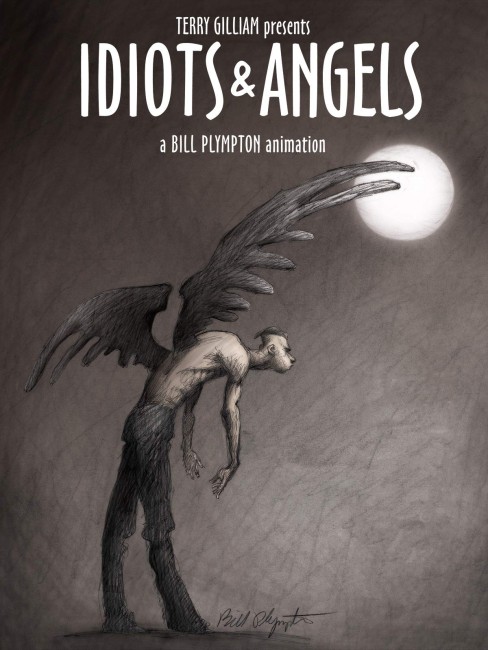
USA. 2008.
Crew
Director/Screenplay/Animator – Bill Plympton, Producers/Art Direction – Biljana Labovic & Bill Plympton, Music – Corey Allen Jackson. Production Company – Bill Plympton Studios.
Plot
A cruel and mean-spirited man spends his time drinking in Bart’s Bar from where he also sells guns. One day after getting out of the shower, the man discovers that he is sprouting stubby angel wings on his back. He plucks them out but they continue to grow. As the wings become larger and he can no longer keep them hidden, this becomes a source of ridicule to others. Soon the man learns to fly, although discovers that the wings have a life of their own and will act to stop his unwholesome intentions. He also woos a lovely cleaner at the bar who dreams of being a dancer. An unscrupulous doctor whose opinion the man sought also seeks to exploit the angel wings.
Idiots and Angels was the fifth full-length animated film from animator and cartoonist Bill Plympton. Plympton came to fame in the 1970s with his surrealistically satiric cartoons, which appeared in high-profile magazines such as National Lampoon, The New York Times, Penthouse, Rolling Stone, Screw, Vanity Fair, The Village Voice and Vogue. In the late 1970s, Plympton then turned to making animated shorts. He has made some 40 odd animated shorts since, being nominated for a Best Animated Short Film Academy Award for both Your Face (1987) and Guard Dog (2004). Plympton has also made several animated features with The Tune (1992), I Married a Strange Person (1997), Mutant Aliens (2004), Hair High (2004), Cheatin’ (2013), Hitler’s Folly (2016), Revengeance (2016) and the H is for Head Games segment of ABCs of Death 2 (2014), the On Eating and Drinking segment of Kahlil Gibran’s The Prophet (2014) and the A True Story segment of The One-Minute Memoir (2020), as well as three surreal live-action films with J. Lyle (1994), Guns on the Clackamas: A Documentary (1995) and Walt Curtis: The Peckerneck Poet (1997), the latter two being mockumentaries. The Tune gained distinction for being the first full-length animated film where the director drew every single frame himself.
The basic premise of Idiots and Angels reminded me of Mervyn Peake’s Mr Pye (1953) about a man who suddenly spouts angels’ wings – in an effort to get rid of them, he deliberately sets out to do bad, only to then find himself developing horns. This was filmed as the little-seen live-action tv mini-series Mr Pye (1986). There was also the later Horns (2013) where Daniel Radcliffe develops a set of devil horns. Plympton’s film riffs on the basic idea of a misanthropic man suddenly being granted angels’ wings and then finding they are forcing him to do good deeds. Plympton does not concern himself with the diabolic half – which may well be why Idiots and Angels peters out in terms of ideas after about the two-thirds point and feels more like a great short film that has been extruded to feature length.
Bill Plympton’s previous films have tended to exist less as narratives and more as a series of bizarrely surrealistic, sometimes scatological juxtapositions where objects are constantly morphing from one shape to the next. With Idiots and Angels, Plympton seems to be aiming for something beyond that. He relies upon a clearcut story for about the first time.
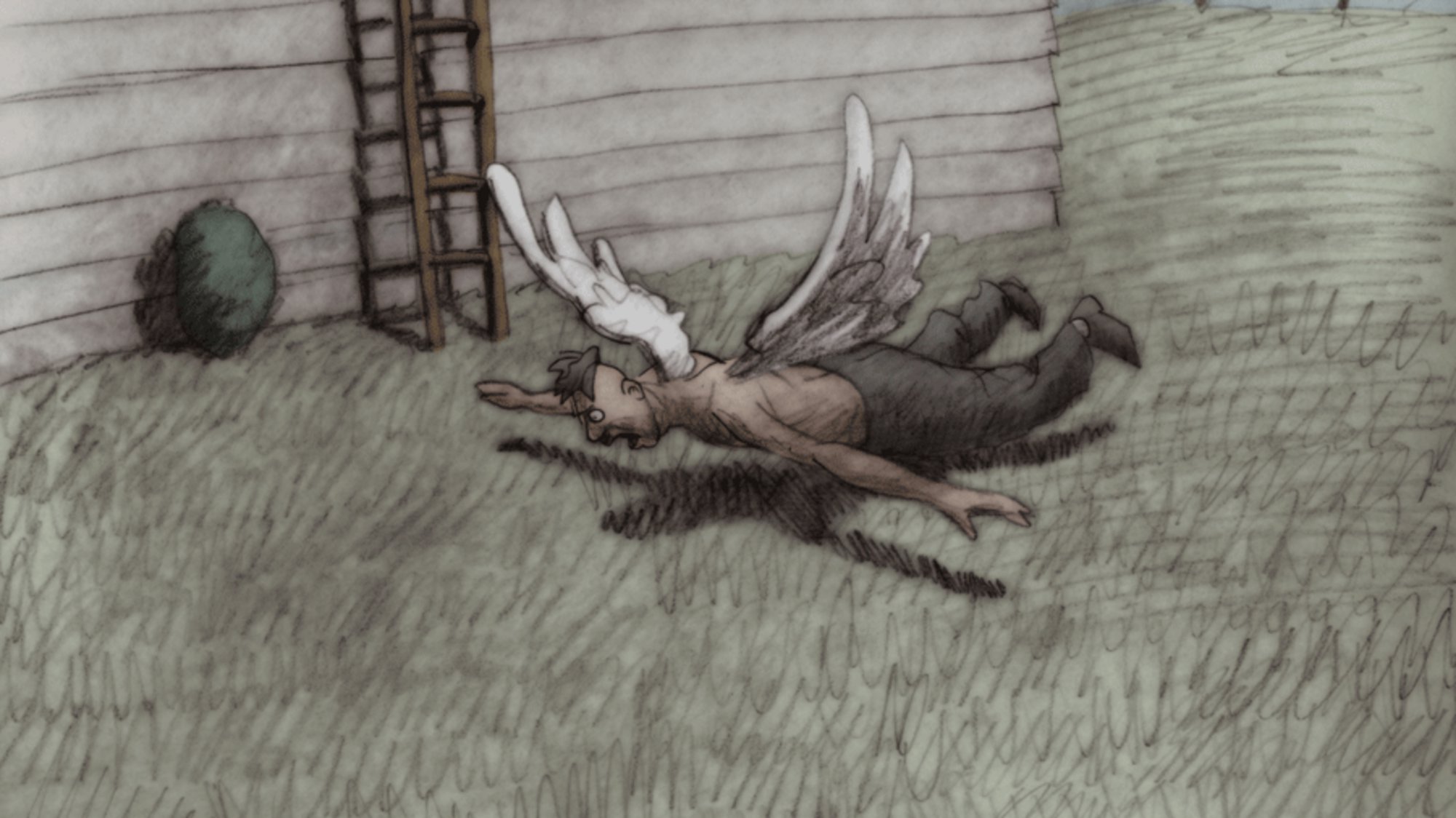
What stuns most about Idiots and Angels is Plympton’s extraordinarily stylised artwork. The entire film looks like a series of (almost) black-and-white pencil sketches given animated life. The animation is all highly exaggerated representation – not unakin to the cartoon work of Gerald Scarfe. Cars are like giant balls of cotton wool with 1950s-style big bodies. Life at the bar is like a 1940s film noir rendered in stylised shadow lines. Where standard animation tends to operate in terms of soft rounded and child-like cuteness, Plympton’s figures exist as stark snapshots of naked expression, much of which is decidedly dark and misanthropic.
Plympton’s love of meldings and wild juxtapositions still play out in a number of scenes – the opening as the man gets up to shower and dress for the day is a masterpiece of dissolves where drops of water from the tap become a toothbrush, where shaving cream becomes soap suds and then the milk on his cereal and so on.
The uniqueness of Idiots and Angels is that Bill Plympton delivers the entire film without dialogue, as merely a series of sound effects, at most grunts and small cries. In this regard, Idiots and Angels makes interesting comparison to the same year’s largely soundless Wall-E (2008), although you could not think of two films more removed on the animation spectrum – Wall-E was a box-office hit pitched to family audiences, while Idiots and Angels is a work for a cult adult audience and comes at almost complete remove from Wall-E‘s cheerful sweetness in terms of its sensibilities.
The lack of dialogue allows Plympton to direct in striking contrasts – none the more so than the scene when the man walks into the bar with a butterfly on his head and each of the patrons drifts off into daydreams about it, before the man turns and savagely crushes it. The wordlessness is beautifully balanced out with a soundtrack that includes a number of perfectly chosen songs from Tom Waits, among others. The result is a strikingly evocative and entirely unique film.
Trailer here