

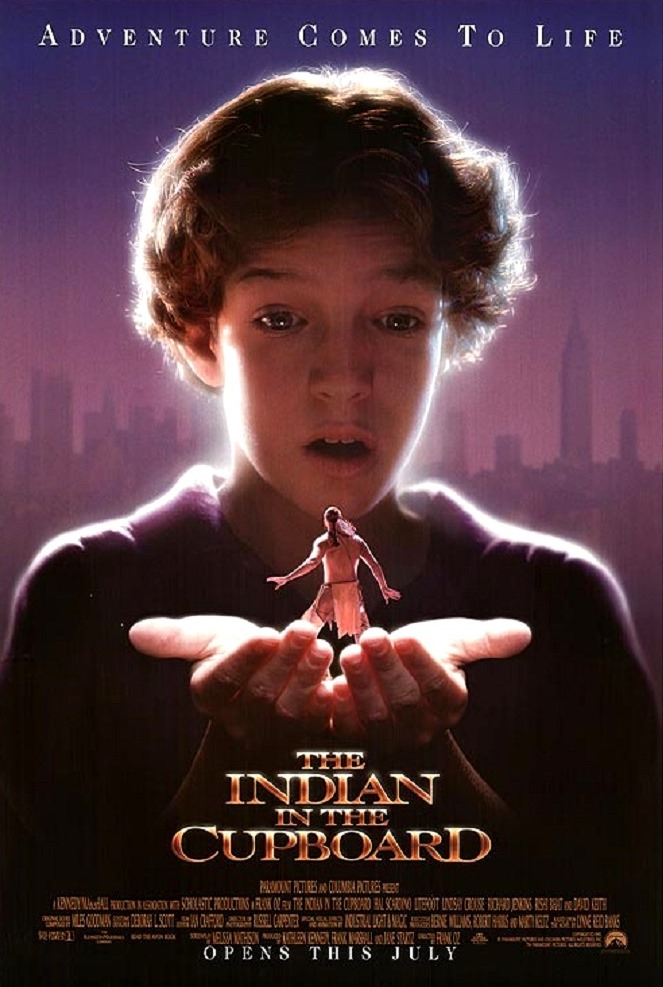
USA. 1995.
Crew
Director – Frank Oz, Screenplay – Melissa Mathison, Based on the Novel by Lynne Reid Banks, Producers – Kathleen Kennedy, Frank Marshall & Jane Startz, Photography – Russell Carpenter, Music – Randy Edelman, Visual Effects – Industrial light and Magic (Supervisor – Eric Brevig), Special Effects Supervisor – Michael Lantieri, Production Design – Leslie McDonald. Production Company – Kennedy-Marshall Productions/Scholastic Productions.
Cast
Hal Scardino (Omri), Litefoot (Little Bear), David Keith (Boone), Rishi Bhat (Patrick), Richard Jenkins (Victor), Lindsay Crouse (Jane), Nestor Serrano (Teacher), Steve Coogan (Tommy Atkins)
Plot
For his ninth birthday Omri is given a small cupboard by his mother, while his best friend Patrick gives him a plastic toy Indian by. Omri places the Indian inside the cupboard. He is startled to later find that the toy has turned into a live Indian only a few centimetres tall. The Indian is frightened and bewildered, believing Omri to be a god. Omri soon befriends the Indian who is an Iroquois named Little Bear and has been transported there from 1761. When Patrick discovers the secret, he recklessly places a toy cowboy in the cupboard. This comes to life as the drunken Boone who wants to shoot Little Bear as a savage. Through Omri’s intervention, the two gradually become friends. However, Omri has to protect Little Bear and Boone from Patrick’s recklessness and the dangers of the outside world.
The Indian in the Cupboard is a lovely fantasy film adapted from the series of children’s books from British author Lynne Reid Banks – the first, the title story, was published in 1980 and was followed by four other volumes. The Indian in the Cupboard was the first production of the company formed by Steven Spielberg’s former Amblin producing partners, Kathleen Kennedy and Frank Marshall. It also has a screenplay by Melissa Mathison, scripter of E.T. – The Extra-Terrestrial (1982).
The director was Frank Oz, who began as an associate of Jim Henson and was most well known as voices of Miss Piggy and Yoda before graduating to director with the likes of The Dark Crystal (1982) and The Muppets Take Manhattan (1984) for Henson, then venturing out on his own with Little Shop of Horrors (1986) and popular mainstream comedies such as Dirty Rotten Scoundrels (1988), HouseSitter (1992), Bowfinger (1999), The Score (2001), The Stepford Wives (2004) and Death at a Funeral (2007).
The Indian in the Cupboard is a beautifully made film. It is not dissimilar to Jumanji (1995), another film that came out only a few months after this. Both films are based on popular children’s stories, although both considerably change the original text. Both films are effects vehicles and have directors who have made their names in the technical field – Frank Oz as a Muppeteer, Jumanji‘s Joe Johnston as an Industrial Light and Magic art director. Both films feature a magical box that, when opened by children, releases something fantastical that transforms everything around them. However, resemblances end about there. Where Jumanji dissolves into noisy chaos, The Indian in the Cupboard achieves a gentle, emotional magic. Naturally, Jumanji was a big hit, while The Indian in the Cupboard did only middling business.
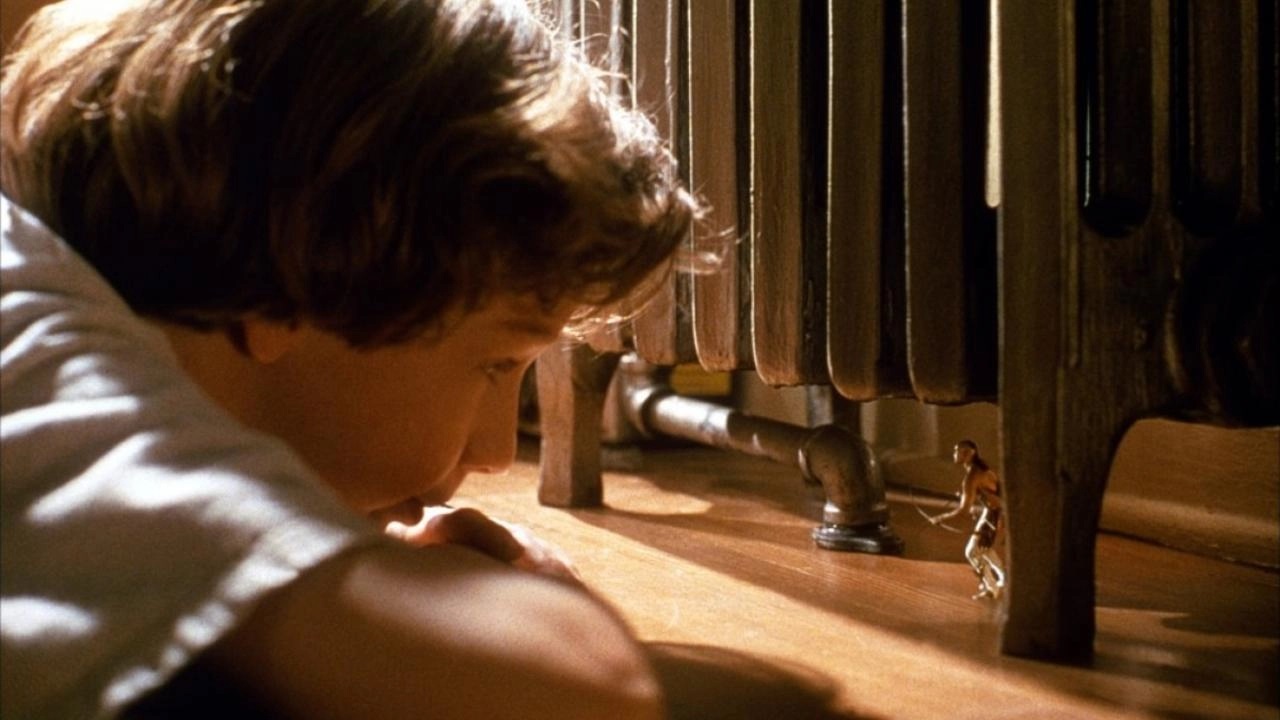
Despite its relative box-office failure, The Indian in the Cupboard is a beautifully made film. Frank Oz never makes a single wrong step. The film is touching and funny in all the right places and Oz never oversteps into mawkishness, never underplays into banality. The effects work is flawlessly achieved. The miniature toys and the full-size children are frequently seen moving together in the same shot but never do we see a matte line, nor does the usual graininess of rear-projection ever become apparent. The result is the fulfillment of an almost perfect sense of wonder. Some of the shots with Litefoot and David Keith sitting watching tv along with the boys; or the conversation where Hal Scardino sits in the middle, having placed one of them on top of a bedpost and the other on a drawer are truly magical.
One of the major pluses of the film is Cherokee Indian rap artist Litefoot’s presence as the title character. Litefoot gives a strong performance of both fearful uncertainty in a new world but also of strength and inner virtue. With his buck teeth and long nose, Hal Scardino is amazingly ugly choice for a kid performer but plays adequately. Even David Keith’s rip-roaring performance as the cowboy grows on one and becomes endearing by the end of the film.
The underlying messages of the film are all heavily PC ones – respect for all life and the environment, the deconstruction of popular myths about Native Indian culture, the insistence on non-aggressive means of dealing with conflicts – but The Indian in the Cupboard makes the points well and they are heartfelt.
(Winner in this site’s Top 10 Films of 1995 list. Nominee for Best Director (Frank Oz), Best Supporting Actor (Litefoot) and Best Special Effects at this site’s Best of 1995 Awards).
Trailer here