
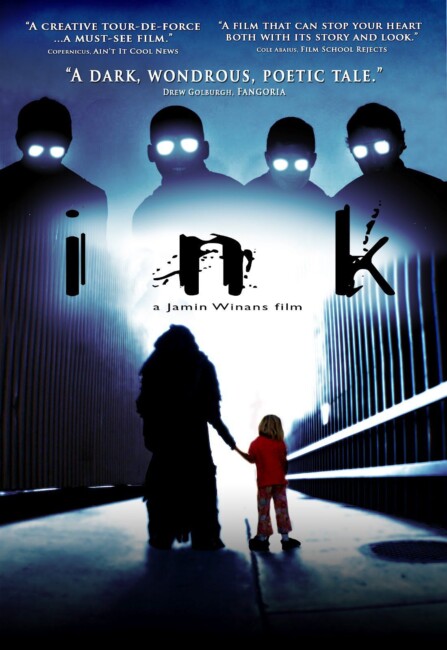
Crew
Director/Screenplay/Music – Jamin Winans, Producer/Production Design – Kiowa K. Winans, Photography – Jeff Pointer, Visual Effects – Ickles Gherkin, Makeup Effects – Alison Chilen, Ink Makeup Design – Todd Debrechini. Production Company – Double Edge Films.
Cast
Chris Kelly (John Sullivan/Ink), Quinn Hunchar (Emma Sullivan), Jessica Duffy (Liev), Jennifer Batter (Allel), Jeremy Make (Jacob), Eme Ikwuakor (Gabe), Shelby Malone (Sarah), Shannan Steele (Shelly), Steve Brown (The Collector), Shauna Earp (The Bride), Steve Sealy (Ron), Marty Lindsey (The Key Master Incubus)
Plot
Stockbroker John Sullivan is caught in a car crash. A hooded figure Ink abducts his young daughter Emma in her sleep and takes her away on a long journey through a dream city. Various dream fighters rush to the rescue. Some time ago, John was despondent following the death of his wife. He buried himself in work after losing custody of Emma, even turning down her grandfather’s plea to go to her while she lay ill in hospital. The characters in the dream employ a blind guide to help them bring about a confluence of events.
Ink was an unusual hit for Denver-based director/writer Jamin Winans who had previously made a handful of short films and the feature-length 11:59 (2005). Both of Winans’ films come in the M. Night Shyamalan/Philip K. Dick mould and deal with protagonists trying to cope with baffling reality-bending scenarios. More unusually, after experiencing difficulty in finding a dvd distributor, even though Ink had won awards at several film festivals, Winans embraced the idea of allowing the film to be freely downloaded from the internet where there were claims of some 400,000 copies being downloaded per month.
Ink received some surprisingly good word-of-mouth reviews that made it a film worth checking out. However, I must say that I ended up feeling contrary to some others proclaiming the film’s originality, even the call for Jamin Winans to be elevated to the same category of genre auteurs like the Wachowski Brothers. Certainly, Winans displays undeniable style. The film immediately plunges us into a fascinating world full of striking and unusual reality flips and images – pursuit by bad guys who have small video projection screens as masks covering their faces, the mysterious character of Ink who taps a miniature set of drums that opens up doorways that they pass through.
The measure of the film’s effect is that you immediately want to know more about what is happening and are trying to piece together the rules on which this world operates. On the minus side, what we are watching is a B-budgeted stylised reality where the mundane world frequently shows through. Unfortunately, when the fantasy realm keeps seeming like it is taking place under real world bridges, back alleys and warehouses, this dents the suspension of disbelief, no matter how much colour saturation and camerawork is piled on to try and hide this.
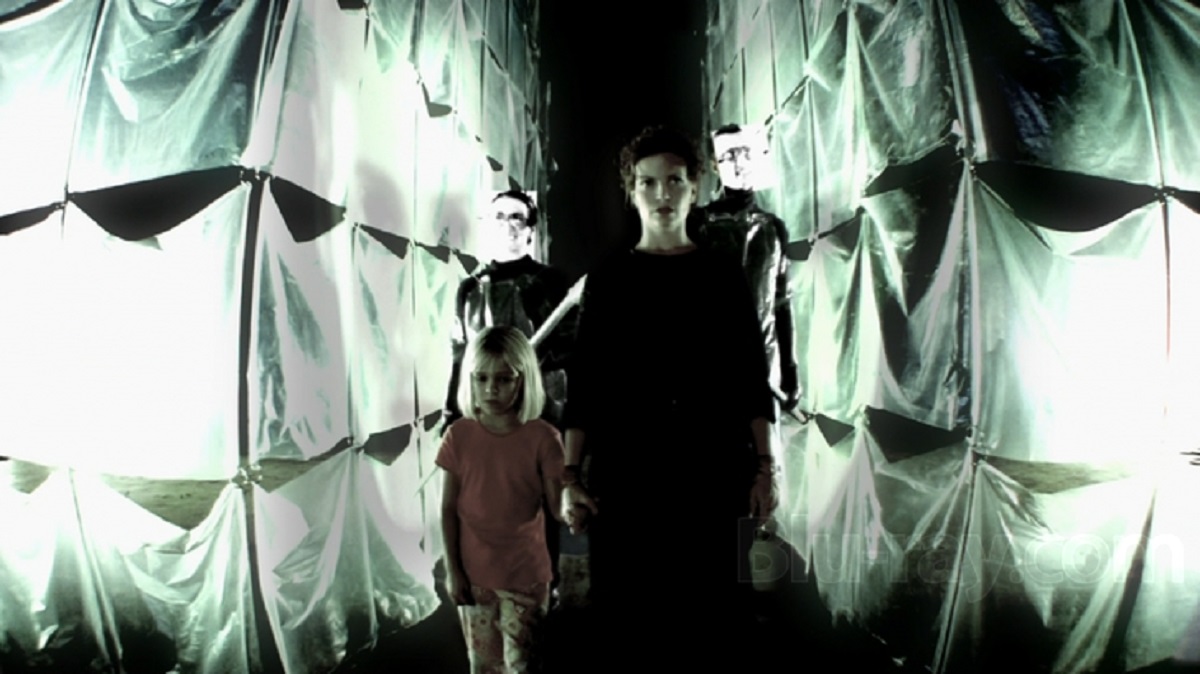
While one does not wish to decry the clear imagination that has gone into the film, nor the efforts of industry outsiders, Ink is a film with pretensions. Most of it consists of two concurrent plotlines – a series of scenes where the character of the hooded and malformed Ink abducts the young girl (Quinn Hunchar) and takes her on a long journey across a city. The other plot follows the dream characters as they assemble and let the blind man guide them across the city to the meeting with Chris Kelly.
The entire film seems to consist of these long, drawn-out journeys and you become impatient wondering where Jamin Winans is going with everything and when he is going to make it pay off. As such, you feel that much of Ink could easily be condensed to take place as a half-hour long short film. There is however one magical scene – where Jeremy Make choreographs a string of random events in the street to all come together and cause Chris Kelly to have the car crash that takes place at the start of the film.
Unfortunately, Ink is a film that seems to think it is being far more profound than it is. [PLOT SPOILERS]. All the dark and moody scenes of flight across the city only ever boil down to an overblown allegory for one man’s battle of the soul. We get several cheaply choreographed slow-motion fight sequences where Jamin Winans is clearly attempting to emulate The Matrix (1999). However, the end anticlimactically reveals that what they are fighting one another to the death for is simply to make one estranged man change his mind and go and see his daughter, while the concurrent plot about the journey with Ink is merely the daughter’s waking up from her illness. This makes Ink decidedly pretentious to say the least.
Jamin Winans subsequently returned with the reality blurring The Frame (2014).
Full film available here:-