

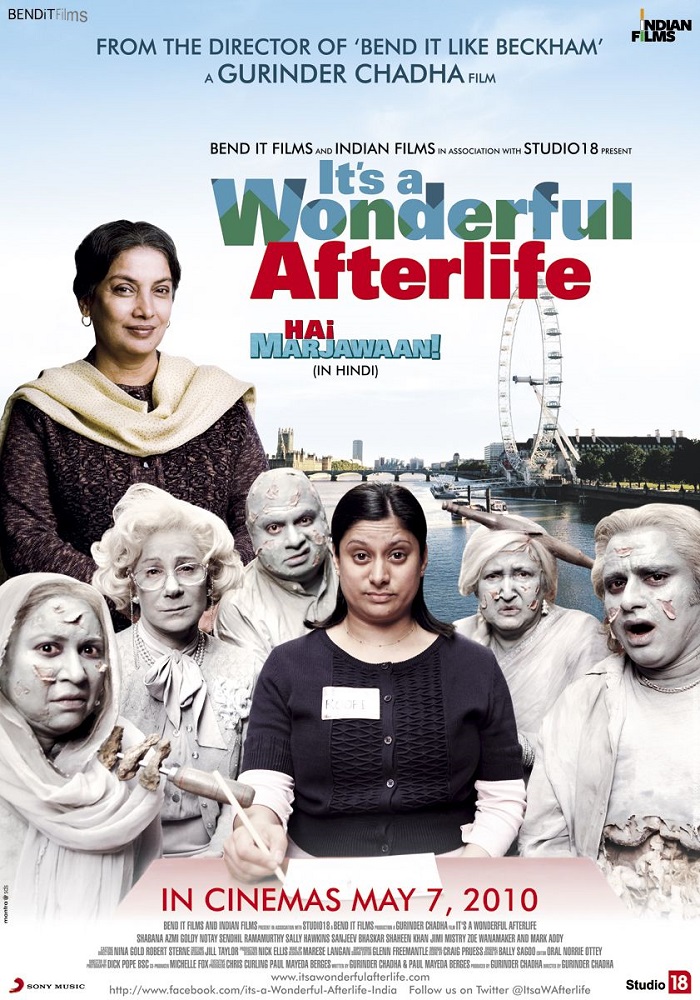
UK/India. 2010.
Crew
Director/Producer – Gurinder Chadha, Screenplay – Paul Mayeda Berges & Gurinder Chadha, Photography – Dick Pope, Music – Craig Pruess, Songs – Billy Sagoo, Visual Effects – Molinare MFM (Supervisor – Simon Carr), Special Effects – Asylum Model & Effects Ltd. (Supervisor – Mark Curtis), Makeup Design – Marese Langan, Prosthetic Makeup – Animated Extras (Chief Designer – Nik Williams), Production Design – Nick Ellis. Production Company – Indian Films/Bend It Films/Studio 18.
Cast
Goldy Notay (Roopi Sethi), Shabana Azmi (Mrs Sethi), Sendhil Ramamurthy (Detective Sergeant Googli ‘Raj’ Murthy), Sally Hawkins (Linda/Gitali), Mark Addy (Detective Inspector Smythe), Sanjeev Bhaskar (Curry Man), Zoe Wanamaker (Mrs Goldstein), Jimi Mistry (Dev), Shaheen Khan (Kebab Woman/Majeet), Adlyn Ross (Rolling Man Woman/Mrs Chopra), Ash Varrez (Naan Man/Mr Chopra), Don Warrington (Chief Superintendent), Ray Panthaki (Jazz Sethi), Jack Gordon (Ari Goldstein)
Plot
London’s Southall district, known as Little India, is plagued by a series of food related killings – a man strangled with naan bread, a woman stabbed with a kebab, a man’s stomach exploded with ultra-spicy curry. Detective-Sergeant Murthy, an ethnic Indian who grew up in the area, is brought in by the police to investigate. While walking through Southall, Murthy meets his childhood friend Roopi Sethi. Roopi’s mother has been waiting for Roopi to get married so that she can finally die. Mrs Sethi has in fact been the one behind the killings, all the victims being people who rejected Roopi as a suitable marriage candidate because she is overweight. Mrs Sethi is now visited by the ghosts of her murdered victims who urge her to kill herself so that they can be free. Meanwhile, the police connect the murder victims to Roopi and take her in for interrogation as a suspect. Murthy is given orders to ask Roopi out and get close to her. During the process of doing so however, he finds himself falling for her.
Gurinder Chadha is a Kenyan-born woman of East Indian ethnicity who grew up in England. Chadha started working as a news reporter for the BBC, directing several tv documentaries for them, before making her feature film debut with Bhaji on the Beach (1993) about expatriate Indian women living in England. It was however Chadha’s third film Bend It Like Beckham (2002) that became a sleeper international hit – and introduced Keira Knightley to the world. Chadha subsequently went onto make Bride and Prejudice (2004), another English-Bollywood fusion, and Angus, Thongs and Perfect Snogging (2008). Chadha is also married to Paul Mayeda Berges, who has acted as co-writer on all of her films, while she co-wrote and co-produced Berges’s one and only directorial outing, the Indian-West fusion Magical Realist romance The Mistress of Spices (2005).
It’s a Wonderful After Life is an exceedingly easy comedy. It has largely been premised on taking the staples of the lightweight fantasy comedy about a mortal haunted/harassed by ghosts – see the likes of Topper (1937) and sequels, which is fairly much the template for this genre, The Ghost and Mrs Muir (1947) and modern variants such as Heart and Souls (1993), The Frighteners (1996) and Ghost Town (2008).
Gurinder Chadha has uplifted the ghost comedy staple and set it in the world of London’s Southall district, which is informally known as Little India due to its predominantly Southeast Asian population. There seems something undeniably autobiographical about the film on Gurinder Chadha’s part. She too grew up in the Southall district. Without wishing to be unkind, you also cannot help but speculate about how much of the character of Roopi in the film, worrying about never being married because she is overweight, is autobiographical to Chadha who is herself a plus-size woman.
It’s a Wonderful After Life is more amiable than it is ever a particularly good film. Everything falls into place with an eminent predictability. From the first 3-4 scenes where Sendhil Ramamurthy is introduced, you can predict that he is going to end up with supposedly unmarriageable daughter Goldy Notay by the end of the film. Notay’s story arc is one that comes by the book of cliches the entire way – how she falls in love with the perfect man, makes a transformation from frumpy to attractive, thinks she has been betrayed due to a set of misunderstandings and is then won back just as the film closes. Gurinder Chada’s failings might be that she never makes anything particularly funny out of the material, nor pushes it in any unexpected directions.
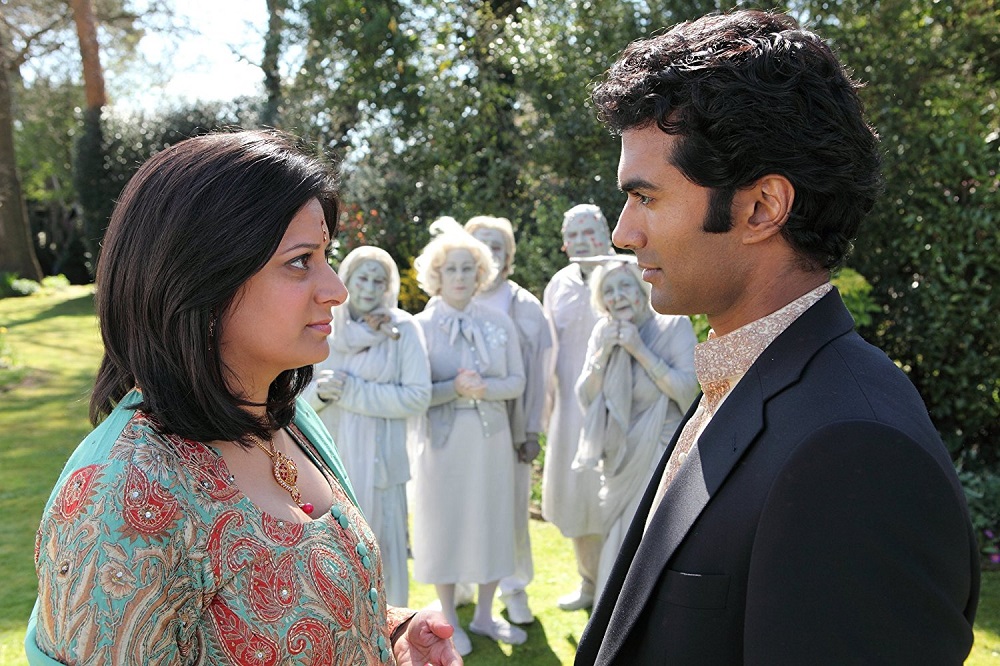
It’s a Wonderful After Life is also peculiarly notable for featuring a leading character that murders multiple people throughout the story yet whose actions come with a complete lack of censure on the part of the filmmakers. The detective hero never seem overly concerned about this, while the police investigation is there largely only to drive the two romantic leads together. Even when Mrs Sethi (Shabana Azmk) is pushed to make the interesting choice between suicide and a jail cell, the ending cops out and produces a previously unmentioned cancer diagnosis she has been suffering from in order to happily wind the story up without complication.
The most bizarre comedic moment – emphasis on the bizarre more than the comedic – is the scene at the wedding banquet where an embarrassed Sally Hawkins is covered in vindaloo just as though it were blood and conjures up psychic powers (we are never sure what they are as she suddenly manifests them out of the blue and they are never referred to or explained anywhere else) and starts throwing food about in a conflagration that is designed as a parody of Carrie (1976). It is a scene that feels so bizarrely out of place that it could almost have strayed in from another film altogether.
The film is well cast for the most part. Gurinder Chada brings together an amazingly large Indian cast, including well-known British nationals of Indian extraction such as Sanjeev Bhaskar, Jimi Mistry and Ace Bhatti. The male lead is American-born East Indian actor Sendhil Ramamurthy, better known as Suresh in the US tv series Heroes (2006-10). On screen here, Ramamurthy does a fine job in projecting a handsome leading man certainty and charm. One of the surprise scene-stealers is Sally Hawkins who sparkles appealingly with a chirpy East London accent and a ditzy belief in Indian mysticism. It is an exceedingly lightweight role but Hawkins does well with it. Goldy Notay is a largely unknown Anglo-Indian actress who seems maybe a too mellow and passive in a leading role where she ends up being out-acted by most of those around her.
Trailer here