
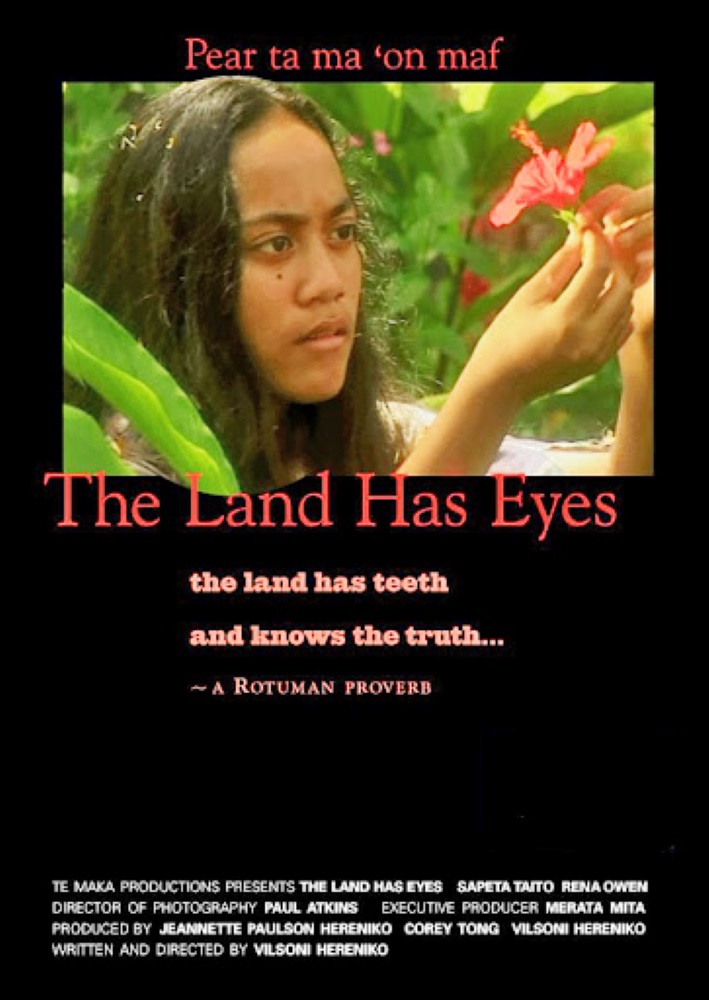
(Pear Ta Ma ‘On Maf)
Fiji/New Zealand. 2004.
Crew
Director/Screenplay – Vilsoni Hereniko, Producers – Vilsoni Hereniko, Jeanette Paulson-Hereniko & Corey Tong, Photography – Paul Atkins, Music – Clive Cockburn & Audy Kimura, Production Design – Hupfield Hoerder. Production Company – Te Maka Productions/Ora Digital.
Cast
Sapeta Taito (Viki), Voi Fesaitu (Hapati), Elisapeti Kafonika Inia (Mata), John Fatiaki (Poto), James Davenport (Judge Clarke), Rena Owen (The Warrior Woman)
Plot
Viki grows up on the small island of Rotuma, 300 miles north of Fiji. She is raised on the stories that her father tells about the legendary warrior woman who founded Rotuma. In school, Viki learns that the pupil that works the hardest will have the opportunity to leave Rotuma and go to Fiji. Viki’s father is then summonsed to court, charged with stealing a neighbour’s coconuts. He pleads innocent but is convicted and fined ten pounds. Viki overhears the trial and realises that the court interpreter Poto deliberately mistranslated to the English judge what her father said in order to have him convicted. Afterwards, she discovers that Poto was bribed with a pig. Viki however believes in the stories that her father told her about how the land has eyes and teeth and will always allow the truth to be told.
The Land Has Eyes has the distinction of being the first ever feature film made in Fiji (at least first ever feature-film made by Fijians, as opposed to foreign filmmakers using the country as a location). The film was shot on the island of Rotuma, which is a small independent British protectorate within the chain of Fijian islands and has a population of around 3000 and its own language. The Land Has Eyes premiered at Sundance and was Fiji’s entry as the 2004 Academy Award for Best Foreign Language Film. The film was shot on digital video with dialogue that vies between English and subtitled Rotuman dialect.
There are many similarities between The Land Has Eyes and Whale Rider (2002), even though The Land Has Eyes was completed well before Whale Rider came out. Both films have similar story structures concerning a young adolescent girl in a Polynesian tribal culture trying to deal with prejudices of her community as well as the pressures of the modern world on her community before she eventually comes to find her strength in rediscovering tribal myth/legend. Both The Land Has Eyes and Whale Rider also end in a Magical Realist catharsis. The story of The Land Has Eyes is largely that of writer/director Vilsoni Hereniko who grew up on Rotuma and, like the heroine of the story, departed the island for Fiji and through his own belief in education eventually became a playwright and a professor at the University of Hawaii, before returning to Rotuma with an international film crew to shoot The Land Has Eyes.
The problem with films like The Land Has Eyes, to some extent Whale Rider, as well as other stories of distant cultures such as Atanarjuat: The Fast Runner (2001), Osama (2003), Return to Kandahar (2003) and The Story of the Weeping Camel (2003), is that in watching them you tend to appreciate them more for what they do – ie. in providing a glimpse into a culture that is previously unrepresented on screen – than you sit viewing them as dramatic films. You tend to feel that you are getting more a dramatised cultural documentary than you are a dramatic work of fiction. This is interesting precisely to the extent that one is interested in finding about these cultures.
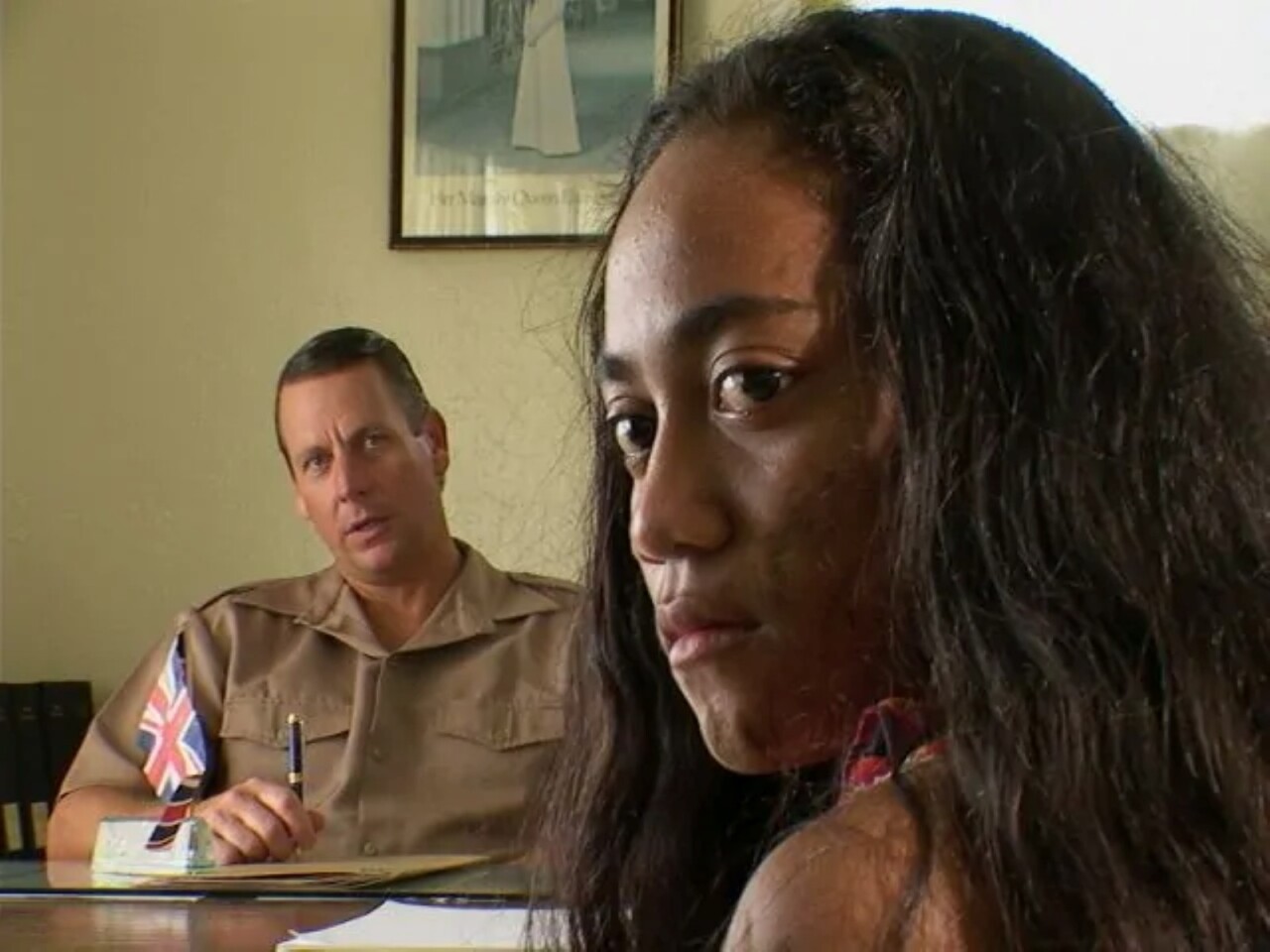
Certainly, The Land Has Eyes offers an fascinating glimpse of the culture and aspirations of such a place as Rotuma – where education is seen as a means of escape from the poverty of the island culture and travelling to Suva (Fiji’s capital) by plane is seen almost as a journey to the promised land; where the amount that one tithes in church is seen as a measure of social standing; where the culture and bureaucracy on the island is dominated by petty corruption and the real authority and decision-making process still lies with the British ruling class; of seeing the local wedding ceremonies and the often impoverished surroundings that the locals live in (at least compared to our Western comforts).
In writing about films like The Land Has Eyes from a science-fiction, horror and fantasy perspective, you feel unkind to the clear effort that has gone into portraying the world seen on screen in having to say that the films are often dramatically dull. This is not always the case with abovementioned but is however a comment that one would have to make about The Land Has Eyes. The dramas that take place in it are minor and the determined intent in offering a portrait of everyday life has a kitchen-sink ordinariness to the point of being humdrum. That said, The Land Has Eyes passes though its relatively low-key dramatics to eventually arrive with modest effect. The end of the film contains a Magical Realist uplift that holds a strong emotional charge in its eventual triumph of the underdog. The Land Has Eyes is ultimately a film that is ragged, where the acting is not that great, but one that feels like a child with a dirty face who manages to win through simply by virtue of being able to give a ragged but winning smile that goes from ear to ear.
Trailer here