

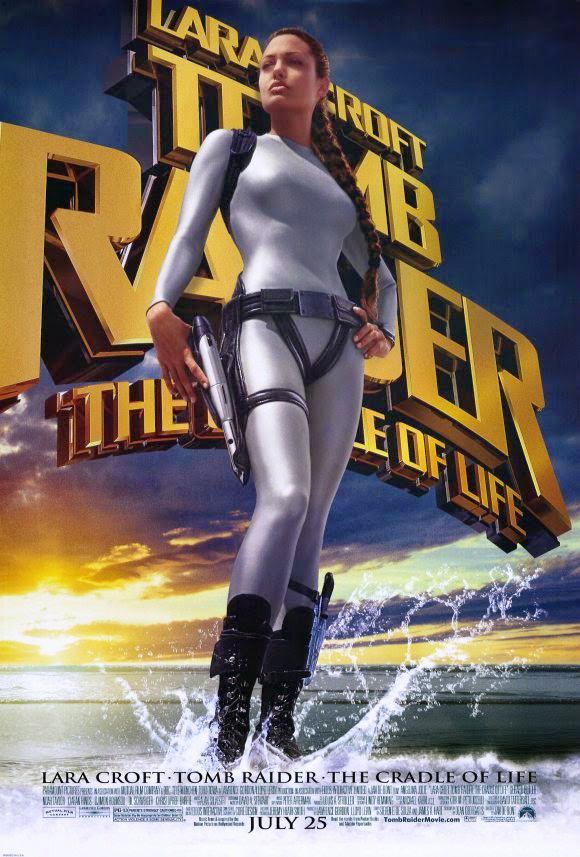
USA/UK/Germany/Japan. 2003.
Crew
Director – Jan De Bont, Screenplay – Dean Georgaris, Story – Steve E. de Souza & James V. Hart, Based on the Game Created by Core Design, Producers – Lawrence Gordon & Lloyd Levin, Photography – David Tattersall, Music – Alan Silvestri, Visual Effects Supervisor – Steve Begg, Visual Effects – Double Negative (Supervisor – Richard Davis), Framestore-CFC (Supervisor – Gavin Toomey), Jim Henson’s Creature Workshop, The Moving Picture Company (Supervisor – Dan Shepherd) & The Peerless Camera Co, Special Effects Supervisor – Chris Corbould, Makeup Effects – Millennium FX Limited (Supervisor – Neill Gorton), Production Design – Kirk M. Petrucelli. Production Company – Paramount/Mutual Film Company/BBC/Tele-München/Toho-Towa/Eidos Interactive Entertainment.
Cast
Angelina Jolie (Lara Croft), Gerard Butler (Terry Sheridan), Ciaran Hinds (Jonathan Reiss), Noah Taylor (Bryce), Christopher Barrie (Hillary), Djimon Hounsou (Kosa), Simon Yam (Chen Lo), Til Schweiger (Sean), Daniel Caltagirone (Nicholas Petraki), Fabiano Martell (Jimmy Petraki), Jonathan Coyne (Gus Petraki), Robert Cavanah (MI6 Agent Stevens), Ronan Vibert (MI6 Agent Calloway)
Plot
Lara Croft arrives in Santorini following an earthquake that exposes the lost site of the Lunar Temple of Alexander the Great. Inside she finds a glowing orb but the temple is then raided by Shai Ling bandits who take the orb and leave her to die. She manages to escape. Back in England, she is approached by MI6 who want her to stop bio-weapons designer Jonathan Reiss who is conducting an international auction of a deadly new virus. She realises that the orb is a map that leads to Pandora’s Box, the legendary Cradle of Life, from which human life originated but that also contains the potential to eliminate all life. She requests the freedom of her former lover, mercenary Terry Sheridan, from a Kazakhstan prison so that he can lead her to the Shai Ling base. Heading from China to Hong Kong to Africa, the two race to get to the Cradle of Life and stop Reiss obtaining the virus.
Lara Croft, Tomb Raider (2001), adapted from the massively popular Eidos interactive computer games, was one of its year’s big worldwide hits. Not many people actually liked the film – even star Angelina Jolie spoke out during the publicity tour for The Cradle of Life as to her dissatisfaction with the finished film – but it was spectacularly popular. Lara Croft, Tomb Raider: The Cradle of Life is the sequel. According to Angelina Jolie, she signed up again because she wanted to do things right this time and add emotional depth to the character. This kind of thinking then surely makes a Tomb Raider 3 inevitable.
The original film’s director Simon West was clearly thought to be behind the film’s lacklustre reception and was not asked to return here. To improve the franchise, the filmmakers in their bright thinking turned to, not as one might suspect, any of the top action directors in the business, or even any of the game’s original designers but … wait for it, Jan de Bont, a director who, it is generally recognised, has made some of the worst films of the last few years.
The Dutch-born Jan de Bont began life as a cinematographer, working on the high profile likes of Die Hard (1988), Flatliners (1990), The Hunt for Red October (1990) and Basic Instinct (1992). He then made his directorial debut with Speed (1994), a film that proved a huge hit through its likable romantic-comic pairing but was entirely brainless when it came to writing and action, something that became all the more apparent with de Bont’s universally loathed sequel Speed 2: Cruise Control (1997). de Bont next made the Michael Crichton-scripted Twister (1996), which was an okay film as long as one took it on the level of ever-expanding mass spectacle that it was intended. However, the stinker in Jan de Bont’s crown was the remake of The Haunting (1999), a film so moronic in its conception and delivery and such an insult to the original masterwork that it has to top the list of worst all-time remakes. Its disastrous reception seemed to prove an end to Jan de Bont’s career and he disappeared into hiding, becoming an in-house producer at DreamWorks SKG, until the Tomb Raider producers had the bright idea to re-employ him again. [In this author’s opinion, Jan de Bont is one of the worst directors currently at work in Hollywood – chief offender on the list is Joel Schumacher, with the remaining top spots equally shared by Renny Harlin, Stephen Sommers and Michael Bay].
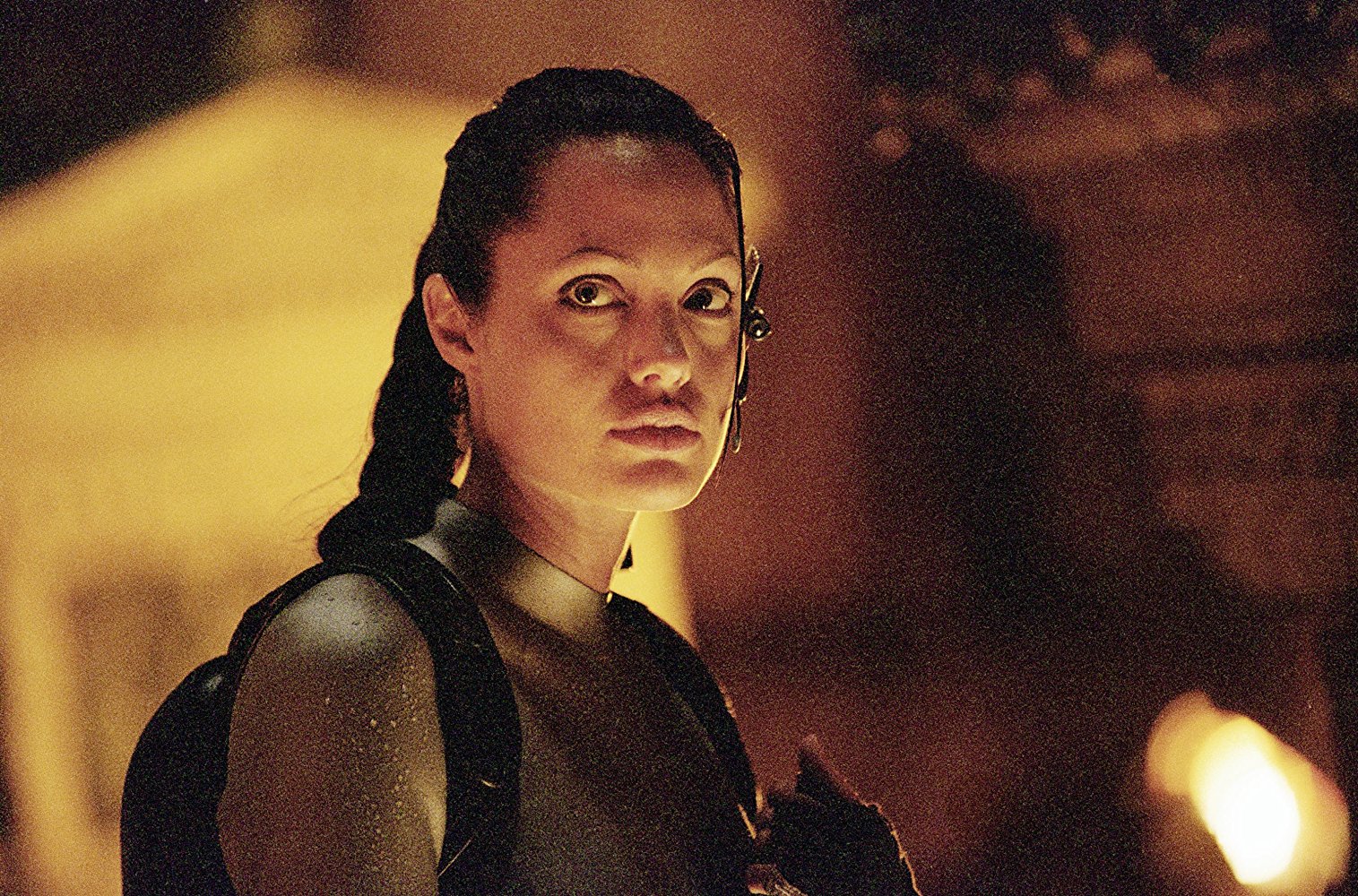
The large problem with Lara Croft, Tomb Raider: The Cradle of Life is that it has been construed as a star vehicle for Angelina Jolie. Her performance, as in the first film, is all cat-like eyes, collagen-injected lips and lithe moves, but nothing you could call acting. Everything is a pose – from her fake English accent to the erect nipples that have been deliberately costumed onto her diving suit. The rest of the film is clearly just the stunt people scaling ropes, diving off buildings and parasailing into action. The problem with vehicles for stars who can get paid $12 million (Angelina Jolie’s salary for the film) is that they become very remote from people telling you that they are not a major new talent, while usually any desire that the actor has to remove the less-than-perfect seeming aspects of their character on screen gets obeyed by lapdog script doctors.
That is what it feels has happened with Lara Croft here. Angelina Jolie got her $12 million desire to be a large-than-life heroine obeyed – but to the extent that anything that is possibly human is removed from the character. There is not a single character conflict, not a single dramatic arc that she must travail anywhere throughout, not a single scene anywhere where one knows that Angelina is not going to come out on top. There does come the choice at the end between whether to leave or exploit the box, but this is a choice that comes far too late in the game and with the outcome not in the slightest doubt. Usually heroes have to earn their destiny – but everything here comes handed to Lara, from her wealth, her inexhaustible supply of gadgetry, to the solution to every situation she faces. Indeed, for the self-styled tomb raider she is, there is not even a single scene in either film where she ever does any archaeological research.
The scriptwriters keep throwing in absurdly improbable gadgets and contrivances to save the day – a submarine surfacing under Angelina while she is abandoned at sea; she and Gerard Butler revealing handy parasailing suits when trapped on top of a building; while everywhere she parachutes into she just happens to meet someone who regards her as a loyal old friend. For me, The Cradle of Life collapsed into total ludicrousness in the first few moments where we are underwater and a shark appears and lunges at the screen with a roar (!!!) and then a few minutes later Angelina Jolie cuts herself to draw it back then punches it on the nose (again with accompanied roaring sound effects) and grabs its tail to ride it to the surface.
Lara Croft, Tomb Raider: The Cradle of Life has a particularly hare-brained script. This comes from Steven E. de Souza, who wrote the first two Die Hard films, The Running Man (1987) and directed another videogame adaptation, Street Fighter (1994), and James V. Hart, who was responsible for Spielberg’s Hook (1991) and Francis Ford Coppola’s Bram Stoker’s Dracula (1992). Their contributions were polished by newcomer Dean Georgaris, although, Geogaris did redeem himself subsequently with the intelligently written Paycheck (2003), the politically charged remake of The Manchurian Candidate (2004) and Tristan + Isolde (2006).
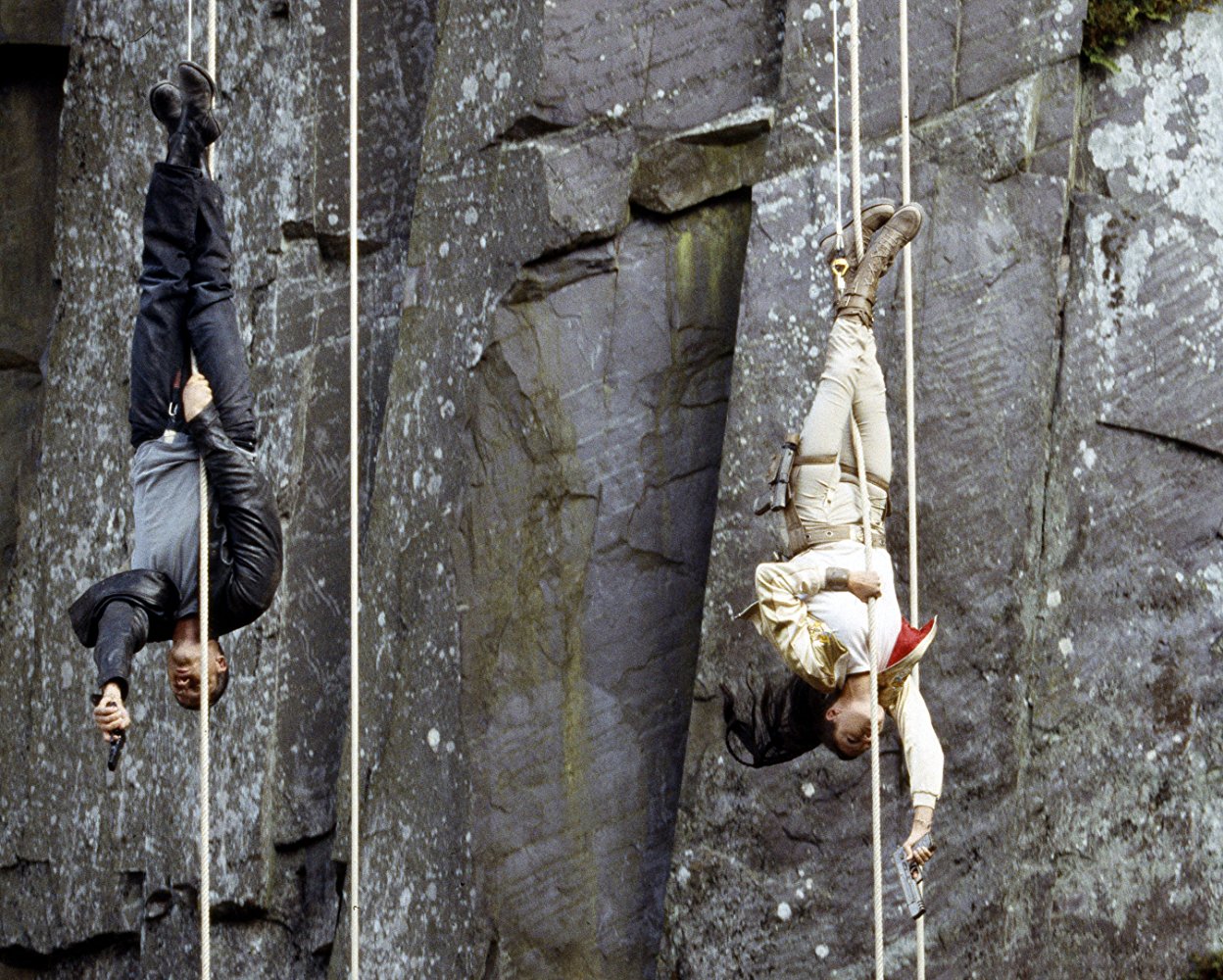
Dean Georgaris gets his history and myth somewhat mixed up to say the least. Santorini was destroyed in a volcanic eruption circa 1628 B.C., not an earthquake. Alexander the Great was not born until 356 B.C., more than a thousand years after the destruction of Santorini and the 2200 B.C. date the film gives as when he buried the Box. Moreover, while Alexander conquered much of Persia and the Mediterranean and ventured as far east as India, he never travelled any further south into Africa than Egypt, certainly not as far as Mount Kilimanjaro (Tanzania).
However, the film’s biggest blunders are when it comes to the myth of Pandora’s Box. According to Greek myth, Pandora was the first woman and was given a box by Zeus and told never to open it. Eventually overcome by curiosity, Pandora did open the box only to unleash all the woes of humankind – pain, sorrow, illness, greed etc. There is no reference in any of the myths to the box holding either the origin of all life or the ability to end it. These are basic facts that it took me all of about five minutes to check up online. When a film has this as its basic premise, you would think it could hold its audience’s intelligence in enough respect to do even a small amount of research about what it is talking.
Moreover, when you are going to throw up as radical a concept as having all life on Earth created out of a Greek myth, then you sure as heck need to throw up some entertaining double-talk to make it sound believable. Contrarily, Lara Croft, Tomb Raider: The Cradle of Life does none of this. It hints that Pandora’s Box was “the Sunday school version” and a cover story for a greater truth but avoids offering any details about what Pandora’s Box and the term anti-life means and, more importantly, any discussion of where the box might have came from in the first place. In actuality, the Box and Cradle are nothing more than Hitchcockian McGuffins, which the film has gone out of its way to make as generic as possible. The rest of the plot plays like Raiders of the Lost Ark (1981) redux – the quest for the mythological artifact, wherein the hero(ine) is requested to go by the secret service for the good of the nation; the need to recruit an old flame to lead them to the artifact; and the same well-dressed villain racing in competition to get the artifact for nefarious purposes, who undergoes a climactic meltdown after he opens the box.
It is worth comparing Lara Croft, Tomb Raider: The Cradle of Life to Raiders of the Lost Ark, the film that inspired the original Tomb Raider game. Raiders of the Lost Ark put its hero through increasingly improbable stunts and action sequences but there was not a single moment where you were not enthralled, even as some of the action started becoming ridiculous. The reason was that Steven Spielberg gave us a personal investment in his hero in the presence of Harrison Ford and directed the action with a breathless suspense that kept you on the edge of the seat and made you believe that Ford might be in mortal danger at any moment. In comparison to Raiders of the Lost Ark, Lara Croft, Tomb Raider: The Cradle of Life feels only like a series of scenes where stunt-people do occasionally interesting things. Jan de Bont is endlessly throwing in random unconnected scenes with motorcycle stunts racing along the Great Wall of China, Angelina Jolie parachuting into action, her shooting at targets while racing along on a horse (a horse that is also capable of skidding) and kendo duelling. Even her entrance is conducted as a series of stunt sequences where she arrives aboard a jet ski bike while clad in a bikini and prefers to spend several minutes doing loops and jumps on the waves rather than merely pull up alongside the boat.
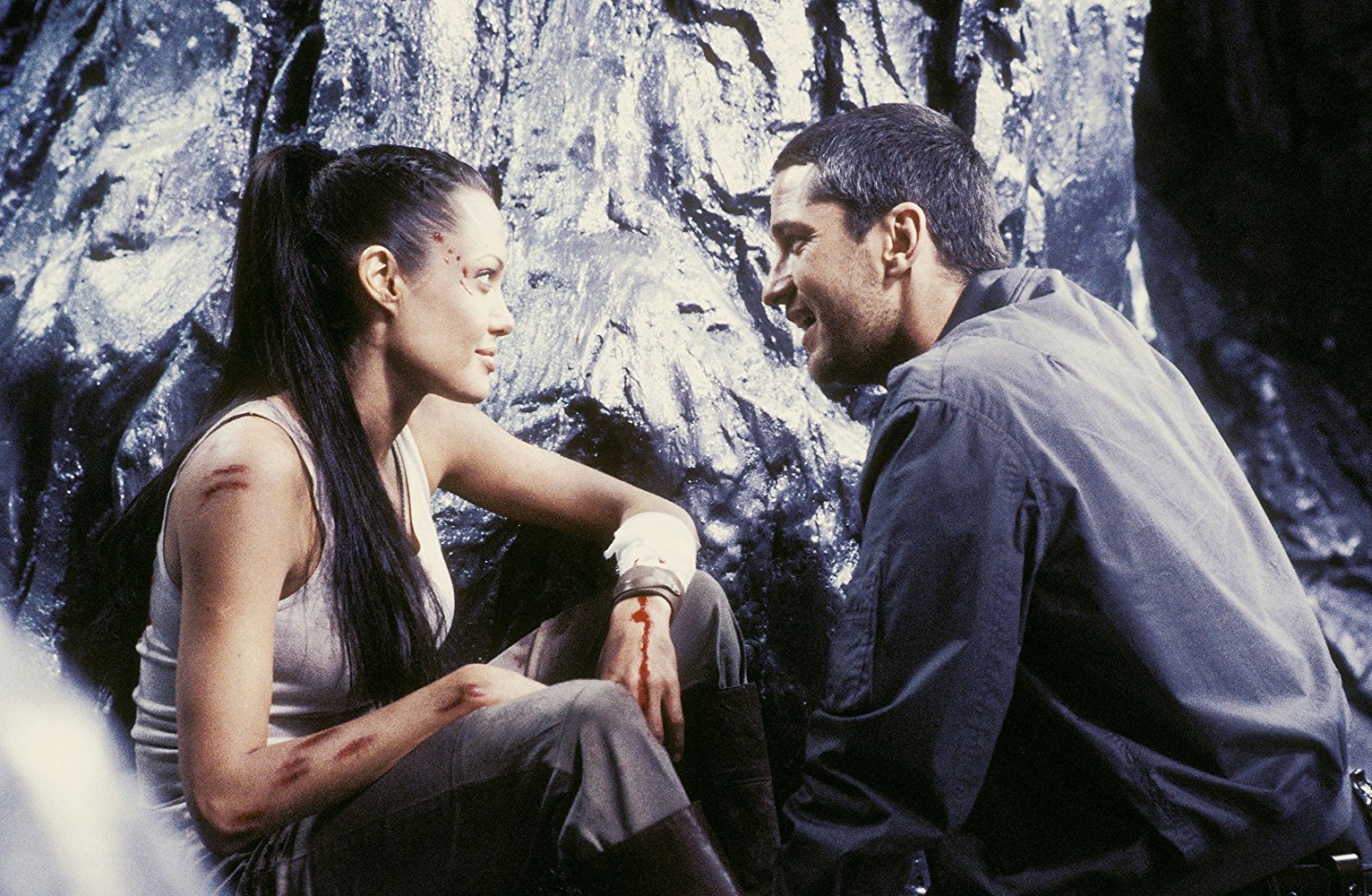
The action sequences have the feel, not of dramatic sequences but of people conducting novelty stunts – diving off a tower in parachute suits, Jolie and Gerard Butler descending a cliff-face on ropes upside down, a choreographed display of sword duelling with an antique musket. Indeed, Lara Croft, Tomb Raider: The Cradle of Life reminds less of Raiders of the Lost Ark than of the mind-numbing xXx (2002), which tried to conduct an action movie as a series of extreme sports novelty stunt sequences. Even the sets have an improbability – three-tiered pagodas, neon signs on pulleys across rooftops, wires running across the roofs of temples, armies of terracotta warriors – where you can tell from the first time they are introduced what types of stunts are about to be staged there.
The result is not unlike the Roger Moore James Bond films where Moore kept going through the most absurdly over-the-top action stunts until all that one could do is sit back and look at the ridiculousness and artistry of the show the stunt people were putting on – only Lara Croft, Tomb Raider: The Cradle of Life lacks the good grace that the Bond series did in at least having Moore wink asides to the audience to show they should not be taking it any more seriously than he was. Bad and all as most of the Moore Bond films were, they at least never took the ridiculousness too seriously; this does. As heroes, both James Bond and Indiana Jones have the same superhuman invincibility and ridiculously high skills that Lara Croft does. They work, she doesn’t, simply because in all cases there is something else there to make the character endearing – in the Indiana Jones films, there is Steven Spielberg to keep the suspense on the edge of the seat and Harrison Ford’s effortless ability to establish a wry charismatic warmth with an audience; in the Bond films, there is the suave sophistication of Sean Connery and to a lesser extent Roger Moore. On the other hand, Lara Croft lacks anything – there is Angelina Jolie who looks physically perfect but fails to display a single human flaw; there’s Jan de Bont who conducts action not as though the lead character was in peril but as if it were a grab bag of novelty stunts he were putting on for some extreme sports adventure show; and a script (as in the original film) that loudly signals that the writers are not taking any of it any more seriously than the level of a children’s cartoon.
On the plus side, Gerard Butler is well cast. At the time, the Scottish-born Butler was emerging as a worthy new leading man in films like Dracula 2000 (2000), The Phantom of the Opera (2004) and once even mentioned as a successor in the role of James Bond, before his big break-out role in 300 (2007). He has a rugged conviction and handsomeness that one had no trouble believing, unlike Angelina Jolie. However, Lara Croft, Tomb Raider: The Cradle of Life is her vehicle and he is almost entirely sidelined, particularly during the action sequences, as though his being there may have shone her up too much.
This was the last of the Angelina Jolie Tomb Raider films. For several years after this, a third Lara Croft film has been announced with various actresses considered in the role. This finally emerged with Tomb Raider (2018) starring Alicia Vikander and was followed by the anime tv series Tomb Raider: The Legend of Lara Croft (2024- ).
(Winner in this site’s Worst Films of 2003 list.).
Trailer here