
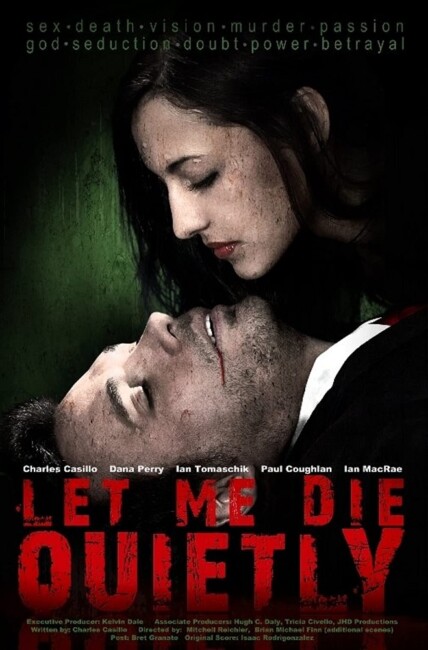
Crew
Director – Mitchell Reichler, Additional Scenes Directed by Brian Michael Finn, Screenplay – Charles Casillo, Producers – Charles Casillo & Kelvin Dale, Photography – Ted Read, Music – Isaac Rodrigonzalez. Production Company – JHD Productions/LMDQ, LLC.
Cast
Charles Casillo (Mario de Maria), Dana Perry (Gabrielle/Anna), Ian Tomaschik (Dr Justin Avery), Paul Coughlan (Detective Devlin), Ian MacRae (Nick), Stephen Geras (Russell)
Plot
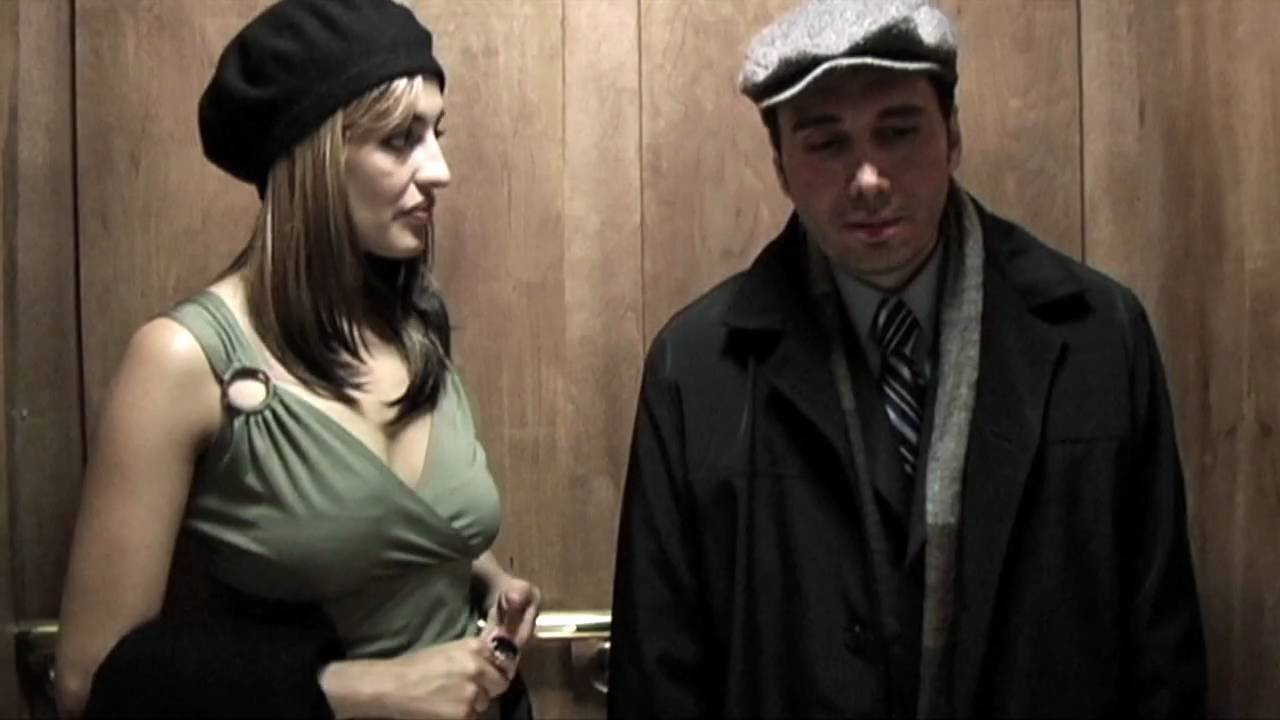
Mario lives a lonely life in New York City, engaging in anonymous sexual encounters with other men in porn theatres. He is troubled by a series of visions of what he believes are people’s murders and tells these to his psychologist Justin Avery in an attempt to understand them. One day, he encounters the beautiful Gabrielle in the elevator of his apartment building. She tells him that she has the same type of visions that he does. The two are attracted to one another. Mario is certain that a murder is about to occur. Gabrielle shows him photos she has taken of a man she sees in her visions. Mario recognises the man as someone who has been following him and they believe that he will be the murderer. As Mario tries to get the police to take him seriously, everything around him is not what it appears.
Let Me Die Quietly is a modest low-budget film that has been doing the rounds of some independent film festivals. It is a directorial debut for Mitchell Reichler. It was also a debut for Charles Casillo who both plays the lead character and writes the film’s script, a first in either case for him.
I was captivated with the milieu and central character that Let Me Die Quietly sets up from the opening scene – that of a lonely man in his mid-thirties (Charles Casillo) whose human contact has been reduced to random sexual encounters with other men in the sordid world of New York porn theatres, while at the same time he appears to be wracked with guilt and is confessing his sins/explaining his life to both a Catholic priest and a psychologist (Ian Tomarschik). The sense of soulless loneliness that comes across in Charles Casillo’s writing/narration during these scenes has an extraordinary melancholy to it. (The extent to which Charles Casillo is both playing the character and writing the lines he is voicing over cannot help but make you wonder how much this lifestyle is something autobiographical on his part).
The intro of Casillo’s clairvoyant powers and of the woman (Dana Perry) who shares them/changes his life all work suitably mysteriously – it is certainly an interesting twist to put on such a character. This is a film where these elements are allowed to emerge in subtle nuances of acting, not in big dramatic fireworks. To this extent, the film is very well cast. Charles Casillo has handsome Italian looks but a paleness and unease that makes the character he plays seem physically haunted and falling apart inside. Opposite him, Dana Perry has a mysterious wide-eyed beauty, yet rather than play for femme fatale allows a vulnerability to emerge.
The set-up as the two psychics start sharing aspects of their vision keeps you wondering where exactly Let Me Die Quietly is going to go. Once the film gets into the detective story and starts trying to piece together aspects of the vision, Let Me Die Quietly heads in more standard directions. We have seen a few too many psychic films and tv movies – the likes of Baffled! (1972), The Eyes of Charles Sand (1972), Visions (1972), Eyes of Laura Mars (1978), Double Exposure (1981), Cassandra (1987), Fear (1990), Sensation (1994), Hideaway (1995), A Deadly Vision (1997), After Alice (1999), In Dreams (1999), The Gift (2000), Murder Scene (2000), Troubled Waters (2006), Empathy (2007) and In/Sight (2011) – for these to offer anything truly original on what has gone before. (For a more detailed overview see Films About Clairvoyance and Precognition).
As Let Me Die Quietly bills itself, it is a work of neo-noir. Classic film noir never dealt with any elements of the supernatural, unless you want to count Night Has a Thousand Eyes (1948) or Nightmare (1956), although the latter eventually opted for a contrived mundane explanation. Where Let Me Die Quietly does adhere to classic noir is in terms of the torturous plotting twists it keeps adding – the continuing unveilings of who is lying to, manipulating and setting up whom. There are perhaps a few too many of these twists and revelations for credibility’s sake but the plot corkscrews and doglegs with sufficient interest.
Where Let Me Die Quietly does work is essentially in becoming a film about human loneliness. In many respects, it is like one of Abel Ferrara’s works – in particular films like The Driller Killer (1979), Bad Lieutenant (1992) and The Addiction (1995), which are portraits of the lonely and those who have lost all hope in New York City. As with many of Abel Ferrara’s films, Let Me Die Quietly also arrives at an end that has the dying hero seek Catholic forgiveness and redemption before he expires.