

Crew
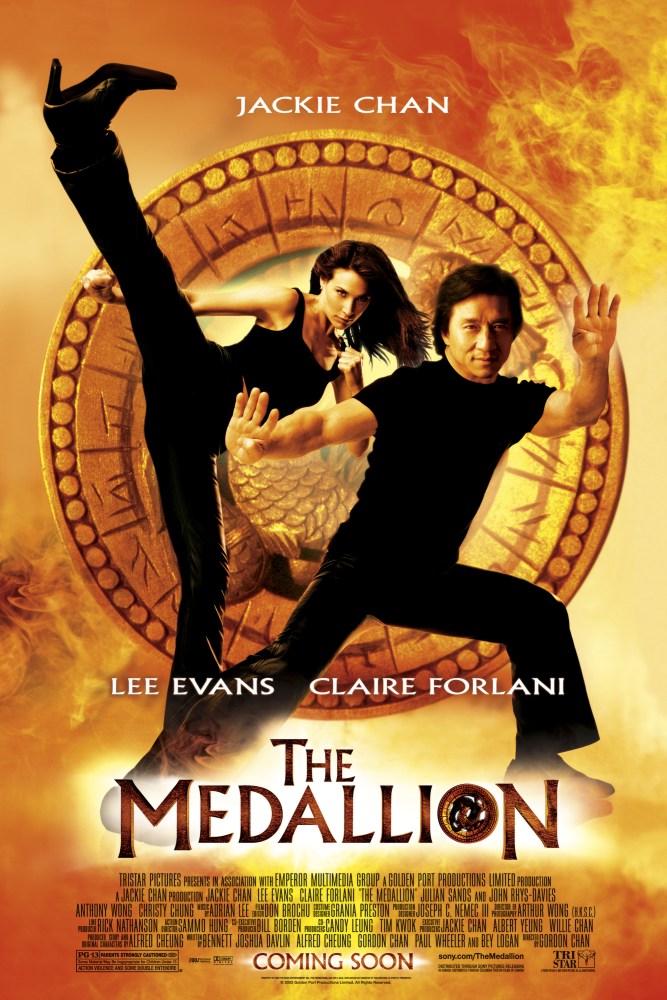
Director – Gordon Chan, Screenplay – Gordon Chan, Alfred Cheung, Bennett Joshua Devlin, Bey Logan & Paul Wheeler, Story/Producer – Alfred Cheung, Photography – Arthur Wong, Music – Adrian Lee, Visual Effects Supervisor – Paddy Eason, Visual Effects – The Moving Picture Company, Special Effects – Team Effects (Supervisor – Kevin Byrne), Production Design – Joseph C. Nemec III, Action Director – Sammo Hung. Production Company – Screen Gems/Emperor Multimedia Group/Golden Port Productions Ltd.
Cast
Jackie Chan (Lieutenant Eddie Yang), Lee Evans (Arthur Watson), Claire Forlani (Nicole James), Julian Sands (Snakehead), Alexander Bao (Jai), John Rhys-Davies (Commander Hammerstock-Smythe), Anthony Wong (Lester Wong), Christy Chung (Charlotte Watson), Johann Giscard Myers (Giscard)
Plot
Eddie Yang, a police detective from Hong Kong, is part of an Interpol operation trying to stop the criminal mastermind known as Snakehead. During a raid, Snakehead’s men snatch a young boy Jai. Later during a smuggling operation, Eddie tries to rescue Jai but fails. Eddie follows Snakehead’s trail to Dublin. There he is paired up with his former girlfriend Nicole James and bumbling British officer Arthur Watson. While trying to rescue Jai, he and Eddie become trapped inside a sinking shipping container. Just as Eddie starts to drown, the boy gives him a medallion to hold. Afterwards, the others mourn Eddie’s death, only for Arthur to see Eddie return to life on the morgue table. Eddie discovers that he now has superpowers, including the ability to leap great distances and an invulnerability to damage. As the two of them try to prevent Snakehead’s men from snatching Jai again, Eddie learns that the medallion can bestow properties of immortality and superpowers on anybody who is holding the boy’s hand when they die. Eddie then realises that Snakehead wants the boy in order to obtain these same abilities.
Once upon a time, Jackie Chan was one of the most celebrated of Hong Kong stars. Chan came to not only star but also choreograph his own stunts and frequently to write and occasionally also direct his own material. Some of Jackie Chan’s films – Drunken Master (1978) and sequels, Police Story (1985) and sequels, Armour of God (1987) and sequels, and Double Dragon (1992) – are regarded as some of the finest of Hong Kong action/martial arts films and Chan’s action choreography, especially on works like Drunken Master II (1994), without par.
The Jackie Chan who has become a star in the West is an altogether different story. Chan’s first big English-language success was Rumble in the Bronx (1995), which was a lesser film than his Hong Kong work but proved a reasonable hit. So too was the entirely lightweight likes of Rush Hour (1998) and Shanghai Noon (2002) and their various sequels, which showed off Chan’s comedic talents to audience-pleasing success. On the other hand, other English-language Jackie Chan films such as The Tuxedo (2002), The Medallion, Around the World in 80 Days (2004), The Forbidden Kingdom (2008) and The Spy Next Door (2010) have been unmitigated disasters. It is notable that all of Jackie Chan’s Hollywood films have been based around his comedic talents more so than his martial arts abilities and seldom in these films has he been granted the opportunity to choreograph his own stunts.
Promisingly, The Medallion is a Hong Kong co-production where Jackie Chan has placed himself in the directorial hands of Gordon Chan who put Jackie through his paces before in Dragons Forever (1988) and Thunderbolt (1995) and elsewhere made the hit hard-boiled action film Beast Cops (1998). Also on board to choreograph the action is Jackie’s long-time friend Sammo Hung, a celebrated Hong Kong star and director in his own right. Unfortunately, while it goes some way towards recapturing classic Jackie Chan, The Medallion is a sad misfire and proved a total damp squib with audiences.
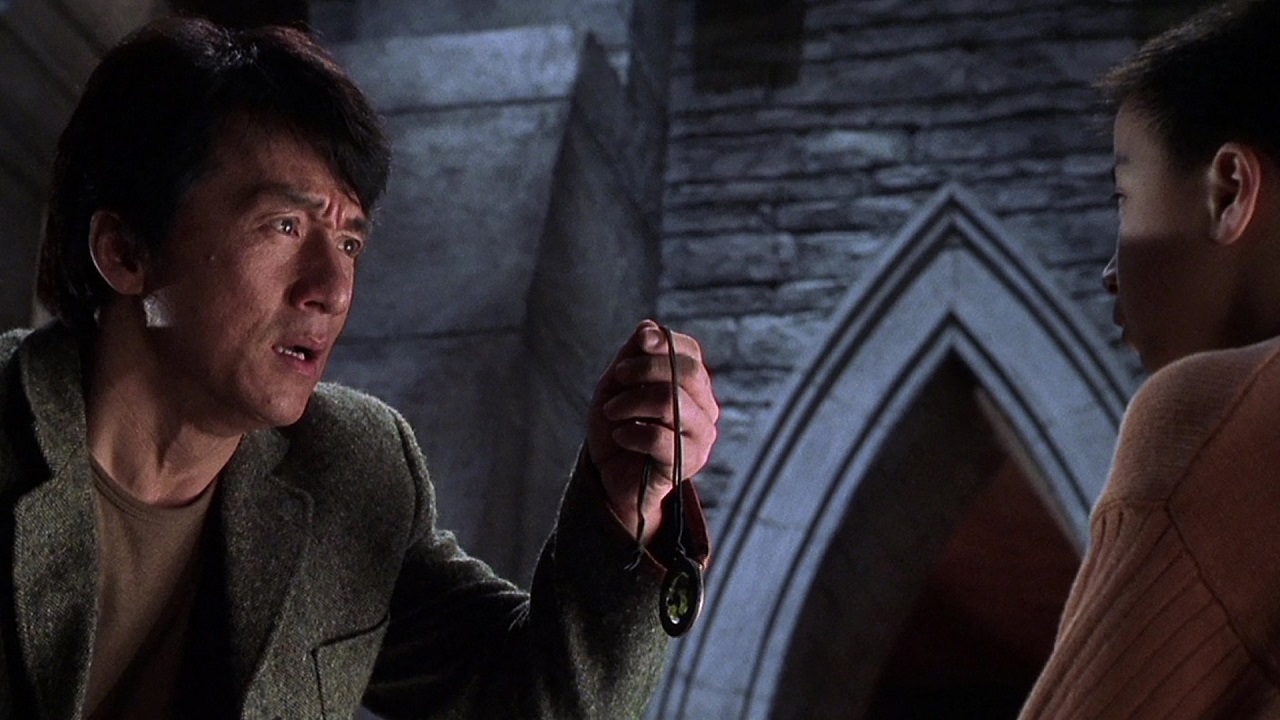
During the early scenes, the plot seems to skip between action scenes without much connection. A glance through the deleted scenes on the dvd extras shows a number of scenes that ended on the cutting room floor, which give the film a good deal more coherence in terms of explaining the background to the prickly relationship between Jackie Chan and Lee Evans, exactly what the Chosen One and medallion are, and especially regarding the people smuggling plot that Chan and Evans are meant to be pursuing at the start. These omitted scenes at least let us know what the action during the early scenes is meant to be about. The effect of their removal, however, is of a film that has had too much meat stripped from its bones and hangs hollowly together between the audience pleasing comedy and action, but makes little sense on a wider level beyond that.
Gordon and Jackie don’t entirely disappoint though – there are some adeptly choreographed acrobatic chases through the streets and dockyards of Dublin. However, the film starts to flag considerably during the latter half when we get Jackie Chan superhero. One has been able to enjoy most of the film’s martial arts sequences up to that point but the scenes with Jackie jumping around, accidentally tearing things off and the like are not particularly funny and, worse, are routine superheroics. There is little to the comedy side of the film. The character of Watson, played by British stand-up comic Lee Evans, is an obvious comic foil. Some of the scenes with he and Jackie talking about “being on top” and “doing it by yourself” being interpreted as gay banter by Evans’ colleagues fall excruciatingly flat. Claire Forlani shines with a natural and classy elegance but The Medallion‘s failure is that it fails to find anything to do with her.
The other surprise about The Medallion is how much the story reworks the Eddie Murphy vehicle The Golden Child (1986). In both films, there is the plot of the chosen child who has godlike abilities; the hero who is innocently caught up in the midst of the action; while Julian Sands has been cast in the equivalent of Charles Dance’s quasi-supernatural evildoer. The Golden Child was one of Hollywood’s first attempts to copy Hong Kong’s Wu Xia cycle but ended up a miserable failure that was caught between being an Eddie Murphy comedy and a Hong Kong-styled fantasy being made by a director who failed to understand the slightest thing about the genre. The Medallion at least does the job of returning The Golden Child to its basics and giving it the much more authentic flavour of a Hong Kong film.