
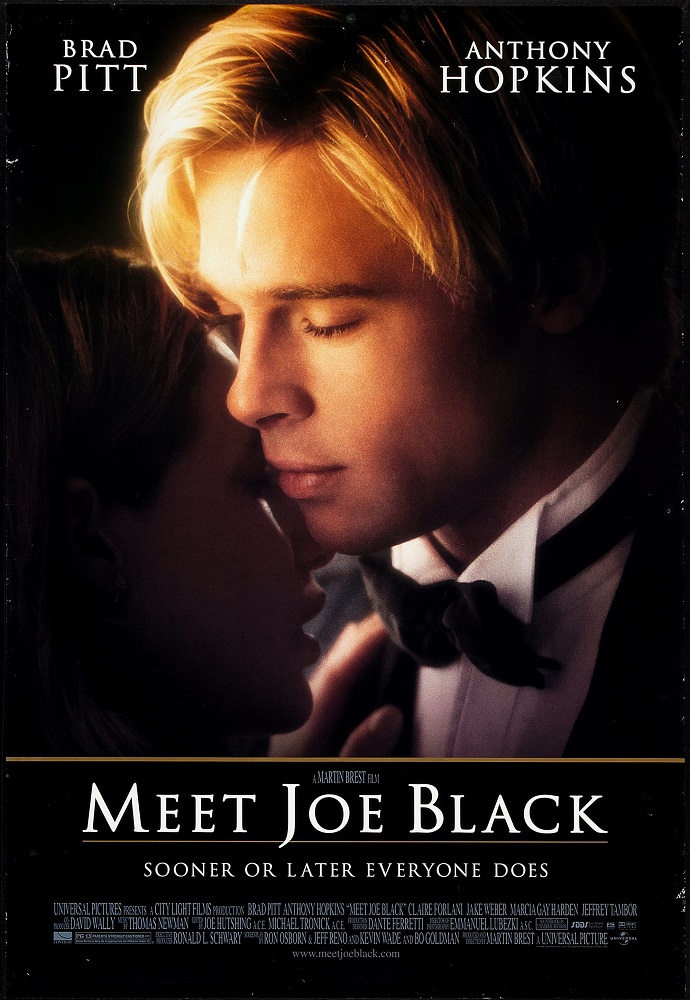
USA. 1998.
Crew
Director/Producer – Martin Brest, Screenplay – Bo Goldman, Ron Osborn, Jeff Reno & Kevin Wade, Based on the 1934 film Death Takes a Holiday Written by Maxwell Anderson & Gladys Lehman, (Based on the Play by Alberto Casella), Photography – Emmanuel Lubezki, Music – Thomas Newman, Visual Effects – Industrial Light and Magic (Supervisor – Michael Owens), Production Design – Dante Feretti. Production Company – City Lights Films/Universal.
Cast
Brad Pitt (Joe Black), Anthony Hopkins (William Parrish), Claire Forlani (Susan Parrish), Jake Weber (Drew), Jeffrey Tambor (Quincey), Marcia Gay Harden (Alison), Lois Kelly-Miller (Jamaican Woman)
Plot
Death appears to billionaire William Parrish as his 65th birthday nears, telling him his time has come but offering to postpone taking him if Parrish will teach him about life. Death takes the body of a handsome youth who is run down in the street to inhabit for the length of his stay, unaware that this is the body of a man who was flirting with Parrish’s daughter Susan that morning. Parrish introduces the stranger as Joe Black, a ‘business colleague’. Joe’s presence and apparent hold over Parrish presents Susan’s ambitious fiancee Drew with the opportunity to try and unseat Parrish as CEO. At the same time, despite Parrish’s wishes, Joe and Susan begin to fall in love.
Meet Joe Black is a loose remake of the classic Death Takes a Holiday (1934). Now it has been retooled as a lavish three-hour A-budget romantic epic starring the late-1990s sex symbol Brad Pitt. Where Death Takes a Holiday reigned in at a slim 79 minutes, Meet Joe Black arrives at a lengthy 178 minutes.
You might think that the extra hundred minutes – usually the running length of an entire feature film – would allow the remake the opportunity to expand upon the original but contrarily it dumps a good deal of the original story – there are none of the montage scenes of what happens around the world as Death literally ‘takes a holiday’ and all death is suspended for the duration.
One might also think that the extra length may have permitted the film time to reach some more profound conclusions about life. A film dealing with such a weighty subject as Death coming to Earth to learn the meaning of life would usually be expected to end on some philosophical or sentimental insight into the value of life. Contrarily, one comes away from Meet Joe Black, having sat through nearly three hours of a film, wondering what it had to say for itself in that time – Brad Pitt gets to discover the joys of eating peanut butter, makes love with Claire Forlani (in a romance that hardly sets the world on fire) and … that is about it.
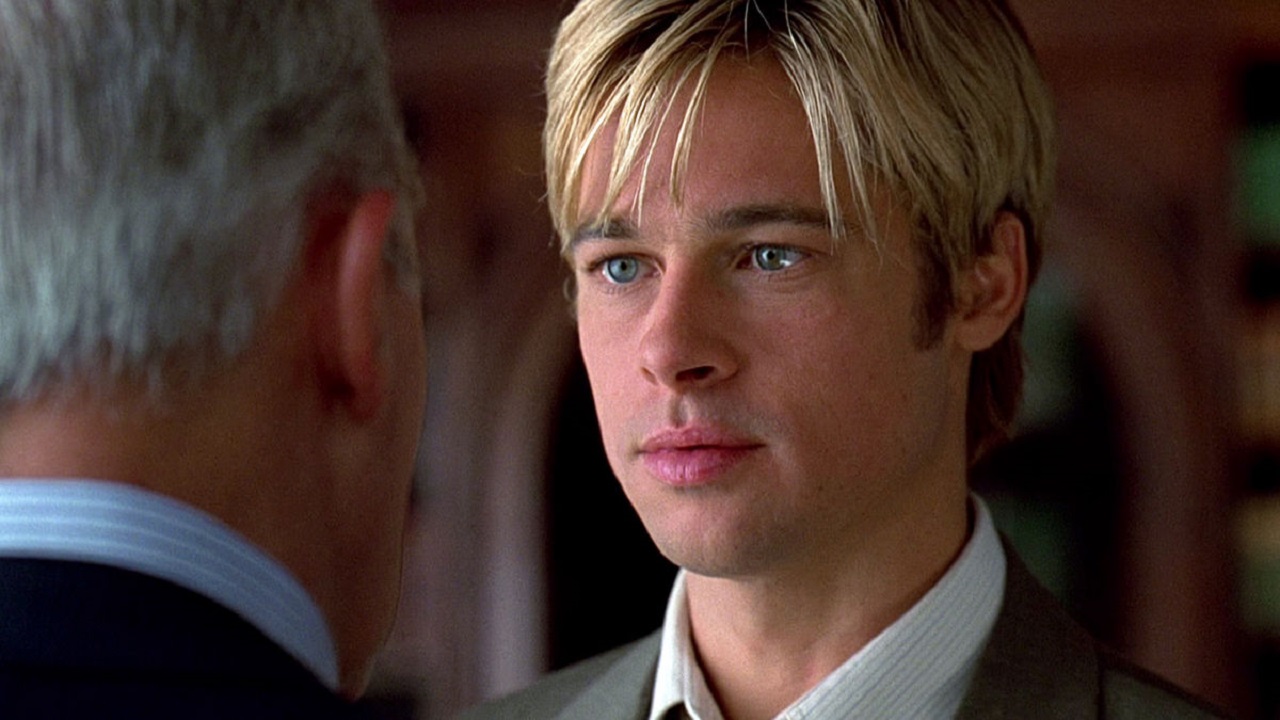
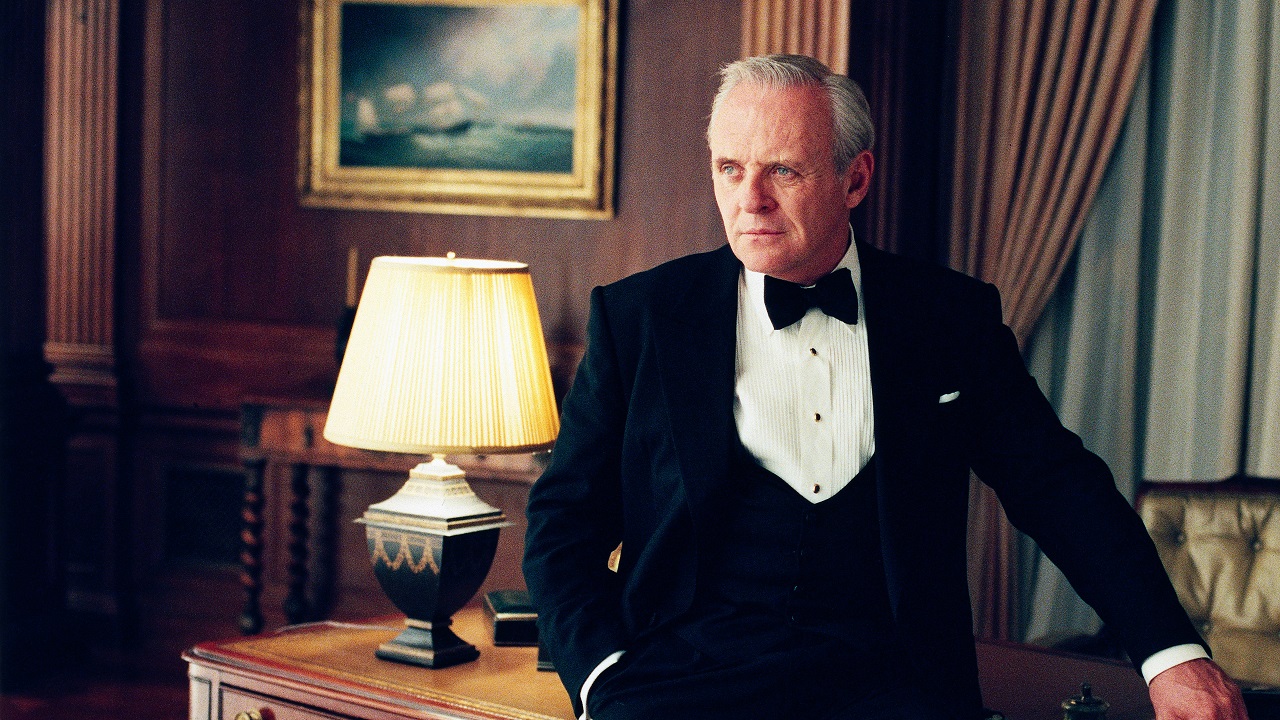
In the end, Meet Joe Black reads like an Ivy League Old Boy wish fulfilment fantasy. The only character who seems to learn anything about life throughout the course of the film is Anthony Hopkins’s billionaire. However, the conclusions he reaches about life are not ones that one feels particularly comfortable with. Hopkins seems to accept a life that is singularly lacking in passion and love, and the film seems to say it is more important to die with dignity and the respect of your business community and surrounded by one’s family (who never seem a particularly close group) than any joie de vivre.
Indeed, the film seems more concerned with Anthony Hopkins retaining control of the business he built with his own hands than it is with he dying with any emotion and feeling in his life. (In any other film of this type, this would be a character that would be regarded as in need of redemption and the rediscovery of the joy of living). In lieu of any feeling, the film substitutes a muted decorum – Anthony Hopkins’s death scene simply takes place with he and Brad Pitt walking off together over a bridge. We never see Hopkins dying – or for that matter even learn how he does so (presumably a heart-attack, as he felt chest pains earlier). Certainly, if one were to look back on their own life, one would like to think it had been a life filled with more passion than Anthony Hopkins’s life here seems to have in it.
One of the most irritating and contrived plot devices is one that has Brad Pitt impersonating an IRS agent to expose Jake Weber’s double-dealings to an eavesdropping executive board. One understands that this is there to wrap up the subplot the film has created about Weber’s double-dealings but the character change the contrivation requires on Brad Pitt’s part is almost impossible to swallow. Most of the film establishes Death as a complete innocent in human ways – not even knowing, for instance, how to use a knife and fork. It seems preposterous that such an innocent can suddenly develop the sophistication to convincingly pull off such a bluff.
Equally preposterous is Brad Pitt’s line calling Jake Weber the most machiavellian person he has ever encountered and threatening Weber with eternal punishment. It seems outrageous to suggest that a Death who has surely claimed the souls of the greatest mass murderers in history can regard an avaricious soul who has conducted an unscrupulous and dishonest (but certainly not illegal) boardroom coup as worthy of eternal damnation. Death, it seems, is someone who makes friends. It makes Meet Joe Black seem even more of an Ivy League Old Boy fantasy – it is surely indicative of the conservative set of values that the film advocates that someone who commits a moderately disreputable scheme to unseat a decent, honest man from his own company is more evil than the greatest sadists and mass murderers in history.
During the 1990s, Brad Pitt seemed to unevenly vie between strong screen performances – Kalifornia (1993), Se7en (1995), Fight Club (1999) – and ones that show him up as no more than a pretty pinup boy – Interview with the Vampire: The Vampire Chronicles (1994), Legends of the Fall (1994), The Mexican (2001). You cannot deny he is an actor that is trying to challenge himself by taking on ambitious roles, nor say that he is not an actor without talent. Unfortunately, here he gives what is surely one of his silliest performances, playing Death sort of as if Star Trek: The Next Generation (1987-94)’s Data the android were trying to play a bleach-blonde surfer.
There is an initially cute silliness to Pitt’s performance but at three hours all the zombified gloopy innocent poses eventually become too much. There is never anything to Pitt’s performance that suggests the majesty that one might associate with a figure like Death. Anthony Hopkins plays with composure and dignity, although seems to be sleepwalking through the role for the greater part. Claire Forlani, in her major breakthrough role, is beautiful – but it is a shy, demure beauty who seems too reticent to ever project anything.
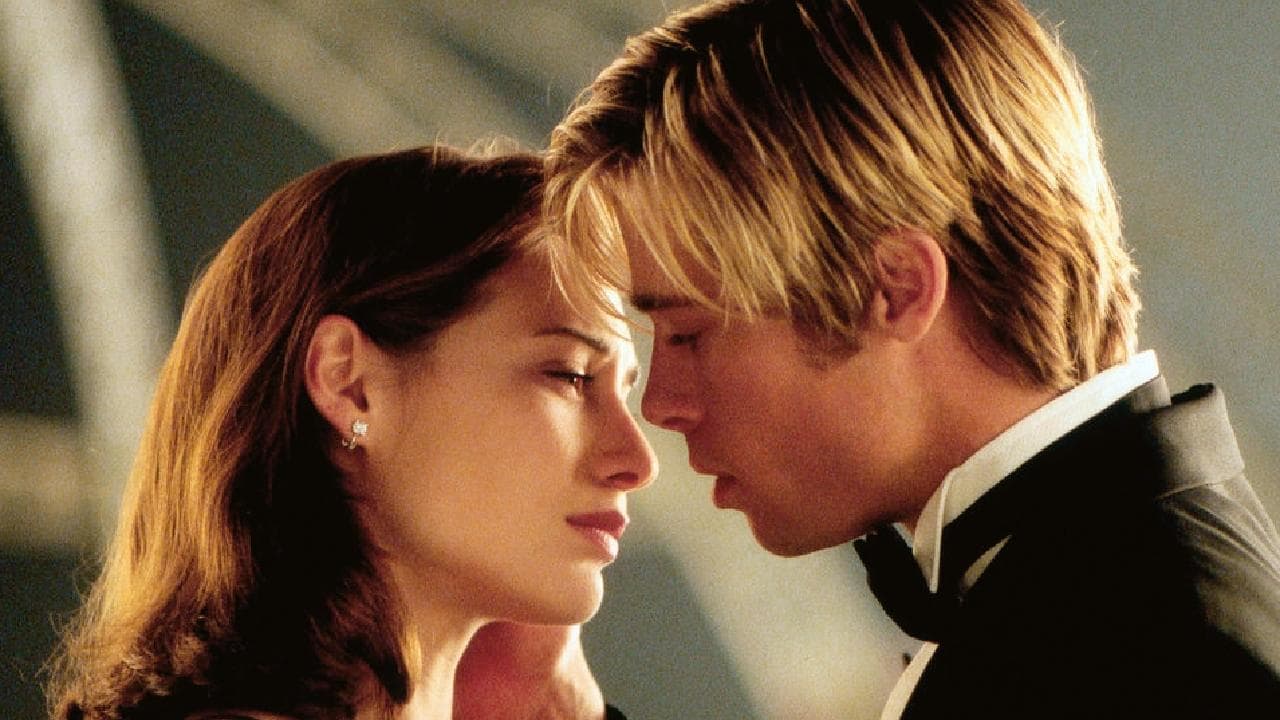
Director Martin Brest has made several quite reasonable films – Beverly Hills Cop (1984), Midnight Run (1988) and Scent of a Woman (1992). Of Gigli (2003), which seemed to kill his career, we will say nothing. Here Brest disappointingly chooses to downplay the film’s fantasy elements. We never see Death’s true personage and the scenes in the original where people do not die due to Death having taken a holiday have been dropped completely. The device used with Death appearing to Anthony Hopkins and echoing his own words back to him seems silly.
You cannot help feeling that a film like this would have worked better if Martin Brest had not kept Death off-screen and concentrated on the romance and had opened up with more confidence in the fantasy side of the film. It would have given Meet Joe Black greater stature and made it seem less trivial. The same year’s similarly themed City of Angels (1998), which in a like manner had an afterlife guardian come to Earth and falling in love and was equally unsatisfying, at least had far more confidence in its fantasy.
Meet Joe Black was one of a spate of films in 1998 centred around afterlife themes. Aside from the aforementioned City of Angels, others included the excellent What Dreams May Come (1998) and the delightful Japanese entry After Life (1998).
Trailer here