

USA. 1948.
Crew
Director – Irving Pichel, Screenplay – Ben Hecht & Quentin Reynolds, Based on the Novel by Russell Janney, Producers – Jesse L. Lasky & Walter MacEwen, Photography (b&w) – Robert de Grasse, Music – Leigh Harline, Special Effects – Russell A. Cully & Clifford Stine, Makeup – Gordon Bau, Art Direction – Ralph Berger & Albert S. D’Agostino. Production Company – Jesse L. Lasky Productions.
Cast
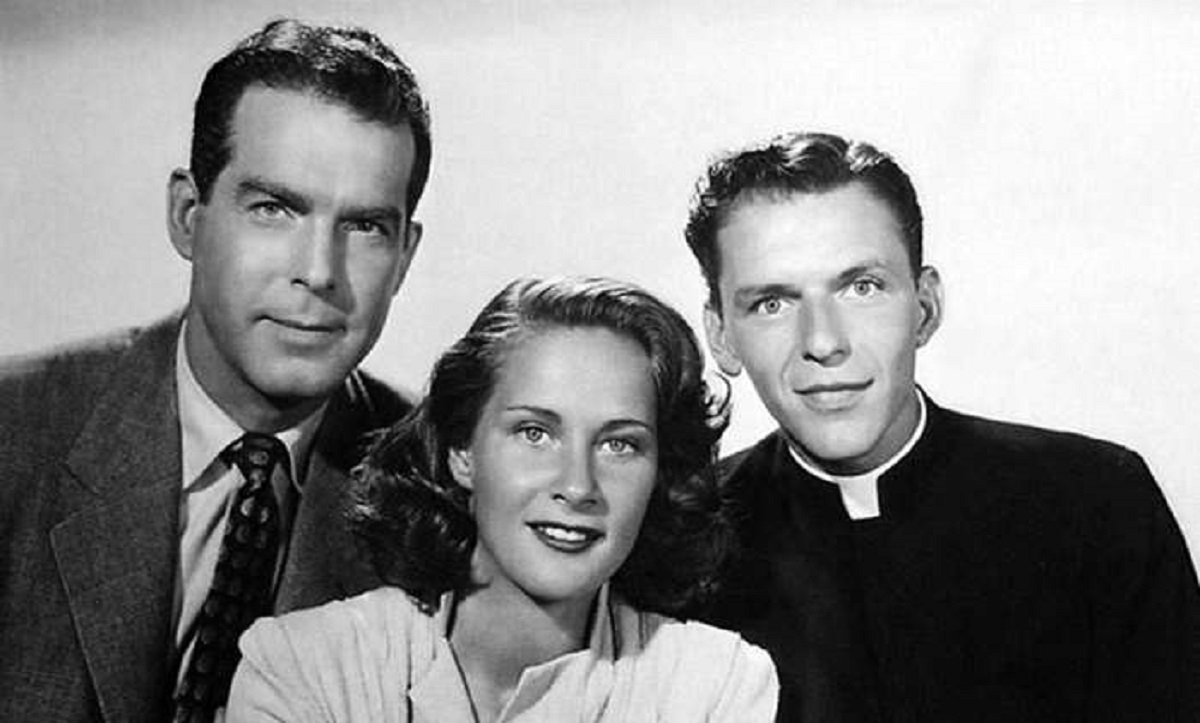
Fred MacMurray (Bill Dunnigan), [Alida] Valli (Olga Truskovna), Frank Sinatra (Father Paul), Lee J. Cobb (Marcus Harris), Harold Vermityea (Nick Orloff), Charles Meredith (Father Spinsky), Philip Ahn (Ming Gow)
Plot
Hollywood press agent Bill Dunnigan accompanies the body of starlet Olga Truskovna back to her hometown of Coal Town, Pennsylvania, for her funeral. Dunnigan tells the local priest the story of how he met Olga as a down-on-her-luck starlet. He managed to get her the starring role in a production of ‘Joan of Arc’ after the previous lead actress quit. However, Olga died of tuberculosis after shooting her final scene. With her death, it is now looks unlikely that the film will ever be released. Dunnigan decides to force the studio to release the film by throwing everything he has into a publicity stunt and hiring all the churches in town to ring their bells for three days in Olga’s honour. This feat starts to have a miraculous effect on the town.
The Miracle of the Bells came out at the tail end of the 1940s Wartime light fantasy films – Here Comes Mr Jordan (1941), A Guy Named Joe (1943), It’s a Wonderful Life (1946) et al. The Miracle of the Bells is not a film that can readily be classified among these other films, rather it came at a period when the light fantasy genre had moved more towards real world fantasies, dealing less with the wholly fantastic – ventures into the afterlife, visitations of angels etc – than of the intrusion of the miraculous into the real world.
There was a spate of these ‘miracle” titled films over the next few years – Miracle on 34th Street (1947), Miracle in Milan (1951), The Miracle of Our Lady of Fatima (1952), The Miracle of Marcelino (1955), Miracle in the Rain (1956) and The Miracle (1959), most of which concern themselves with the appearance of the miraculous amid the everyday. Many of these films, including The Miracle of the Bells, are specifically rooted inside Catholic faith. (For a more detailed overview see Films About Miracles and Catholicism in Fantastic Cinema).
One cannot decide whether The Miracle of the Bells is either the most pretentious religious film or the most pious piece of self-aggrandising crap that Hollywood has ever made. It is difficult to believe that a production crew could get together to take wallowing idiocy like this seriously. The whole point of the film seems to be to elevate a wannabe Hollywood starlet from Nowheresville, USA to near-sainthood for the sole reason that she dreamed of a glamorous life. This comes amid pompous allusions to Joan of Arc – in a metaphor of comical inflation, Valli’s mundane death by tuberculosis is seen as akin to Joan’s burning at the stake.
The sanctimony of it all stinks, pure and simple – according to the film, Hollywood stars are supposed to be glamorous so that their pride and beauty can inspire everybody out there who is depressed by the drudgery of life. Replace Alida Valli’s starlet here with some swollen-headed red carpet diva of today – say Lindsay Lohan or Paris Hilton – and then try and think of them worthy of Catholic sainthood because they are more glamorous and beautiful than anybody else and you can see just how ghastly the film’s message is. The final religious message – how it doesn’t matter if a miracle is fake or not, it is getting the people into church to believe that matters – has all the moral integrity of a used car salesman selling a car that has no engine as being in perfect running condition.
Fred MacMurray emerges out of the material okay as the press agent, while Italian actress Alida Valli (billed only as Valli) shines with an elegant beauty as the dead starlet. It is only Frank Sinatra, clearly uncomfortable in trying to act with a pained earnestness as a priest, who lets the show down.
Irving Pichel’s other credits as director include co-directing the famous human hunting for sport film The Most Dangerous Game (1932), co-directing the H. Rider Haggard adaptation She (1935) about a lost city and an immortal queen, and solo directing the angel fantasy Earthbound (1940), the mermaid comedy Mr Peabody and the Mermaid (1948), George Pal’s The Great Rupert (1950) and the classic sf film Destination Moon (1950).
Screenwriter Ben Hecht was one of the legendary Hollywood writers, having turned out the screenplays for classics like Scarface (1932), Gunga Din (1939), Wuthering Heights (1939), Spellbound (1945), Notorious (1946), Kiss of Death (1947), Ulysses (1954) and another miracle film Miracle in the Rain (1956), not to forget Queen of Outer Space (1958).