

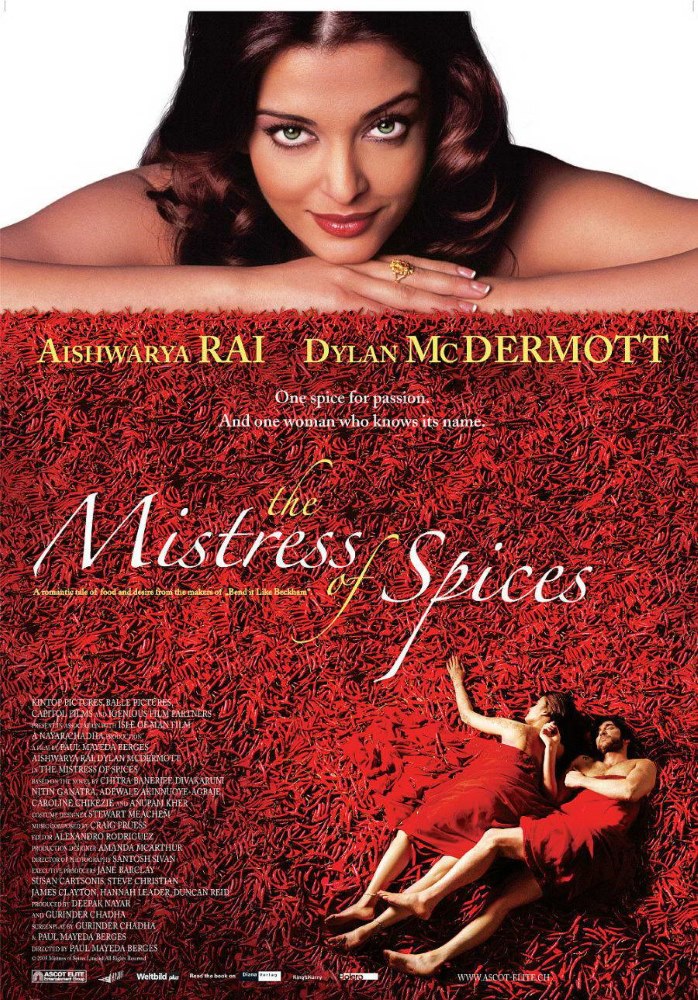
Crew
Director – Paul Mayeda Berges, Screenplay – Paul Mayeda Berges & Gurinder Chadha, Based on the Novel The Mistress of Spices (1997) by Chitra Banerjee Divakaruni, Producers – Gurinder Chadha & Deepak Nayar, Photography – Santosh Sivan, Music – Craig Pruess, Visual Effects – Framestore CFC (Supervisor – Craig Lyn), Production Design – Amanda McArthur. Production Company – Kintop Pictures/Balle Pictures/Ingenious Film Partners/Isle of Man Film/Nayar-Chadha/Mistress of Spice Ltd
Cast
Aishwarya Rai (Tilo), Dylan McDermott (Doug), Nitin Chandra Ganatra (Haroun), Anupam Kher (Geeta’s Grandfather), Ayesha Dharker (Hameeda), Adewale Akinnuoye-Agbaje (Kwesi), Sonny Gill Dulay (Jagjit), Caroline Chikezie (Myisha), Nina Young (Evie, Doug’s Mother), Zohra Segal (First Mother), Padma Lakshmi (Geeta), Toby Marlow (Young Doug), Shaheen Khan (Jagjit’s Mother), Bansree Madhani (Young Tilo)
Plot
After her parents were killed in India by bandits, the orphaned Tilo was adopted by a sisterhood that raised her in the mysteries of Indian spices. Eventually becoming a Mistress of the Spices, she was despatched to open a spice bazaar in San Jose, but was given three warnings by her mentor – that she never allow her own desires to influence the spices, that she never leave the shop and that she never let another touch her. The spices give Tilo an intuitive ability to see her customer’s futures and she is able to suggest ones that will affect their lives. One day, the architect Doug crashes his motorcycle just outside her store and Tilo is able to prescribe the spices that heal his injury. However, Tilo becomes attracted to Doug and ignores the warnings and lets him to touch her. In allowing her own emotions to become wound up in what she prescribes, the spices begin to betray Tilo, causing her customers’ fates to turn out for ill.
The Mistress of Spices comes from husband and wife team of Paul Mayeda Berges and Gurinda Chadha. Gurinder Chadha is a Kenyan-born Indian woman who lives in England, while Berges is Japanese-American. Chadha came to fame as director of Bhaji on the Beach (1993) and then the American-made What’s Cooking? (2000), where Berges made his screenwriting debut. The two gained international attention with Chadha directing and she and Berges co-writing Bend It Like Beckham (2002) and Bride and Prejudice (2004). All of these films draw upon Chadha’s Indian roots (or more to the point expatriate Indian roots). Chadha subsequently went onto direct It’s a Wonderful After Life (2010) from a screenplay by Berges, a comedy concerning a murderous mother who is followed by the ghosts of her victim. Paul Mayeda Berges made his directorial debut with The Mistress of Spices.
The Mistress of Spices falls into the category of Magical Realism and the peculiar sub-topic of magical cooking that has become popular in Magical Realist films such as Babettes Feast (1987), Like Water for Chocolate (1992), Simply Irresistible (1999), Chocolat (2000) and Woman on Top (2000). The Mistress of Spices follows on from these other films in having the heroine offering up food items that have a mysterious influence on the lives and fates of those around her. As with most of these films, the heroine’s own romantic complicities become wound into the story.
Although, where most Magical Realist films, including the abovementioned, tend to circle around romances, The Mistress of Spices seems as much taken up with the struggle between tradition and individuality. In particular, the film concerns itself with various generations of Indians trying to adapt to living as American immigrants where each – Tilo, Geeta’s grandfather, Haroun the taxi driver, the troubled youth Jagjit, even Doug and his American Indian background – is caught between the traditions of their heritage and the struggle to assimilate into the melting pot of America.
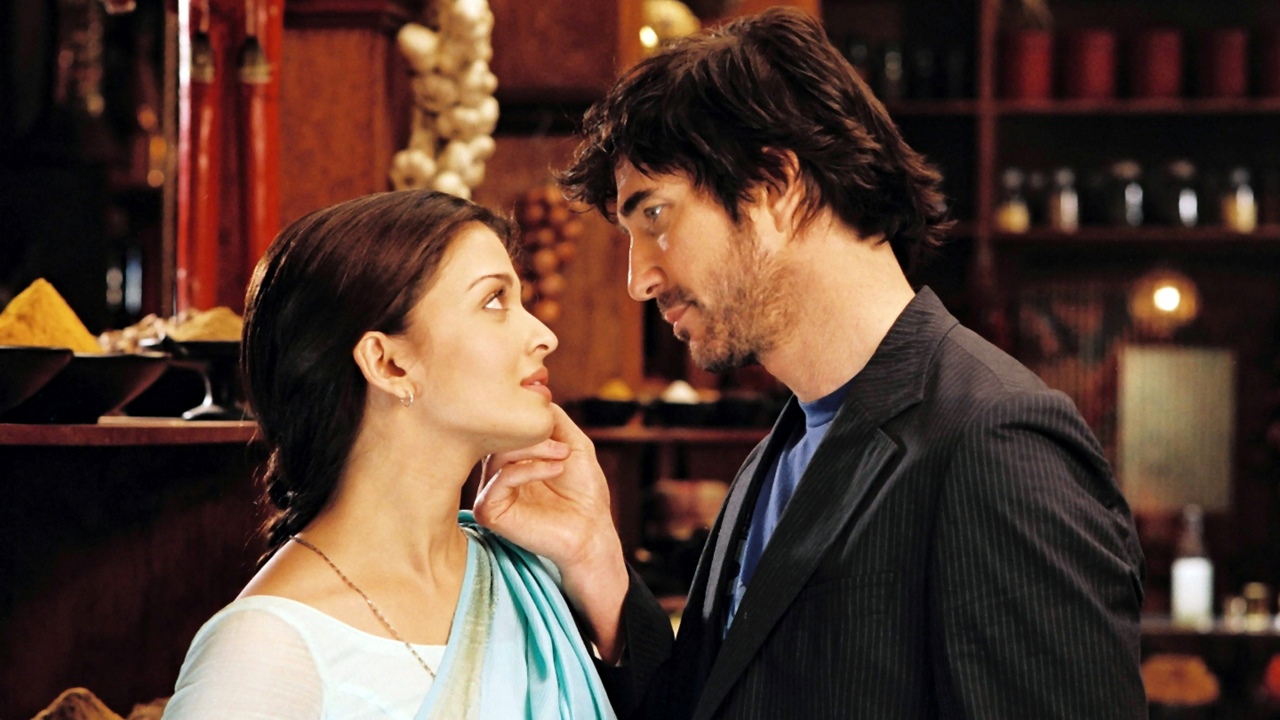
Berges casts Indian actress Aishwarya Rai from Bride and Prejudice as his lead actress. With her piercingly blue eyes, Aishwarya Rai has a stunning beauty. Although the complaint may be that Aishwarya Rai is a shy beauty and that Tilo is too passive a character. Indeed, the major problem with the film is that though she is the centre of the film, Tilo only drifts about reacting to events rather than seeming to partake in them. All we ever know of her comes in voiceover.
Furthermore, in comparison to most other Magical Realist films, Paul Mayeda Berges’s direction is on the quiet and subdued side. A film like The Mistress of Spices should ache with longing and unresolved passion; fate and the fantastical should weave dizzying and completely improbable coincidences, but Berges contrarily makes a film that, though it is clearly fantasy, is resolutely realist and seems ever so cautious about opening up with the giddy froth of Magical Realist cinema.
Perhaps the most annoying aspect of The Mistress of Spices is how Paul Mayeda Berges and Gurinda Chadha set up various aspects of the story and then walk away from an adequate dramatic resolution. Tilo is given three conditions – not to let her own desires become involved with the spices, to never leave the shop and to never let another touch her. All of these conditions are broken throughout – as you know they are going to be. The problem is the weak resolution where Tilo is punished by the spices (as should dramatically follow), only for Berges and Chadha to fade out as she starts up a new shop and continues on her romance with Dylan McDermott as though nothing had happened. A Magical Realist film like this – Like Water for Chocolate being a perfect example of how it should work – needs to leave its heroine torn between the love she most fervently wants and the cruelty that fate has decided for her or else have her have to earn her compromise, not just have fate bend over and meekly allow her to have what she wants because the writers have decided that she should.
The resolution also leaves many aspects of the story unresolved. There is the character of Geeta and her grandfather who Tilo is giving spices to in order to make Geeta give up the Latino man she loves and accept a traditional Indian marriage. This – giving a man spices that will allow him to enforce his traditional ways on another person – seem a cruel fate to wish on someone and one that is surprising given that the film has the heroine trying to buck what fate has decided for her. However, after the spices rebel against Tilo, we never even find out what Geeta’s eventual fate is.