
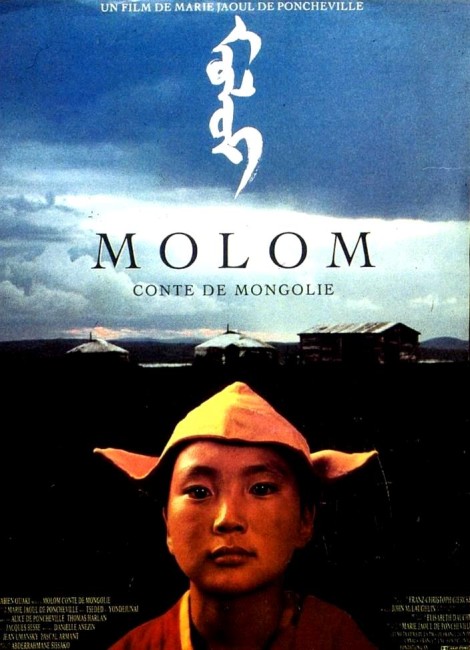
(Molom, Conte de Mongolie)
Crew
Director/Screenplay/Producer – Marie Jaoul de Poncheville, Photography – Jacques Besse, Music – John McLaughlin, Art Direction – Abderrahmane Sissako. Production Company – Lung Ta/France 2 Cinema/Les Films de la Pagode/Compagnie des Films.
Cast
Tsededordj (Molom), Yobdejunai (Yonden)
Plot
Molom, a god come to Earth in the form of an old man, finds Yonden, a young boy abandoned by a drunken father and raised by wolves, and takes him with him on a journey across the Mongolian steppes. The journey toward civilisation becomes one of understanding as Yonden starts to learn the Buddhist ways and discover the ‘most valuable pearl’ within himself.
Molom, A Legend of Mongolia is an interesting film to sit down to. One rapidly realises the film that you are seeing is very different from the one the advance publicity and press synopsis has described. The press machine presents it as though it were a creation myth/native legend about a god come to Earth to teach a young boy life lessons, whereas in fact the film on screen seems almost constructed to deliberately defy such a synopsis. On one hand, the film offers a narrated version of events as though they were said literalisations of legend but the events being described on screen are contrarily depicted in a mundane, non-fantastique way. Indeed, what the narration offers us is a much more ambiguous – and from the evidence presented, more favoured – option that the mythic interpretation of events is only something that exists in the mind of the young boy who is comprehending experiences through his naive worldview. More so than any creation myth, the film is more a story about a Buddhist spiritual journey.
That said, a literalistic interpretation of mythic events might have made for a more interesting film than the one on display. In taking the mundane route, Molom, A Legend of Mongolia disappointingly falls into a certain category of arts film that seems to assume that filming the most routine day-to-day events in the life of other cultures without concern for drama or plot makes for significant cinema. And sadly most of the film doesn’t.
It is only near the end that Molom momentarily rises out of mundanity. There is one conceptually dazzling burst of imagery that spectacularly contrasts the opposition between the mythic interpretation and mundane events the film has set up – young Yonden, having foolishly killed a bird, walks away in remorse, haunted by Molom’s words that its spirit will follow him for the rest of his life and then we see its shadow fall over him – only we recognise the shadow as that of a hovering helicopter. Up until that point, the contemporary world has only hovered at the very periphery – a pocket telescope, a home-made rifle – and the film could otherwise be set in any period. Its’ shock arrival in this manner (not to mention its startling contrast of the mythic worldview and the mundane reality) has an effect not unakin to a classic science-fiction Conceptual Breakthrough story. It also presages an abrupt shift from native to modern culture and the rest of the film chronicles the steady encroachment of civilisation – depicted by the desolate and dreary surrounds of Ulan Bator – and the seeming loss of the mythic worldview that living in modern society entails.
Marie Jaoul de Poncheville is an occasional actress. She has made two other works as director, both set around Central Asia, with the documentary Lung Ta: Forbidden Tibet (1990) and Tengri (2008) set among the nomads of Kyrgyzstan.