
Crew
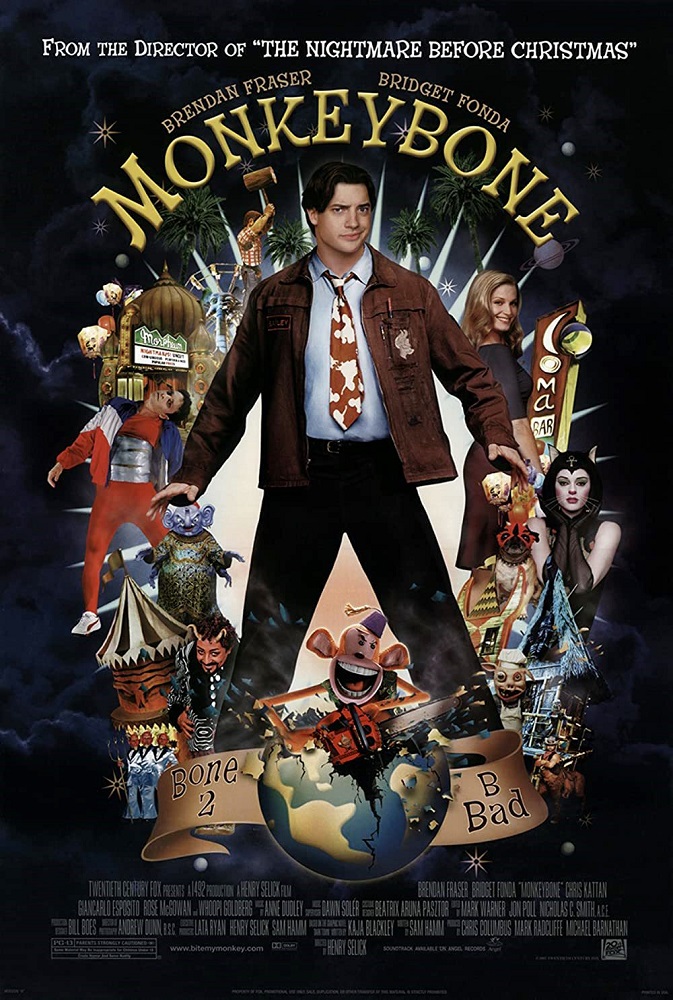
Director – Henry Selick, Screenplay – Sam Hamm, Based on the Graphic Novel Dark Town by Kaja Blackley, Producers – Michael Barnathan & Mark Radcliffe, Photography – Andrew Dunn, Music – Anne Dudley, Music Supervisor – Dawn Soler, Visual Effects Supervisors – Peter Crosman & Pete Kozachik, Visual Effects – Centropolis Entertainment, Digiscope, Giant Killer Robots Inc, Howard Grant Films, Look! Effects Inc, Menace FX, M5 Industries & R!ot, Stop Motion Animation Supervisor – Kat Alioshin, Special Effects Supervisors – Paul Lombard & Charles Stewart, Creature Design Supervisor – Ron Davis, Creature Effects – Keith Vanderlaan’s Captive Audience Productions & Steve Johnson’s XFX Inc, Animation Supervisor – Paul Berry, Puppet Animation – DeCarlo Studios, Makeup Effects Consultant – Greg Cannom, Production Design – Bill Boes. Production Company – 20th Century Fox/1492 Productions.
Cast
Brendan Fraser (Stu Miley), John Turturro (Voice of Monkeybone), Bridget Fonda (Julie McElroy), Chris Kattan (Organ Donor Stu), Whoopi Goldberg (Death), Giancarlo Esposito (Hypnos), Rose McGowan (Kitty), Dave Foley (Herb), Megan Mullaly (Kimmy Miley)
Plot
Cartoonist Stu Miley is about to break through into the big time with his animated tv series ‘Monkeybone’ about a mischievous monkey, but is rejecting all offers to commercialise his creation. He leaves his launch party, intending to go home and propose to his girlfriend Julie McElroy, only to have a car accident and fall into a coma. He wakes up to find himself in the afterlife in a bizarre train station of the subconscious where he meets Monkeybone come to life. He learns from Hypnos, the god of sleep, that the only way out is to travel into the Land of Death and steal an Exit pass. He and Monkeybone succeed in doing so but then Monkeybone takes the pass and exits to inhabit Stu’s body, leaving Stu behind. Hypnos reveals that this is all a plot to harvest more nightmares. In Stu’s body, Monkeybone goes crazy, commercialising the series, while hatching an evil plot to distribute a nightmare gas created by Julie in the Monkeybone toys.
Monkeybone was the third film from director Henry Selick. Selick made an extraordinary debut with The Nightmare Before Christmas (1993), which, although this was not a huge success at the time, found a cult audience. Selick returned with James and the Giant Peach (1996) but, while excellent, it was even less of a hit. Henry Selick has become the sole torch carrier of the almost lost art of stop-motion animation.
Even though Selick has talent to spare, stop-motion animation is not cheap to produce and Selick spent about five years trying to find the finance for Monkeybone. Alas, Monkeybone was a colossal box-office flop and was mercilessly savaged when it premiered. Selick took several years to mount a comeback with the somewhat better received Coraline (2009), which was also not a box-office success.
With Monkeybone, Henry Selick loosely adapts a graphic novel by Kaja Blackley. The film comes across as a conceptual mixture of Cool World (1992) – animator Ralph Bakshi’s mix of cartoon and live-action wherein a cartoonist entered a world of his own creation and then was left trying to stop one of his creations loose in the real world – and Selick’s mentor Tim Burton’s Beetlejuice (1988), which was set in a rickety akilter afterlife.
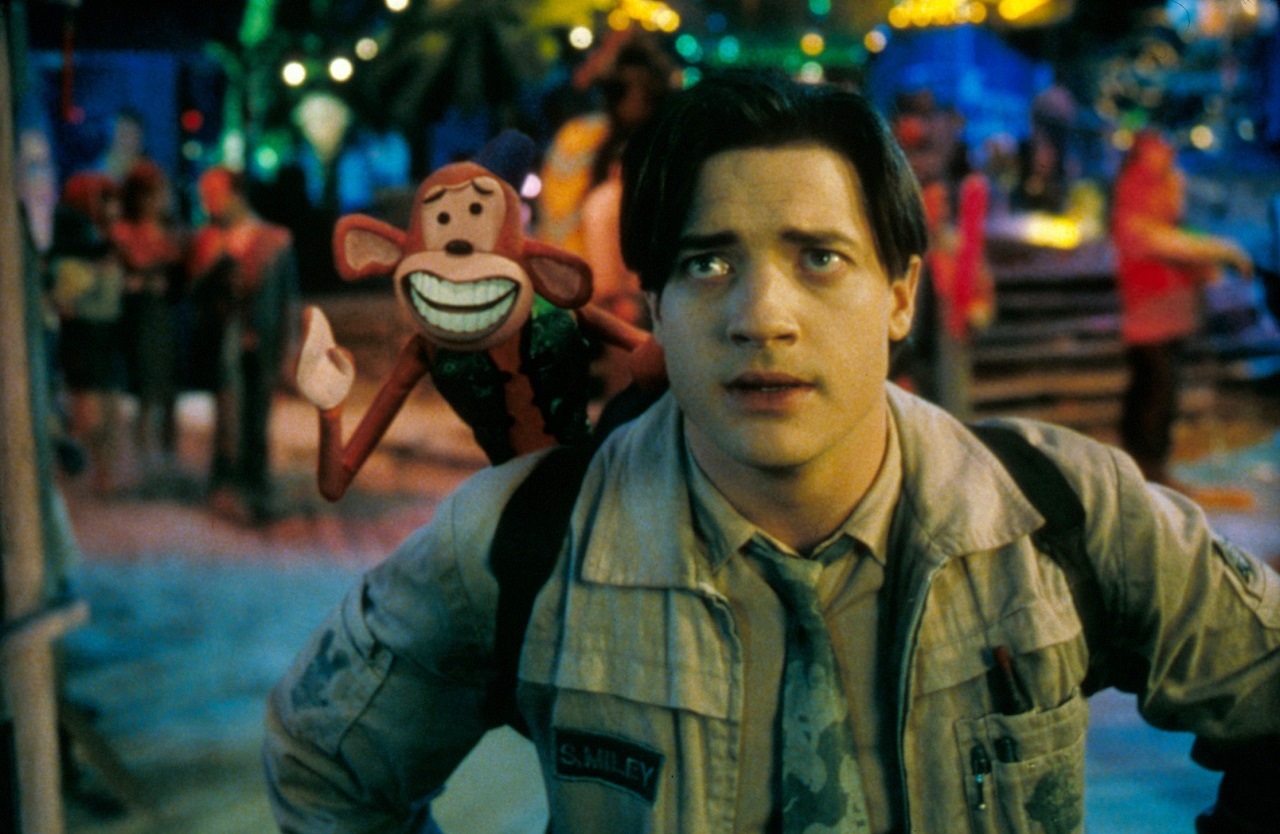
As might be expected of a Henry Selick film, Monkeybone comes filled with a menagerie of eccentric creations – piano-playing blue elephants, wasp women, mice jailers, talking bulls. This is a film that needs to be viewed a second time just to drink in the bizarreness of the creations in the background or the eccentricity of the production design. Typical of the weird nature of Selick’s imagery is a nightmare from the point-of-view of a dog wherein we see him tied up and about to be castrated by cats dressed as redneck farmers; or of a nightmare in which Dave Foley is pursued by ambulatory toilets.
Of all of Henry Selick’s films so far, Monkeybone has the greatest ratio of live-action to stop-motion animation – about half and half. However, Selick seems less at home in the live scenes, which tend to degenerate into a slapstick freneticism. Brendan Fraser does another variation on his goofy, eye-rolling, eyebrow-waggling routine, which is starting to become tiring by now. The one who comes out of this the best is Chris Kattan who has and is a good deal of fun as the organ donor with the broken neck.
However, it becomes hard to swallow the film’s big message that commercial sellout is bad when the film can cut from a scene that rails against such to a blatant product placement for Haagen-Daas ice cream. While the slapstick is overdone, Selick has a sufficiently dark, offbeat, even occasionally bawdy, sense of humour to make Monkeybone enjoyable, if on the whole it seems the slightest of his films so far.
(Nominee for Best Production Design at this site’s Best of 2001 Awards).