
aka The Horse’s Mouth
Crew
Director – Pennington Richards, Screenplay – Patrick Campbell, Based on the Story by Robert Barr, Additional Dialogue – Anthony Steven, Producer – Colin Lesslie, Photography (b&w) – Wolfgang Suschitsky, Music – Temple Abady, Music Conductor – Marcus Dods, Art Direction – Michael Stringer. Production Company – Group 3
Cast
Michael Medwin (Timothy Blake), Robert Beatty (Robert Jefferson), Joseph Tomelty (Terry Roche), Virginia McKenna (Sheila Roche), Gillian Lind (Jane Boyd), Mervyn Johns (Tom Mitchum), Ursula Howells (Peggy), Arthur Macrae (Alan Digby), Maire O’Neill (Mrs Lenham)
Plot
Timothy Blake, the obituaries and births editor for The Daily Post, is in disgrace with his overbearing editor Robert Jefferson because of a mix-up. He takes a bird watching holiday on a remote island, where he is welcomed by the local postmaster Terry Roche and his attractive daughter Sheila. He then makes the discovery that Roche has a well in an abandoned shed on his property that contains a Greek oracle. Roche has allowed the oracle tenancy in the well in return for it daily answering one question and giving him information about the weather or the whereabouts of locals’ lost property. Blake excitedly sets upon this discovery, exploiting the oracle to gets tips about the national weather and winners at the horse races, which allows him to regain his standing with Jefferson. However, the predictions begin to have unexpected side effects across the nation.
The Oracle is the sort of banal light comedy that was all in vogue in post-War Britain. It was one of the films that were referred to as ‘quota quickies’ – works that were made cheaply between 1930s and 1950s, usually shot in black-and-white to fulfill a government mandate that fifteen percent of films screened in theatres be British made.
The first half of The Oracle has a low-key, rather routine amiability. Nothing much happens – there is some light comedy centered around the locals on the island and the discovery of the oracle. The plot then makes several odd changes of direction and in its second half becomes not unlike the then recent British comedy classic The Man in the White Suit (1951) in charting the social devastation that a fantastical discovery would wreak on society. The basic thesis herein is that the ability to predict the future would take the fun out of life and make everything monotonous.
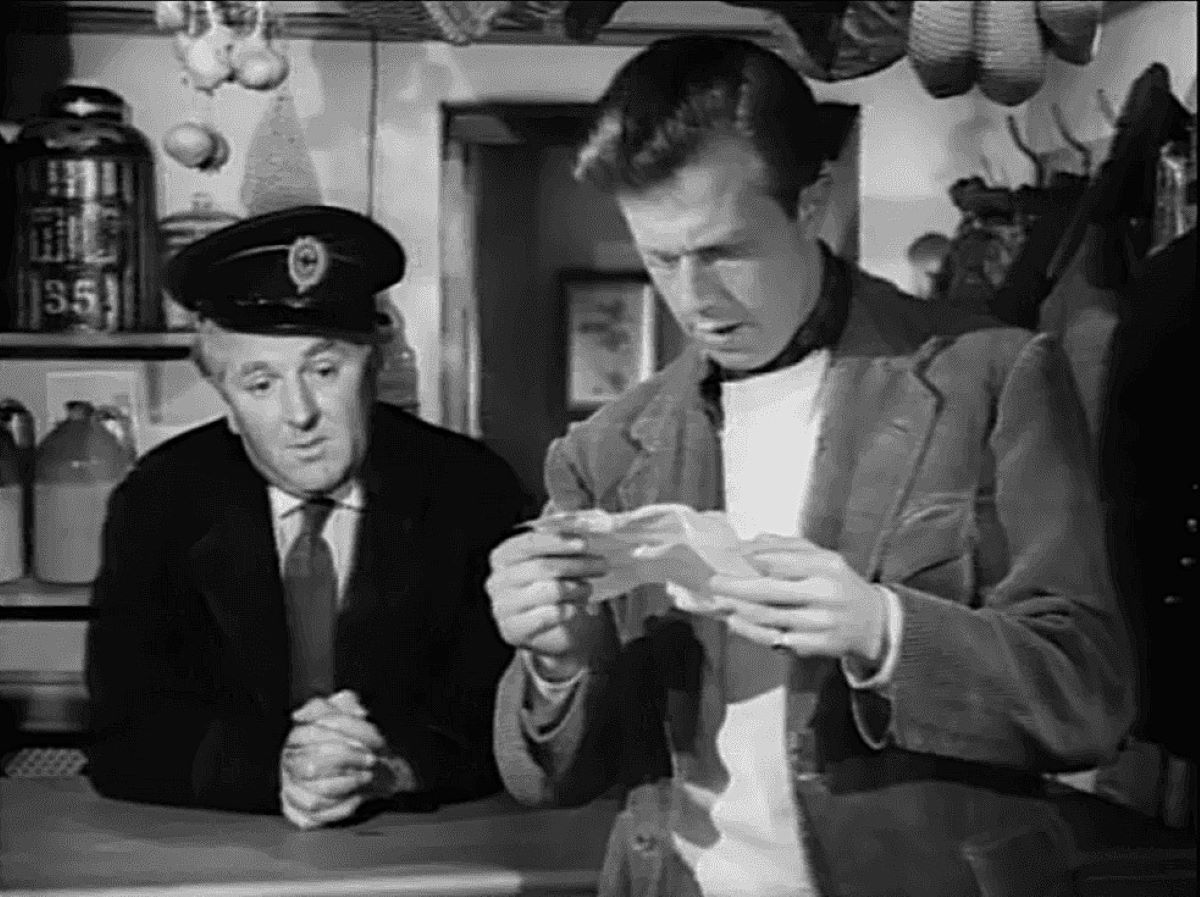
In its later third, the film turns into a variant on Rene Clair’s It Happened Tomorrow (1944) about a newspaper predicting future headlines. The amusement here (to modern audiences) is that when allowed to ask only one question of the oracle, just how much the one question that is finally asked is indicative of the time the film was made – that the most pressing question that people can think to ask is “Will there be another war?”
Surprisingly, the last quarter-hour of the film turns serious and generates a certain dramatic urgency with the prediction of a plane crash and Robert Beatty’s editor thinking that his wife is going to be on it. The film ends with The Oracle nattering away and commenting on the credits as they roll.