

UK/Russia/France/Italy/Netherlands. 1992.
Crew
Director/Screenplay – Sally Potter, Based on the Novel by Virginia Woolf, Producer – Christopher Sheppard, Photography – Alexei Rodinov, Music – Sally Potter, David Bedford, Fred Frith & David Motion, Music Supervisor – Bob Last, Special Effects – Yury Borovkov, Paul Corbould & Viktor Okovitey, Production Design – Jan Roelfs & Ben Van Os. Production Company – Adventure Pictures (Orlando) Ltd/Lenfilm/Rio/Mikado Film/Sigma Filmproductions/British Screen.
Cast
Tilda Swinton (Orlando), Billy Zane (Shelmerdine), Charlotte Valandrey (Alexandra ‘Sasha’ Menchegora), Lothaire Bluteau (The Khan), John Wood (Archduke Harry), Heathcote Williams (Nick Greene/Publisher), Quentin Crisp (Queen Elizabeth I)
Plot
In 1600, the youthful Orlando is presented to the court of Elizabeth I where he rapidly becomes Elizabeth’s favourite. Before she dies, Elizabeth orders him to never grow old. Through the ages, Orlando experiences love, loss and adventure, always going to sleep and waking up in another age. In 1750, Orlando changes gender and becomes a woman. This causes consternation to the society of the time where efforts are made to seize her property. Eventually in the 20th Century, Orlando writes her autobiography and concludes that she has found a time when she is welcome.
Orlando was the film that announced British director Sally Potter to the world. Her second film, it proved a reasonable arthouse and festival hit. Sally Potter subsequently went onto make a series of always highly individualistic and personal films with the likes of The Tango Lesson (1997), The Man Who Cried (2000), Yes (2004), Rage (2009), Ginger & Rosa (2012) and The Party (2017). She later returned to genre material with the alternate life pathways film The Roads Not Taken (2020).
Potter’s adaptation of Virginia Woolf’s 1928 novel is a considerable joy. The central premise is conducted with considerable amusement. Potter plays the time travel and sex change aspects of the story with a charmingly nonchalant deadpan – “I was four hundred years old and had hardly ever aged a day, but being England nobody ever said anything” – the character delightfully concludes at the end.
It becomes apparent that the character of Orlando is meant to stand in for the spirit of woman and women’s changing role throughout history – from being treated as mere chattel in the 18th Century to the florid Romanticism of the Victorian era to finally finding liberation in the present day (represented by the chintzily surreal image of Tilda Swinton sitting in a field as singer Jimmi Sommerville flies above with plaster angel wings singing the celebratory I Am Coming in his inhuman castrato voice).
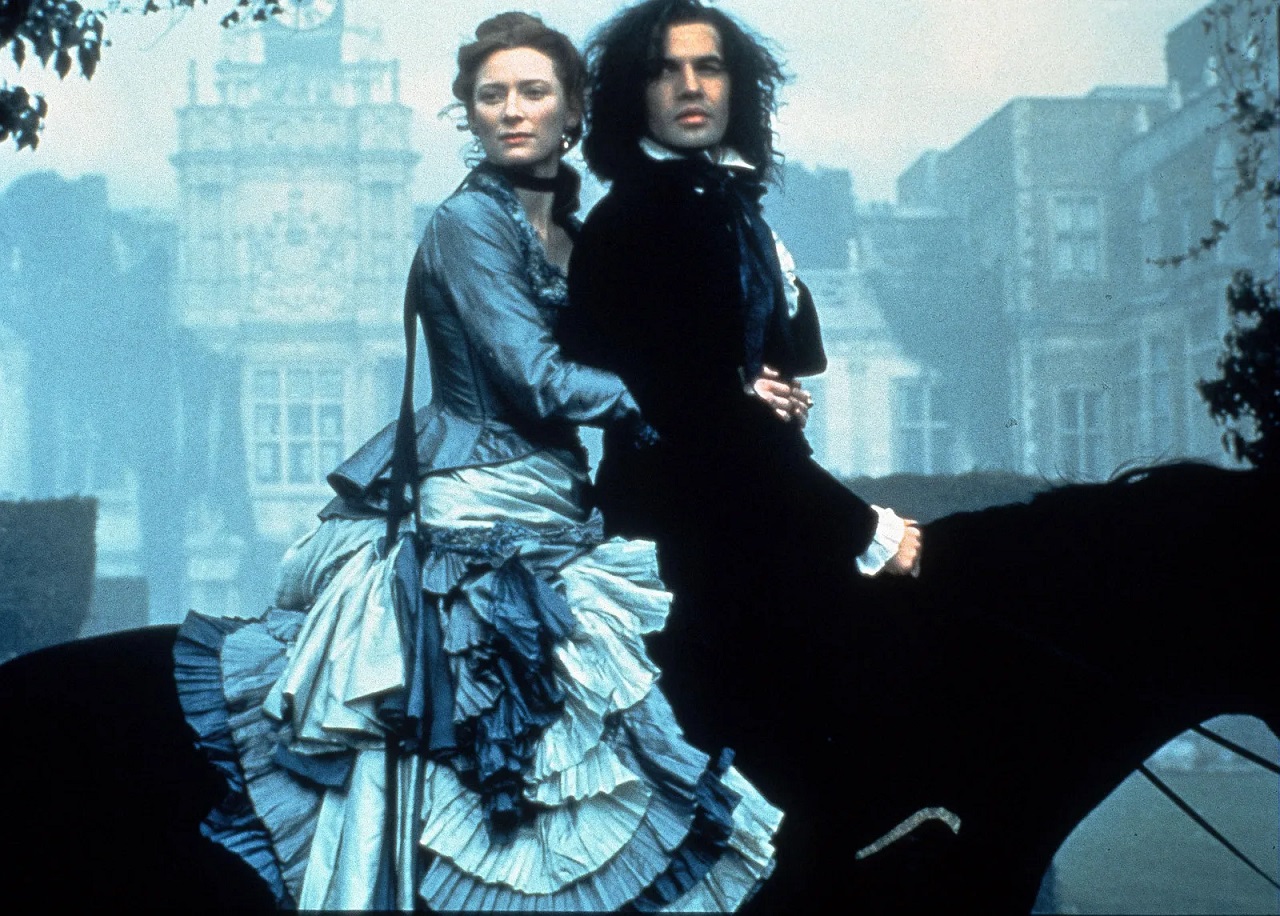
Tilda Swinton never particularly convinces us she ever is a man. Nevertheless, she plays with a wry self-mocking innocence that proves a central strength to the film. Indeed, with a performer of any less strength, Orlando would be far hollower. As it is, it is terribly uneven in places. What one does remember about it is the odd witty line and various humorous vignettes – the highly amusing meeting with Jonathan Swift and Dr Johnson who pompously lecture on the place of women in society; the lawyers’ attempts to make sense of her sex change and time hopping; John Wood’s proposal; the sequence with the freeloading poet played by Heathcote Williams.
A number of other sequences fail to make it – one with Tilda Swinton running pregnant across a WWI battlefield is so brief it feels as though an entire sequence has been truncated. Nevertheless, the film’s constant good humour and Tilda Swinton’s joyfully illuminated performance carries Orlando over its rough spots.
The casting is almost as eccentric as the film – particularly memorable is Quentin Crisp’s turn as Queen Elizabeth I. (When one realizes that one scene has the male Crisp, playing a woman, kissing the female Tilda Swinton, playing a man, one sees just how eccentric Sally Potter’s games of sexual identity swapping becomes). The sets are particularly sumptuously dressed – the spirit of Peter Greenaway consciously hangs over the film, with Sally Potter even having employed Greenaway’s production designers Ben Van Os and Jan Roelfs.
Trailer here