
Crew
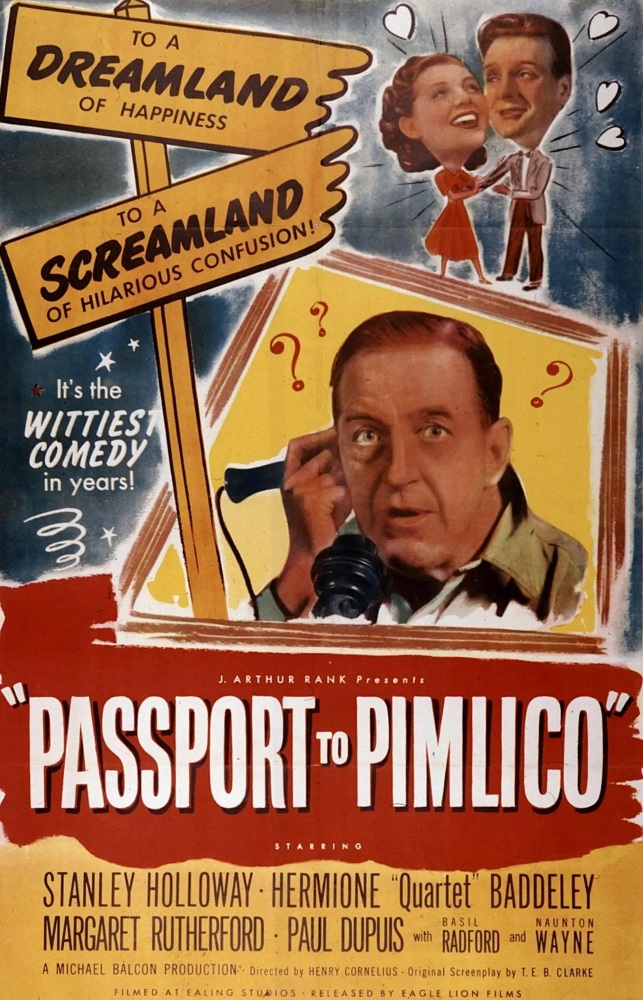
Director – Henry Cornelius, Screenplay – T.E.B. Clarke, Producer – Michael Balcon, Photography (b&w) – Lionel Barnes, Music – Georges Auric, Art Direction – Roy Oxley. Production Company – Ealing.
Cast
Stanley Holloway (Arthur Pemberton), Raymond Huntley (Mr Wix), Hermione Baddeley (Edie Randall), Philip Stainton (PC Spiller), Paul Dupuis (Duke of Burgundy), Barbara Murray (Shirley Pemberton), Betty Warren (Connie Pemberton), John Slater (Frank Huggins), Margaret Rutherford (Professor Hatton-Jones)
Plot
In the London suburb of Pimlico, an old tire that children are playing with rolls into a crater in a disused lot and causes an unexploded bomb to detonate. The explosion unearths a cave filled with valuables. Among these is a scroll showing that King Edward IV made Pimlico part of the Duchy of Burgundy in the 15th Century. At first, the notion of Pimlico being a foreign country becomes an excuse for the locals to flaunt post-War rationing restrictions and barroom closing hours. The police refuse to do anything, saying that they have no jurisdiction to work on foreign soil. The joke starts to get out of hand when the rest of the city reacts by imposing customs and immigration duties on visitors leaving Pimlico. The Pimlico locals respond by stopping and searching the subway train for contraband goods as it passes the Pimlico platform. In reprisal, the rest of the country closes the borders and cuts off power, telephone lines and water to Pimlico.
Passport to Pimlico was one of the famous comedies from England’s Ealing Studios. Although Ealing had been producing films since the 1930s, its fame came in the immediate aftermath of World War II when the studio produced a series of comedies that have widely been regarded as classics. These include the likes of Kind Hearts and Coronets (1949), The Lavender Hill Mob (1951), The Man in the White Suit (1951) and The Ladykillers (1955). Less well known is the studio’s production of dramas, the most famous of which is probably the classic horror anthology Dead of Night (1945).
Passport to Pimlico was inspired by a true incident during World War II when the Dutch royal family was forced to flee to Canada after the Nazi occupation of The Netherlands. In 1943, the Princess (later Queen) Juliana was pregnant with Princess Margriet. In order for Margriet to be born a Dutch royal, the Canadian parliament had to pass a decree that temporarily made the maternity ward of an Ottawa hospital Dutch soil for the duration of the birth.
A further part of the film’s inspiration came from the Berlin Airlift. In 1948, as part of the escalating tensions with the West, the Soviets blocked off road and rail access to West Berlin, leaving the entire city with only a month’s supply of food and fuel. The British and Americans allies responded by airlifting some 5000-8000 tons of food and supplies in every day over eleven months between mid 1948 and 1949. This is something that lends clear satiric inspiration to the latter scenes in Passport to Pimlico where the Londoners flaunt the blockade imposed on Pimlico by throwing supplies, even parachuting pigs, over the barricade.
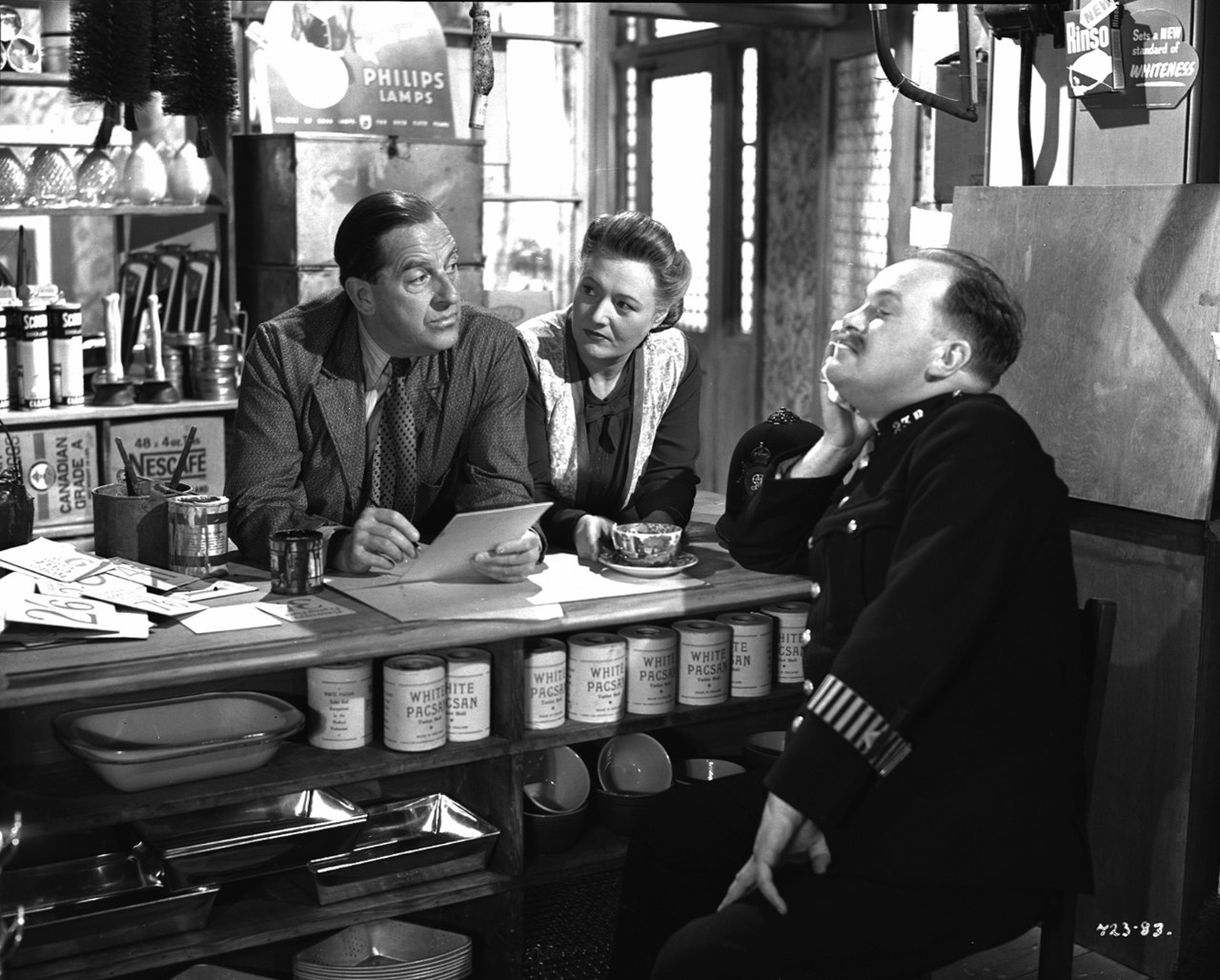
Out of these ideas, T.E.B. Clarke, a regular writer of Ealing’s comedies, spins a charming whimsy. Like some of the best science-fiction, Clarke takes a simple idea – the idea of a London suburb becoming a separate country – and spins it out to perfectly logical extremes. The way that Clarke keeps piling spins atop the premise makes the film a considerable joy. There is a perfect drollness in the battles with officialdom and the ingenious simplicity of solutions that the Burgundians manage to come up with every time. Bubbling not far beneath, the film relishes in an amusingly subversive streak in the idea of the little folks constantly outwitting lumbering bureaucratic officialdom. It is delivered with enormous panache.
Director Henry Cornelius moves without missing a step, unafraid of silliness in throwing in shots of parachuted pigs or one charming shot that follows the toss of a newspaper through the air and down into the bomb crater and the waiting bomb squad men. There is a perfect deadpan drollness to the film – like the charming scenes where it is proposed everyone deal with the water shortages by bathing in alcohol, or the courtroom scenes where every parent tries to get their child to admit to rolling the tire into the crater. Everyone present is a delight, with many of the scenes being stolen by the perpetually eccentric Margaret Rutherford as an academic expert.
Passport to Pimlico is also very much a product of its times – with its picture of the post-War British economy dominated by rationing, shortages and blackmarketeers, where the London landscape is littered with unexploded bombs from the German Blitz, and a cheerful West End folksiness overcoming all odds. It is hard to imagine that the film could ever have been made at any other time.
The same idea of a tiny independent country against the rest of the world was later taken up by the film The Mouse That Roared (1959) and its sequel Mouse on the Moon (1963).