

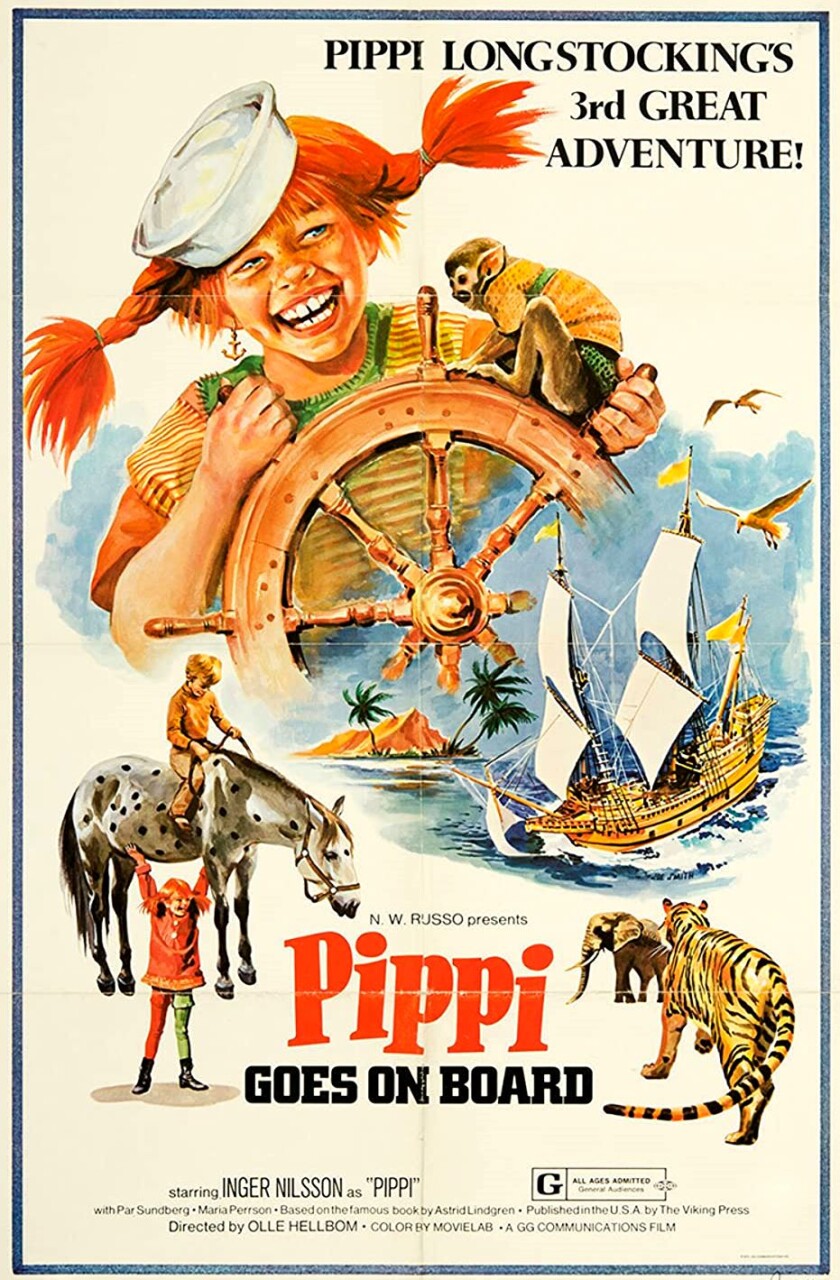
(Häe Kommer Pippi Längstrump)
Crew
Director – Olle Hellbom, English Dialogue – Fred Ladd, Based on the Characters Created by Astrid Lindgren, Producer – Olle Nordemar, Photography – Kalle Bergholm, Music – Christian Bruin, Pippi Theme – Konrad Elfers & Jan Johansson. Production Company – Iduna Film/KB Nord Art AB
Cast
Inger Nilsson (Pippi Longstocking), Maria Persson (Anneka Settigren), Par Sundberg (Tommy Settigren), Margot Trogger (Miss Prossel), Beppe Wolgren (Captain Ephriam Longstocking), Hans Clarin, Paul Esser, Ulf G. Johnson, Gothe Grefbo
Plot
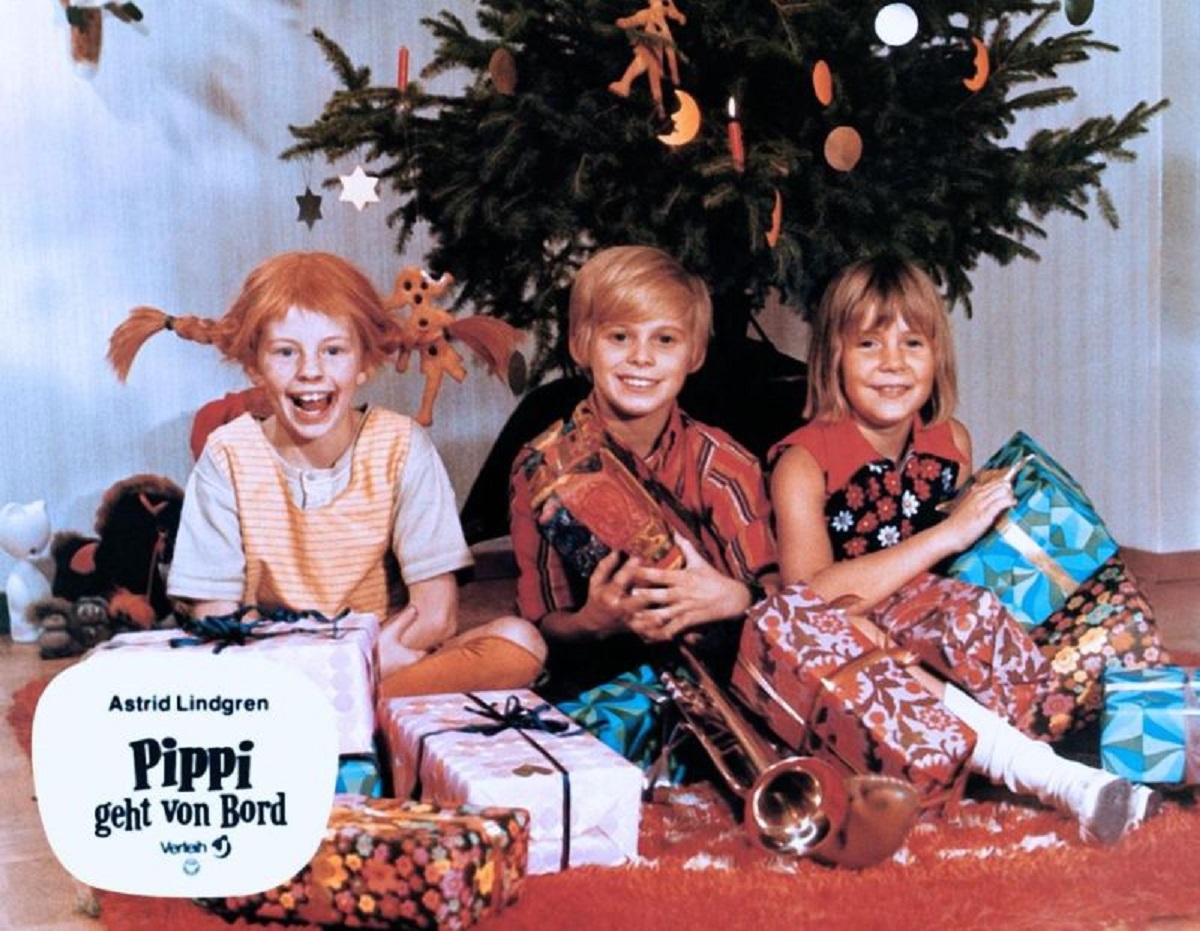
Instead of heading to the South Seas with her father, Pippi Longstocking returns to rejoin Tommy and Anneka Settigren. She takes them on a journey, sailing downriver in a dinghy to an island and then to visit a circus that comes to town. She ends up creating much mischief with her games, which upsets a number of adults. Meanwhile the two crooks escape from jail and come back to try and steal Pippi’s gold coins. At the same time, the officious Miss Prossel tries to have Pippi placed in a children’s home again.
Pippi Goes on Board was the first sequel to the Swedish/West German Pippi Longstocking (1969). These two films emerged out of a popular tv series Pippi Longstocking (1969), which lasted for thirteen episodes. The first film was re-edited together from episodes of the tv series but the subsequent films appear to have been made for theatrical release. (See below for the other Pippi Longstocking films).
All of the Swedish Pippi Longstocking films are drearily made but Pippi Goes on Board is the worst of the bunch. Continuity-wise, Pippi Goes on Board follows straight on from the very last scene of the previous film. Much of what happens – particularly when it comes to the nemeses of the two criminals and Miss Prossel – has just been recycled from the first film. Nothing really ever happens throughout – the film is a series of non-incidents that leaves one still waiting for the plot to begin by the time it ends. Surely filmmakers should realise that endless scenes of children playing are not enough to constitute an entertaining children’s film.
Furthermore, the low-budget prevents the film from being in any way interesting. This is especially the case when it comes to the presentation of the film’s shabby circus. The film is lazily conceived – two children go missing for a night, two criminals escape and nobody seems to even notice, let alone care. Olle Hellbom again directs but the minor whimsical delights that the first film had have become heavy-handed and the film is missing any lightness of touch.
The other Swedish Pippi Longstocking films are:– Pippi in the South Seas (1970) and Pippi on the Run (1973).
The first three of these Swedish Pippi Longstocking films all borrowed the titles of Astrid Lindgen’s Pippi books. In the case here, the film is taken from Astrid Lindgren’s Pippi Goes on Board (1947). Although despite such a title, Pippi Goes on Board is notable for not actually featuring any scenes where Pippi boards a ship – the nearest it comes is a scene where Pippi, Tommy and Anna briefly sail away to an island aboard a rowboat.
Full film available here