

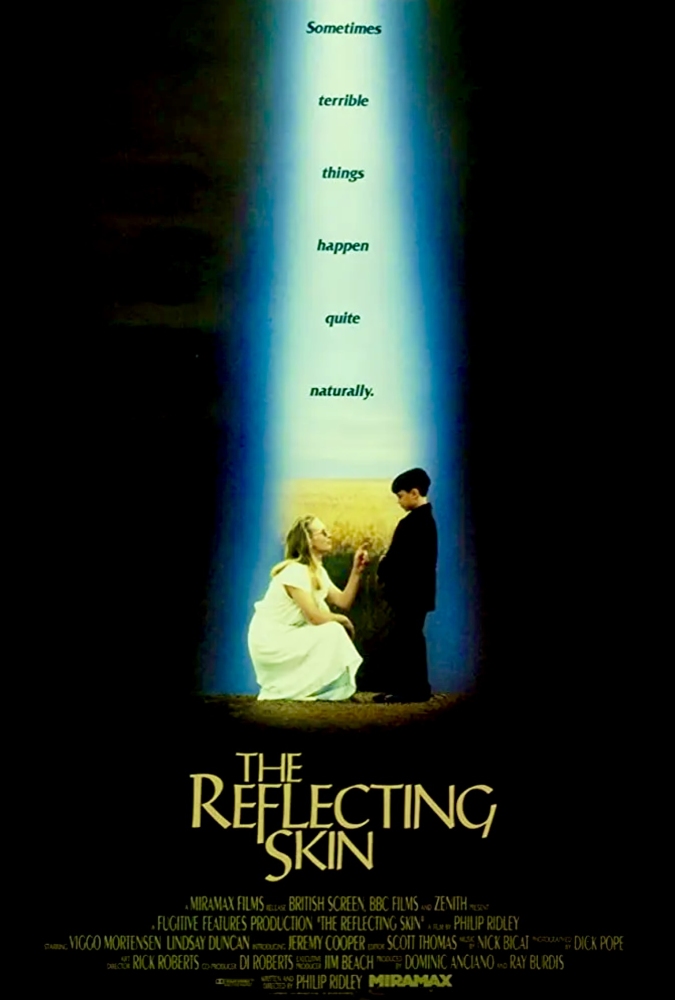
UK. 1990.
Crew
Director/Screenplay – Philip Ridley, Producers – Dominic Anciano & Ray Burdis, Photography – Dick Pope, Music – Nick Bicat, Special Effects – Lee Routly, Makeup – Al Magallon, Art Direction – Rick Roberts. Production Company – British Screen/BBC Film/Zenith/Fugitive Features.
Cast
Jeremy Cooper (Seth Dove), Viggo Mortensen (Cameron Dove), Lindsay Duncan (Dolphin Blue), Sheila Moore (Ruth Dove), Duncan Fraser (Luke Dove), Robert Koons (Sheriff Ticker), David Longworth (Joshua), Evan Hall (Kim), David Bloom (Deputy)
Plot
The 1940s in the Mid-American wheat fields. Young Seth Dove tells people that the strange albinoid widow Dolphin Blue is a vampire and soon comes to believe this himself. One of Seth’s friends is then found murdered. The local police brutally hound Seth’s father, a known homosexual, to the point that he kills himself but Seth believes the real killer is Dolphin. Much to Seth’s consternation, his older brother Cameron then becomes involved with Dolphin.
This independent feature was the directorial debut of British screenwriter Philip Ridley who had previously written The Krays (1989). The Reflecting Skin was celebrated as one of the most unique films of its year and received a good deal of favourable genre press. Although, its classification as a horror film is not one that one feels entirely comfortable with. For that matter, The Reflecting Skin is not a film that is easily able to be pigeonholed. Its narrative or the even point of the film are never entirely clear – what it appears to be is a film about the trauma of growing up told in a series of oblique images.
Sharp and brutal horrors alternate with languid scenes that appear to operate on a form of dream logic that allows complex metaphors and childhood tall-tales to blur into one. An embryo (of what the film never says) is made into an angel with its wings ripped off and is seen as the soul of a murdered boy; the character of Dolphin, an albino in black dresses, black leather and dark sunglasses is said to be a vampire (which Jeremy Cooper reads about in his father’s old pulp magazines) and her actions have an ambiguity that seems to belie the belief (even if the evidence that Jeremy Cooper uses to support his claim is seen to be deliberately exaggerated in the telling), although vampirism is then turned around to become a metaphor of non-specific horrors and tied to child molestation. The profusion of imagery the film accrues, even if not entirely coherent, is startling and provocative.
A number of scenes have a disturbing impact – like where Jeremy Cooper, in punishment for turning his bedroom light on after being told to go to sleep, is forced by his mother to keep drinking water until he involuntarily urinates; or the genuinely horrifying sequence where deputy David Bloom hounds Duncan Fraser about his homosexual past and a sobbing Fraser goes out and douses himself in petrol and then sets it alight.
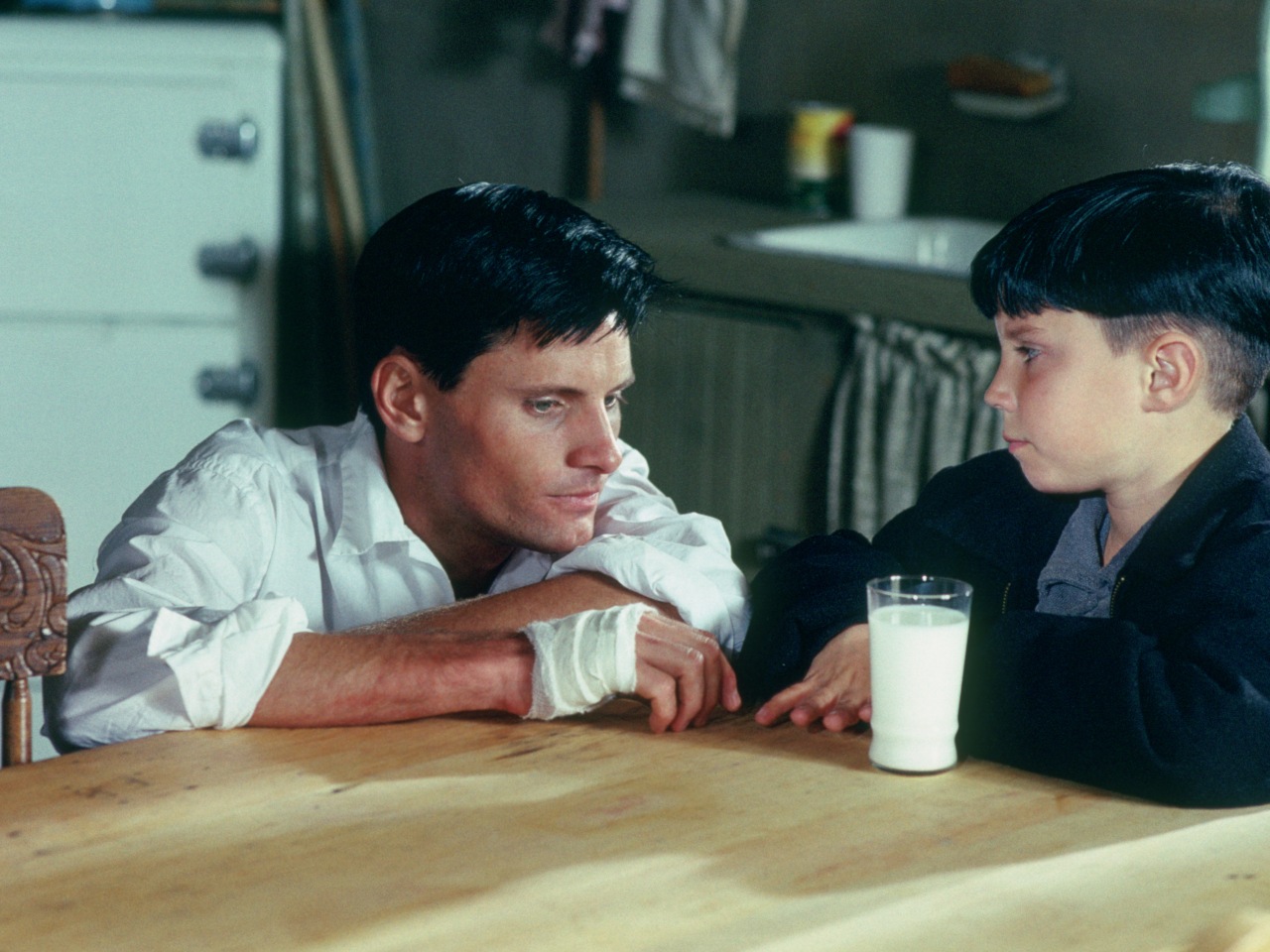
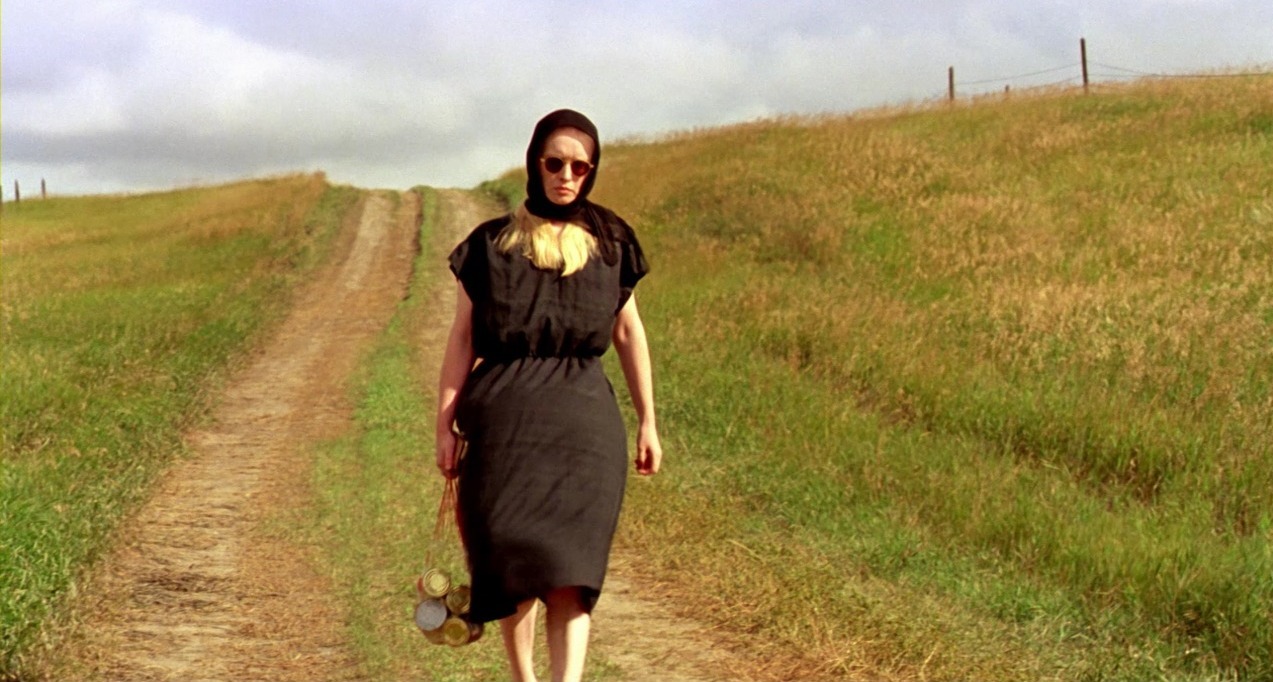
The entire film takes place in a dreamily distant hyper-real landscape that seems like a Van Gogh painting come to life. [In The Psychotronic Encyclopedia of Film (1995), Michael Weldon hit the nail perfectly on the head when he called The Reflecting Skin “a remake of Days of Heaven (1978) as directed by David Lynch”]. Philip Ridley (who is an exhibited painter and a novelist when he is not making films) is visually fascinated by the agoraphobic wide-openness of the wheat fields, aligning them with his camera lens so as to place houses and paths in patterns that are deliberately offsetting to the eye, while the production designer does an incredible job, constructing barns and sheds that seem to be built out of melting oil colours.
Philip Ridley has gone onto make two other films so far with The Passion of Darkly Noon (1995), a fascinating film about religious repression, and the horror film Heartless (2009) wherein a man makes a pact with a Devil-like figure that has a terrible price.