
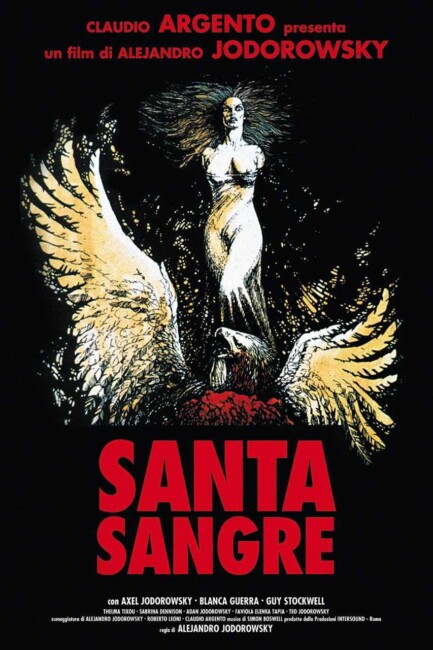
Mexico/Italy. 1989.
Crew
Director/Story – Alejandro Jodorowsky, Screenplay – Claudio Argento, Alejandro Jodorowsky & Roberto Leoni, Producer – Claudio Argento, Photography – Daniele Nanuzzi, Music – Simon Boswell, Art Direction – Alejandro Luna. Production Company – Produzioni Intersound
Cast
Axel Jodorowsky (Fenix), Blanca Guerra (Concha), Adan Jodorowsky (Young Fenix), Guy Stockwell (Orgo), Thelma Tixou (The Tattooed Lady), Sabrina Dennison (Alma), Faviola Elenka Tapia (Young Alma)
Plot
Doctors at an asylum try to rehabilitate Fenix, a patient who is distant and uncommunicative. Fenix remembers back to his childhood growing up in a circus. His father was Orgo the circus owner and his mother Concha, a trapeze artist and priestess of the Santa Sangre church that was erected to the memory a young girl who was raped and had her arms cut off. Concha discovered Orgo with another woman and in anger threw acid in his crotch, only for him to respond by cutting her arms off with a knife, before slitting his own throat. Witnessing this drove Fenix insane and he was placed in the asylum. Concha now comes to the asylum to fetch Fenix. She makes him her partner in a mime act where he performs as her missing arms. However, this becomes a tormented relationship for Fenix as Concha, wishing to maintain her hold over him, forces him to kill any other woman that he desires.
The films of Russian-born Chilean-raised Alejandro Jodorowsky are almost unclassifiable. Throughout his wild and fascinating life, Jodorowsky has at various points acted as an avant-garde theatre director and performer, a comic-book creator and even created his own mystic school of tarot-based psychology. It is however for his films that Jodorowsky has attained a cult.
As filmmaker, Jodorowsky believes in a brand of take-no-prisoners surrealism and treats the film he makes as an intended mystical/transcendental experience for his audiences. His cult classic El Topo (1970) is a surrealistic Zen Western wrapped up in fetishism and ultra-violence; the Zen/Carlos Castenada-styled The Holy Mountain (1973) is another transcendental quest film that was filmed with a cast that had to undergo mystical enlightenment training before filming; his third film Tusk (1980) about the relationship between a woman and an elephant was such a flop that it has not been seen outside of France; while Jodorowsky disowned his subsequent The Rainbow Thief (1990) about a prince and a thief living in the sewers due to creative interference by the producers. His very first film Fando and Lis (1968) resulted in a riot when it first premiered in Mexico and remained largely unseen until the 2010s.
Jodorowsky was also attached to a completely wild-sounding film version of Frank Herbert’s Dune (1965) in the 1970s, although this ended up financially collapsing. All of these contain a mix of wild hallucinatory surrealism and undeniable mystic/religious pretensions but should at least be seen for the vividness of Jodorowsky’s imagery.
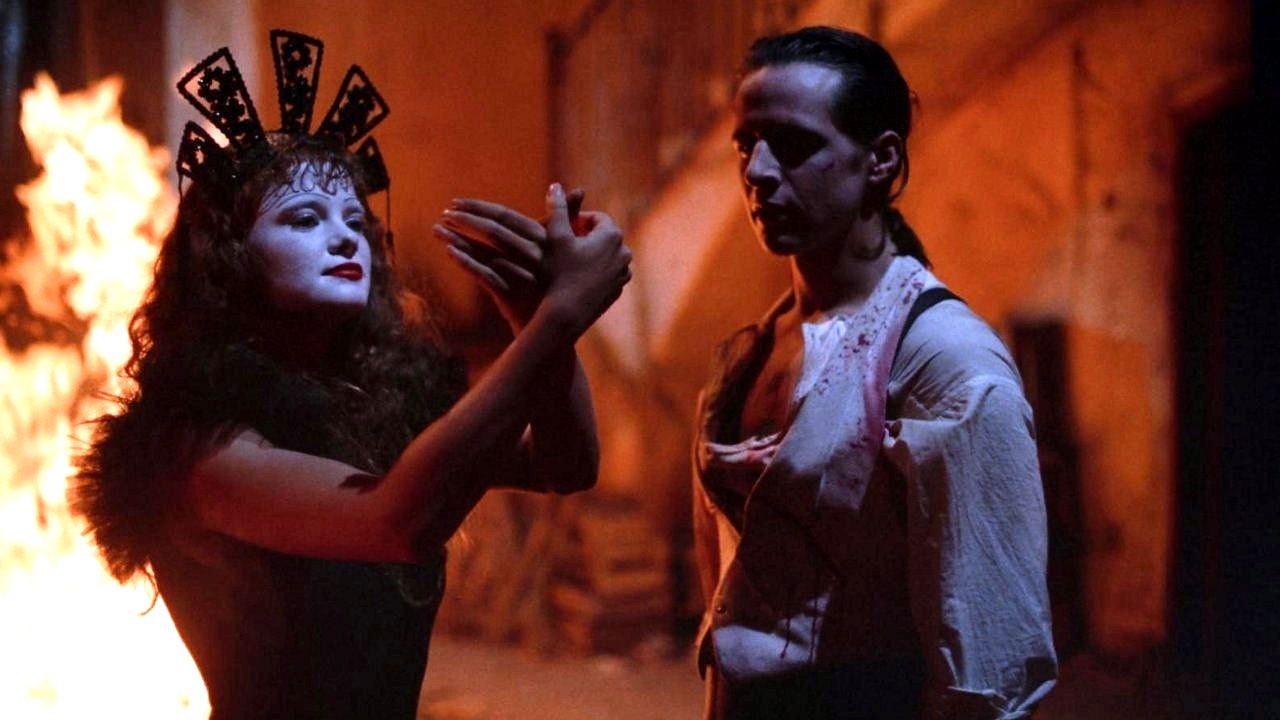
To call Santa Sangre Alejandro Jodorowsky’s most commercial and conventionally plotted film may well be to understate its extraordinary power. It contains a near-indescribable mixture of elements that vie between graphic horror and bodily mutilation, hallucination, surrealism, tormented sexuality and quiet tenderness. Purportedly inspired by a meeting between Jodorowsky and a redeemed Mexican serial killer who wanted Jodorowsky to make a film of his life story, it arrives seeming like a collision between a remake of Psycho (1960) as conducted by Luis Buñuel and a Mardi Gras version of Freaks (1932) being fought over by Federico Fellini and Dario Argento (the film is produced and co-written by Argento’s younger brother Claudio).
Jodorowsky has never been a director known for his subtlety. There are times here when he goes over-the-top with bludgeoning Ken Russell-like phallic symbolism of giant anacondas bursting forth from Axel’s coat, but most of the film’s conceptualisations are striking and outlandish. The mime pairing of Axel and Blanca Guerra is remarkable to watch – how his arms slung through her sleeves take on a sinuous femininity even when they are feeding her breakfast.
There are moments of genuine tenderness in the film – like the scene where Guy Stockwell tattoos young Fenix with a knife, and the lovely mime work of the deaf-mute character Alma (Sabrina Dennison) who spends the entire film in painted white face. One of the most beautiful scenes is the burial of an elephant in the town rubbish tip where it is then torn apart by the starving poor. There are others moments where the film is downright weird – like where Fenix decides to take The Invisible Man (1933) as a personal metaphor and dresses his face in bandages, or how we first see him as the film opens perched naked on the branch of a tree in the midst of an empty room at the asylum.
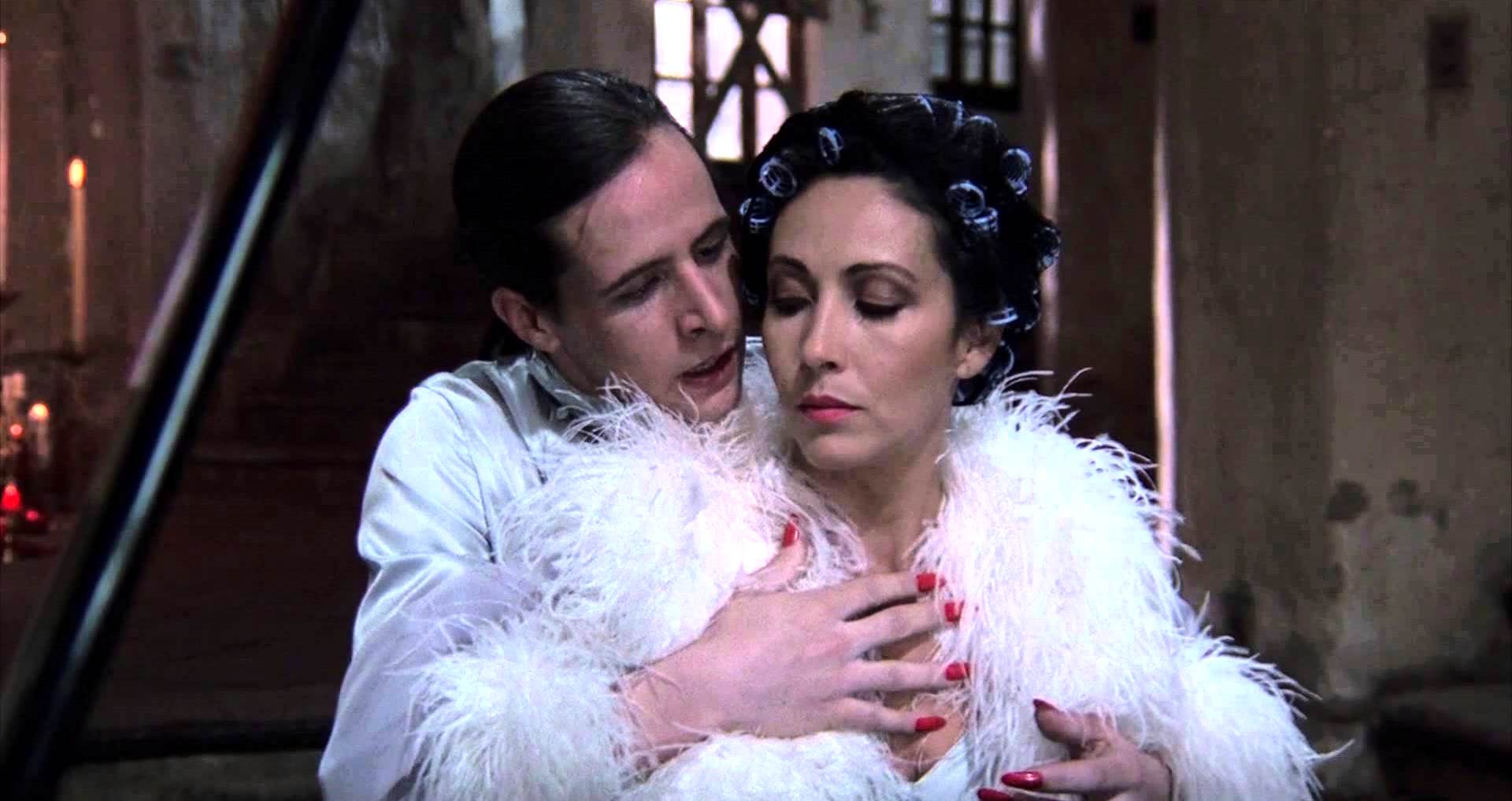
Nobody takes their clothes off but when characters unleash their passions on screen, the film smoulders with sensual energy, particularly when it comes to the carnal paradings of Tattooed Lady Thelma Tixou over a knife-taunting Guy Stockwell, and the fervid pent-up passion that comes in Blanca Guerra’s performance, or Axel’s rendezvous with a hard-liquor drinking female bodybuilder and his hypnotising of a stripper with a glittering knife blade. Startling, weird, funny – one is never sure whether Jodorowsky is pulling one’s leg or getting seriously wrapped up his own pretensions, but the ride is a wildly colourful one while it lasts.
In his previous films, El Topo and The Holy Mountain, Jodorowsky himself played the central characters of the mystic questors. Here he casts his son Axel as the character of Fenix, with his younger son Adan playing Fenix as a child. (Jodorowsky’s other son Ten also turns up as an asylum warder who takes the patients on a visit to a brothel). Axel gives a good performance, despite the stiltedness of the language barrier, he being especially standout in cape and top hat in the memorable scene where he hypnotises the stripper.
After a twenty-four year silence, Alejandro Jodorowsky returned to cinema screens with the surreal autobiographical works The Dance of Reality (2013) and Endless Poetry (2016), as well as the documentary Psychomagic: A Healing Art (2019). Also of interest is Jodorowsky’s Dune (2013), a fascinating documentary about Jodorowsky’s planned production of Frank Herbert’s Dune (1965) that was announced but never got off the ground.
Trailer here