
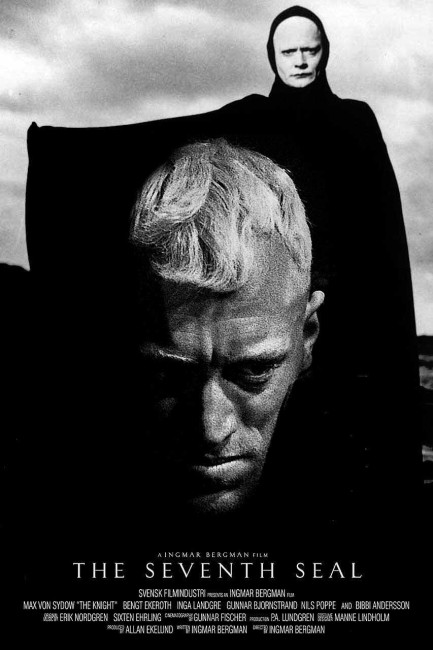
(Det Sjunde Inseglet)
Sweden. 1957.
Crew
Director/Screenplay – Ingmar Bergman, Producer – Allan Ekelund, Photography (b&w) – Gunnar Fischer, Music – Erik Nordgren, Art Direction – P.A. Lundgren. Production Company – AB Svensk Filmindustri.
Cast
Max Von Sydow (Antonius Block), Gunnar Bjornstrand (Jons), Bengt Ekerot (Death), Nils Poppe (Josef), Bibi Andersson (Mia), Bertil Anderberg (Raval), Ake Fridell (Plog), Maud Hanson (The Witch), Inga Gill (Lisa)
Plot
The knight Antonius Block returns from the Crusades. All around him, he sees misery, religious frenzy and witch persecutions as plague ravages the land. However, Antonius has lost his faith and cannot see meaning in the suffering anymore. Death appears to claim him but Block engages Death in a game of chess in the knowledge that each moment Death stays to play will be one moment longer he is able to live.
The Seventh Seal is one of the genuine masterpieces of cinema. When it premiered at the Cannes Film Festival in 1957, The Seventh Seal was given a special prize as being too great to be judged by normal critical merit. Its greatness, and also director/writer Ingmar Bergman’s greatness, is its epic insight into the great spiritual/philosophical crisis of thought in the 20th Century – indeed, of Western thought since the Age of Reason. If one compares The Seventh Seal to the films that Hollywood were making at the same time, nothing ever comes anywhere near this in intellectual depth.
The question that The Seventh Seal poses is “What meaning can God have amidst death, suffering and pain?” Ingmar Bergman’s meditation on such matters results in a profound work of nihilism. Bergman smashes away the notion of God and in so doing reduces all to a world of meaningless pain and insanity. The great religious war of The Crusades, the Black Death, the witch burnings – all are seen as futile and pointless, pain in a world that has lost any sense of meaning. Death, in Bergman’s eyes is inevitable; all that we try to do, the ways we have of worshiping Death or of driving it away – the flagellants, the witch burnings, the attempts to laugh in its face – are futile.
Max Von Sydow’s knight finally gains his redemption – although pointedly it is a redemption that only gives him a feeling of moral worth and does nothing to save him from Death. Although, it is perhaps here that Bergman does allow himself some of his own illusions – his rhapsodies in favour of a simple life with the peasant Josef are perhaps one illusion that he proves unwilling to finally shatter. Mindedly, a life of bliss that seems untroubled by the great intellectual weight that the film carries might not seem too unwelcome in the circumstances.
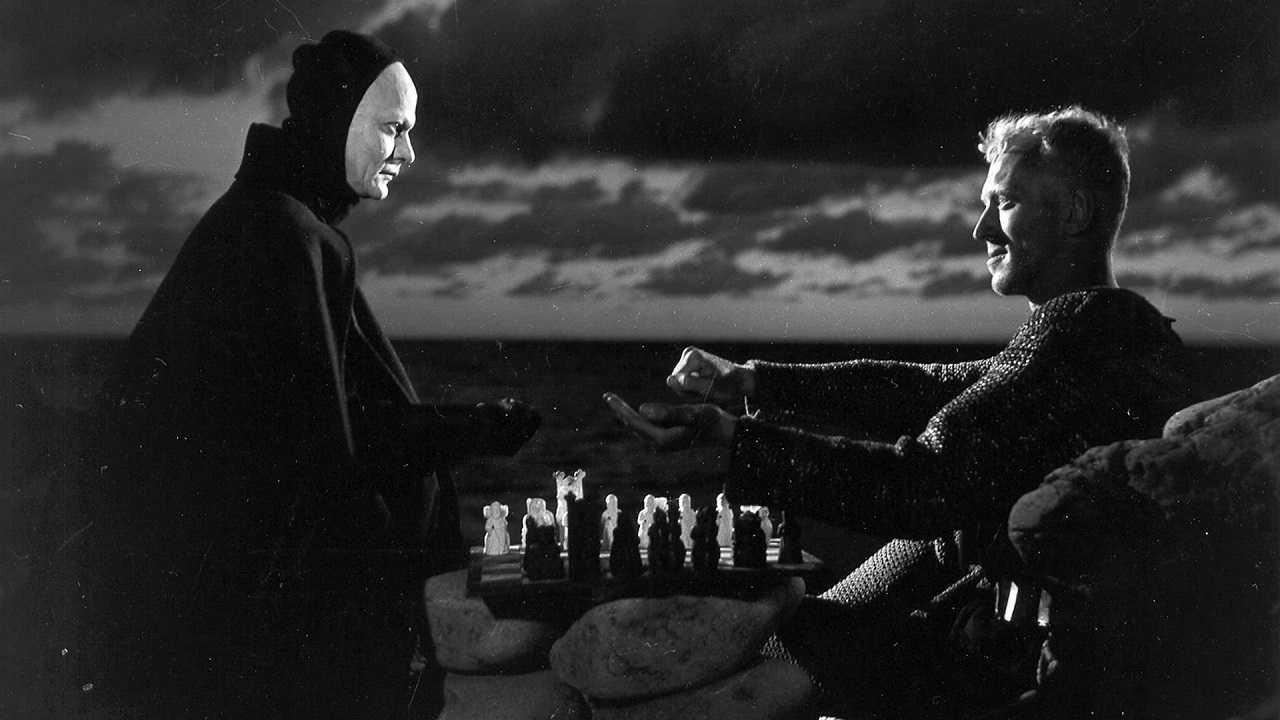
Ingmar Bergman stated that his inspiration for The Seventh Seal were memories of a mural depicting Death (some likeness of which turns up being painted in the film) that haunted him from his childhood upbringing in the Lutheran church. The film is filled with strong and powerful images out of Mediaeval fresco. The very central image of Death and the knight sitting on a beach playing chess is a remarkable one in itself that resonates throughout cinema. Although surely the most haunting image is the one that closes the film, of Josef’s vision of the Mediaeval Totentatz (the Dance of Death) with Death seen leading the film’s dead across a skyline in the distance dancing at the end of a rope.
The scenes of the madness and despair of the Middle Ages – seminarians robbing the dead; of witches pilloried in the street, pelted with animal excrement and then being burnt; the scene in an inn where the simple-minded Josef is made to dance like a bear at the end of a flaming brand; where the troubadour’s performance is interrupted by the plague-ridden flagellants swinging burning censers, whipping themselves and dragging crosses of burden – radiate a haunting sobriety. Even the image that opens the film of a raven flying across a storm-ridden sky holds a powerful symbolic resonance.
Bergman is greatly aided by his cast. A young Max Von Sydow makes for fine physical casting – his tall and bony features seem gaunt and drawn and his natural blonde hair becomes snow white under the black-and-white camerawork. There is also a fine performance from Gunnar Bjornstrand – like Max Von Sydow, another frequent collaborator of Bergman’s – who moves through the film with a rough and cynical vulgarity, yet out of which he brings a strong nobility.
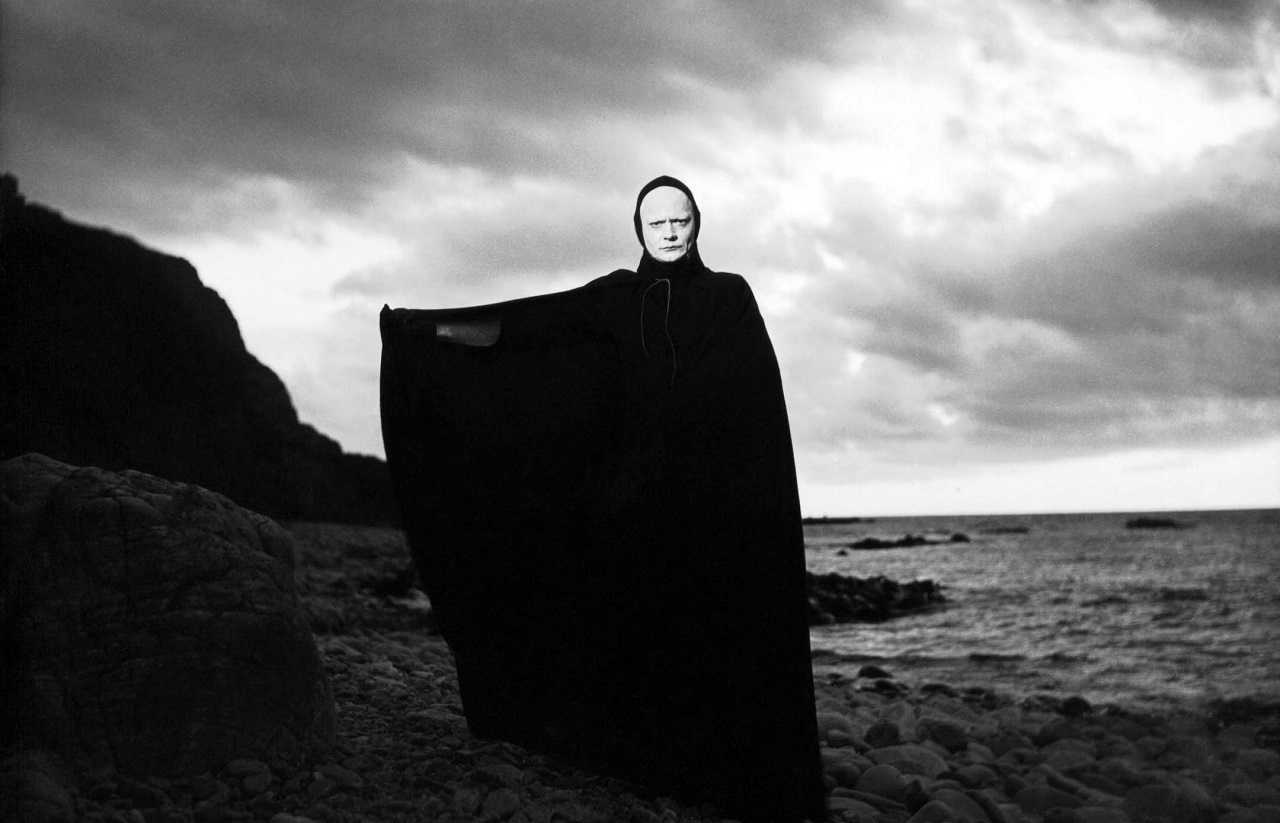
Bengt Ekerot’s Death is good too. Bergman chose Bengt Ekerot it seems for a face that displays a remarkable placidity, even, it might seem, compassion – yet this is something that Bergman plays against throughout, as the character of Death is wholly implacable, whose only straying from its single-minded purpose is to dally to play a very human game of chess.
The image of the chess-playing Death created here by Ingmar Bergman has become a vividly resonant one in cinema. The Seventh Seal and its image of a personified Death has been parodied a number of times – in Woody Allen’s Love and Death (1975), Bill and Ted’s Bogus Journey (1991), Last Action Hero (1993) and Muppets Most Wanted (2014), even copied by tv commercials and made into an ongoing comic character in the books of Terry Pratchett.
Ingmar Bergman’s other ventures into fantasy have been:– The Magician/The Face (1958) about a troupe of performing magicians who may or may not have real supernatural powers; the revenge film The Virgin Spring (1959); The Devil’s Eye (1960), a comedy about The Devil sending Don Juan to tempt a vicar’s ; Hour of the Wolf (1968) about a tormented artists’s hallucinations come to life; the acclaimed adaptation of Mozart’s fantasy opera The Magic Flute (1975); and the family saga/ghost story Fanny and Alexander (1982). All are recommended with the highest praise.
Trailer here
Full film available online here:-