
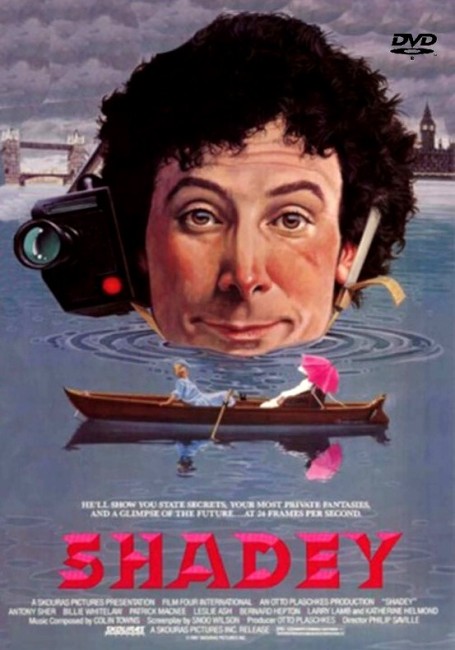
Crew
Director – Philip Saville, Screenplay – Snoo Wilson, Producer – Otto Plaschkes, Photography – Roger Deakins, Music – Colin Towns, Special Effects – Terry Cox & George Gibbs, Production Design – Norman Garwood. Production Company – Larkside Films/Film Four International.
Cast
Anthony Sher (Oliver Shadey), Patrick MacNee (Sir Cyril Landau), Leslie Ash (Carol Landau), Katherine Helmond (Lady Constance Landau), Billie Whitelaw (Dr Cloud), Bernard Hepton (Captain Amies), Larry Lamb (Dick Darnley), Jesse Birdsall (Carl)
Plot
Wealthy diamond merchant Sir Cyril Landau is approached by motor mechanic Oliver Shadey who offers to trade his psychic skill – the ability to mentally view remote locations and then record what he sees onto film – if Sir Cyril will give him the £25,000 he needs for a sex change operation. Shadey also makes predictions about Sir Cyril’s mentally unbalanced wife Lady Constance and their daughter Carol, a model. Carol accepts a part in a music video shoot in Belgium and becomes involved with its director. Shadey watches mental films he has made of an incident where a drunken Sir Cyril had incestual sex with Carol. Sir Cyril then trades Shadey to MI5 in return for a set of new offices. However, Shadey refuses to do espionage work and so MI5 try to force him using drugs. Moreover, they do not appear intent on honouring the agreement he made with Sir Cyril.
I must admit to being attracted to the description of Shadey given on its video cover – a black comedy about a man who had the unusual psychic ability to imprint the visions in his head onto film. The film has an interesting cast line-up, including worthy names like Patrick MacNee, Billie Whitelaw and Bernard Hepton, as well as the perpetually daffy Katherine Helmond. The film also granted the lovely and underrated Leslie Ash her first leading role. Moreover, Shadey is co-produced by Film Four International, a company that has funded an estimable number of British arthouse productions. However, the resulting film almost appears to have been made as a test to its viewing audience to see how far through they are prepared to sit before they give up watching altogether. Almost certainly, if Shadey were a modern American indie film, it would have been left on a distribution shelf. (Even at the time it was made, Shadey was only ever given a minimal theatrical screening in England).
The film is all over the place. You are not sure if it is trying to be a comedy – certainly, there is almost nothing that raises a laugh or can be construed as attempting to do so (apart from mildly amusing scene where a South African ambassador asks a bishop about possible homosexual readings of The Bible) – or a thriller – but there director Philip Saville seems disinterested in the machinations of the spy agency. It is not even a fantastic film, as Saville demonstrates no interest in exploring the intriguing initial premise of Anthony Sher’s psychic photography skills.
All that we have is a slow moving series of character interactions in search of the plot. You sit back after watching the film and wonder what the point of it was, what the filmmakers imagined they were trying to communicate in making it, least of all how someone managed to convince people to fund it. Part of the reason may well be that director Philip Saville had just come from the massively successful tv mini-series The Boys from the Blackstuff (1982) about a group of unemployed bricklayers in Thatcherite England and was considered a hot talent where people must have been queuing up to throw money at him without even asking what he wanted to do.
It is as though Philip Saville were part of the French New Wave of the 1960s/1970s where directors used to make films that had no plots and hung around vague, everyday kitchen sink happenings or threw in random incomprehensible surrealism. The film here traipses through various dreary happenings that come without event or Saville ever clueing us into what is happening. Things perk up slightly when Anthony Sher sits watching one of his psychic films wherein a lingerie clad Leslie Ash seems to be seducing a drunken Patrick MacNee and we go “Wait a minute, isn’t she supposed to be his daughter?” But even this potentially dark undertow does not appear to be of much relevance to the film and is never explored any further. You even start wondering if Philip Saville has not made Shadey as dull as possible either as a joke or in an effort to show his contempt to viewers, producers, distributors or whomever.
One of the worst parts about the film is Anthony Sher’s performance as the title character. His is a performance that wanders all over the map. One minute Shadey seems a weak, helpless fool who is the pawn of the circumstances around him; the next Anthony Sher sits there with a mischievous calculating smile. At one point, he turns up at Leslie Ash’s engagement party in a candy-striped suit and straw boater, looking for all the world like a Charlie Chaplin-esque clown. The worst scene is surely the one in the kitchen at the party with Sher taunting Katherine Helmond (who gives a performance that is almost as silly and over-the-top as his). The scenes with Sher pulling faces and poking his tongue out at her, not to mention the bizarrely ecstatic expression on his face as she stabs him in the crotch with a knife contain some amazingly awful acting that any director in their right mind would have dumped on the cutting room floor. (It is hard to believe from this that Anthony Sher is a celebrated actor with RADA who received a knighthood for his acting).
The film goes out on an entirely surreal ending. After being stabbed in the crotch, Anthony Sher is somehow revived or resurrected and then dresses in drag and goes to a restaurant with spy masters Billie Whitelaw and Bernard Hepton where he orders every item on the menu. As he walks back with Hepton, Hepton asks him if he can predict death, whereupon someone suddenly appears from behind and garrottes Hepton. Patrick MacNee is abducted by masked men in a van but later turns up released and we never find out what that was about. Anthony Sher enters an elevator, trailing a huge mass of toilet paper from the padding he put in his drag bra. Various spies follow him as the elevator goes up and down, before it bursts into white light and blasts through the roof like something out of Willy Wonka and the Chocolate Factory (1971). Next we see Katherine Helmond walking in the grounds of the asylum she has been placed in and thinking that she sees daughter Leslie Ash in a boat on the river. In the final image, which is oddly reminiscent of the end of Celine and Julie Go Boating (1974), Philip Saville cuts to the boat on the river, which is an exact replica of a picture that Anthony Sher had on a calendar, where we see that it is Leslie Ash and Sher in drag enjoying a punt on the river like they were best girl friends.
Director Philip Saville has a career in British television that goes back to the 1960s. Although outside of Shadey and the drama Metroland (1997), Saville has rarely ventured onto cinema screens. He has made a number of other genre tv mini-series, including Count Dracula (1977), the acclaimed Louis Jourdan adaptation of Bram Stoker for the BBC; The Life and Loves of a She-Devil (1986), the famous quasi-fantastical Fay Weldon feminist work about a woman’s revenge; First Born (1988) and a further Fay Weldon adaptation The Cloning of Joanna May (1991), both about cloning; the little-seen theatrical film The Fruit Machine (1988) about gay youths pursued by a killer; and the Hallmark biopic My Life as a Fairytale: Hans Christian Andersen (2001).