

USA. 2007.
Crew
Director – David Silverman, Screenplay – James L. Brooks, Matt Groening, Al Jean, Ian Maxtone-Graham, George Meyer, David Mirkin, Mike Reiss, Mike Scully, Matt Selman, John Schwartzwelder & Jon Vitti, Based on the TV Series The Simpsons Created by Matt Groening, Producers – James L. Brooks, Matt Groening, Al Jean, Richard Sakai & Mike Scully, Music – Hans Zimmer, The Simpsons Theme by Danny Elfman, Sequence Directors – Mike Anderson, Lauren MacMullan, Rich Moore, Steven Dean Moore & Gregg Vanzo, Animation Production – Film Roman & Rough Draft Studios, Art Direction – Dima Malanitchev. Production Company – 20th Century Fox/Gracie Films.
Voices
Dan Castellanata (Homer Simpson/Grampa Simpson/Itchy/Krusty the Clown/Barney Gumble/Mayor Quimby/Squeaky-Voiced Teen/Multi-Eyed Squirrel), Julie Kavner (Marge Simpson/Patty Bouvier/Selma Bouvier), Nancy Cartwright (Bart Simpson/Maggie Simpson/Ralph/Nelson/Todd Flanders), Yeardley Smith (Lisa Simpson), Harry Shearer (Ned Flanders/President Arnold Schwarzenegger/Kent Brockman/Montgomery Burns/Reverend Lovejoy/Principal Skinner/Smithers/Scratchy/Dr Hibbert/Lenny/Skull), Hank Azaria (Comic Book Guy/Moe Szyslak/Chief Wiggum/Lou/Carl/Cletus/Professor Frink/Bumblebee Man/Robot/Dr Nick), Tress MacNeille (Colin/Medicine Woman/Mrs Skinner/Nelson’s Mother/Pig/Cookie Kwan), Pamela Hayden (Milhouse Van Houten/Rod Flanders), Albert Brooks (Russ Cargill), Tom Hanks (Himself), Russi Taylor (Martin)
Plot
In church, Grampa Simpson suddenly begins to utter nonsensical phrases. Marge later realises that what he was talking about is coming true. Lisa tries to raise awareness about pollution in Lake Springfield and eventually persuades the town to erect a wall to prevent dumping of waste in the lake. In the process of doing so, she meets and is attracted to Colin, an Irish boy newly moved to town, who has similar interests to her. Meanwhile, Bart starts to think Ned Flanders might be a better father figure than Homer is. Homer takes home a pig left over from a Krusty Burger commercial. He has the problem of what to do with its waste and so dumps it into Lake Springfield. This is the straw that finally turns the lake toxic and creates mutant squirrels. Environmental Protection Agency head Russ Cargill gets an order from President Arnold Schwarzenegger to have Springfield named the most polluted town in the country and placed under an impenetrable dome. When Homer is found to be responsible, a lynch mob come after him, but he and the family make an escape from the dome. They set up a new home in Alaska. Homer enjoys the life there. Marge than realises that Russ Cargill has obtained orders from President Schwarzenegger to blow Springfield up and decides they must return to stop this.
The tv series The Simpsons (1989– ) has, in its extraordinary thirty year run (and still going strong), has become a genuine US cultural landmark. Created by Matt Groening, who named the characters after his own family members, The Simpsons started as a series of one-minute shorts that appeared as part of The Tracey Ullman Show (1987-90), before being spun off as its own series. Numerous aspects of The Simpsons – phrases like “eat my shorts”, “ay caramba”, “woohoo”, “okely dokely” and particular Homer’s “d’oh”, which is now in the Oxford English Dictionary – have become widespread parts of popular culture.
Like The Muppet Show (1977-81) before them, The Simpsons always comes on two levels – it is at face value an animated tv series that is enjoyed by child audiences, while at the same time comes with a clever sense of humour that is aimed at adults. The series has conducted numerous parodies of various aspects of popular culture. Among other things, the series is known for guest appearances from almost every celebrity under the sun who is usually spoofing their own image – guests in the past have included everyone from Leonard Nimoy, Kathleen Turner, Michael Jackson, Elizabeth Taylor, U2, Michelle Pfeiffer, Winona Ryder, Aerosmith, Meryl Streep, British Prime Minister Tony Blair, David Duchovny and Gillian Anderson spoofing their roles in The X Files (1993-2002, 2016-8) and all of the surviving members of The Beatles at various points. In terms of genre interest, The Simpsons makes an annual Treehouse of Horror episode, which usually conducts spoofs of popular horror films. Matt Groening also went onto create the fine animated series Futurama (1999-2003), which likewise spoofed numerous aspects of science-fiction.
Beyond that, The Simpsons also made a number of substantial changes in television. Before The Simpsons came along, American tv was dominated by family sitcoms like Family Ties (1982-9), Who’s the Boss? (1984-92), Family Matters (1989-98) and the 1980s No 1 hit of The Cosby Show (1984-92). The Cosby Show in particular with its cosy messages about how there is nothing more desirable in life than a happy, together family became the quintessence of the 1980s sitcom. The Simpsons, with perhaps a little help from other shows that came out around the same time like Married With Children (1987-97) and Roseanne (1988-97), in effect knocked the edges off the cosy together family and gave us the sitcom centred around a dysfunctional family. The Simpsons was quickly followed by other animated copies such as King of the Hill (1997-2010), Family Guy (1999-2002, 2005– ) and American Dad (2005– ) where the emphasis was on dysfunctionality. The other thing that The Simpsons showed was that animated television could be conducted for adult audiences in primetime rather than afternoon after-school or Saturday morning slots. It was followed by other adult-aimed shows like the abovementioned Family Guy, King of the Hill, The Critic (1994-5), The PJs (1999-2001) and those that definitely had no children’s content such as Beavis and Butt-Head (1993-7) and South Park (1997– ), which pushed the satiric and taboo envelope in a big way.
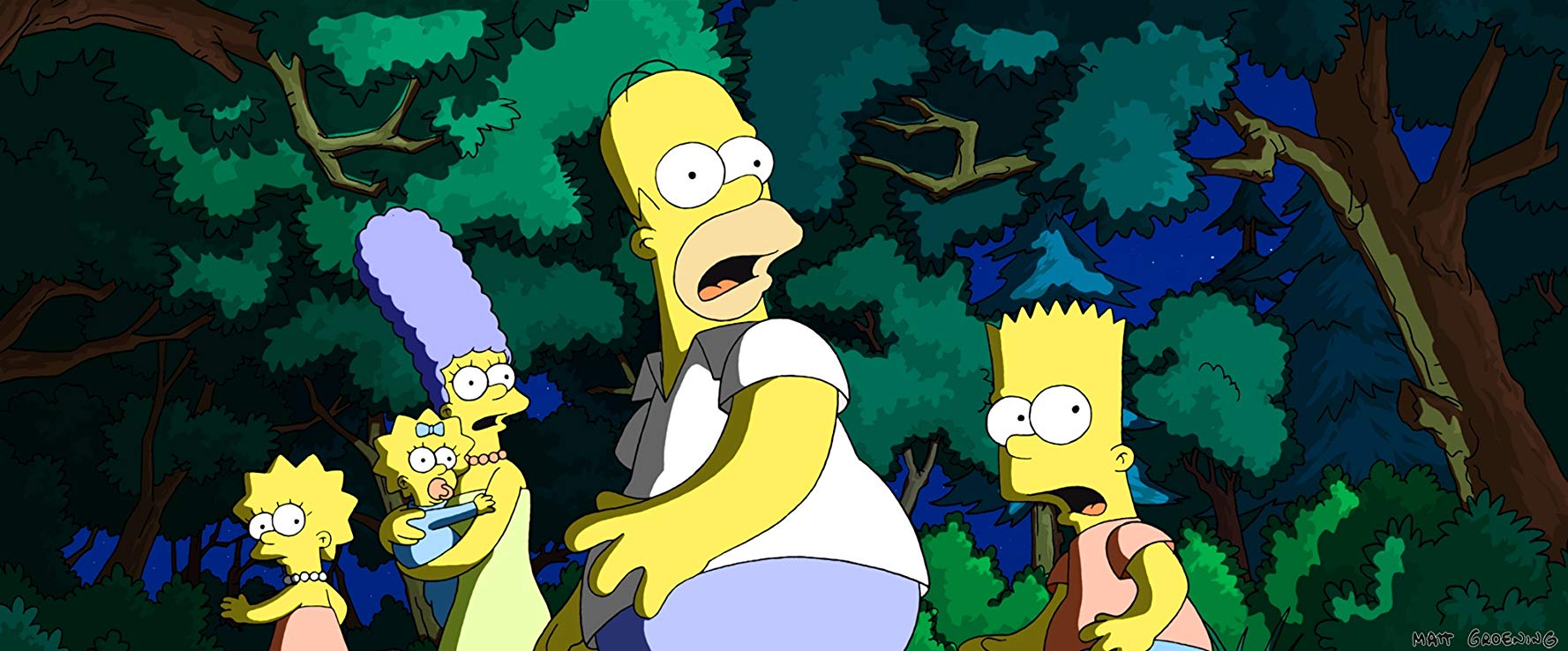
In spinning off such a massively popular tv success, The Simpsons Movie comes with an enormous degree of expectation. As such, The Simpsons Movie feels like it is not all that it could have been, although is by no means a failure either. What it feels like is a strictly average episode of the tv series that has been stretched out onto the big screen. It suffers from the same problem that many film spinoffs of popular tv shows do – Star Trek – The Motion Picture (1979), The Nude Bomb (1980), Star Trek: Generations (1994), The X Files (1998), Serenity (2005) to name a handful of genre examples – where the actors seem to be blinking in bewilderment to find something that was small and cosy on the small screen has suddenly been rendered in giant-size.
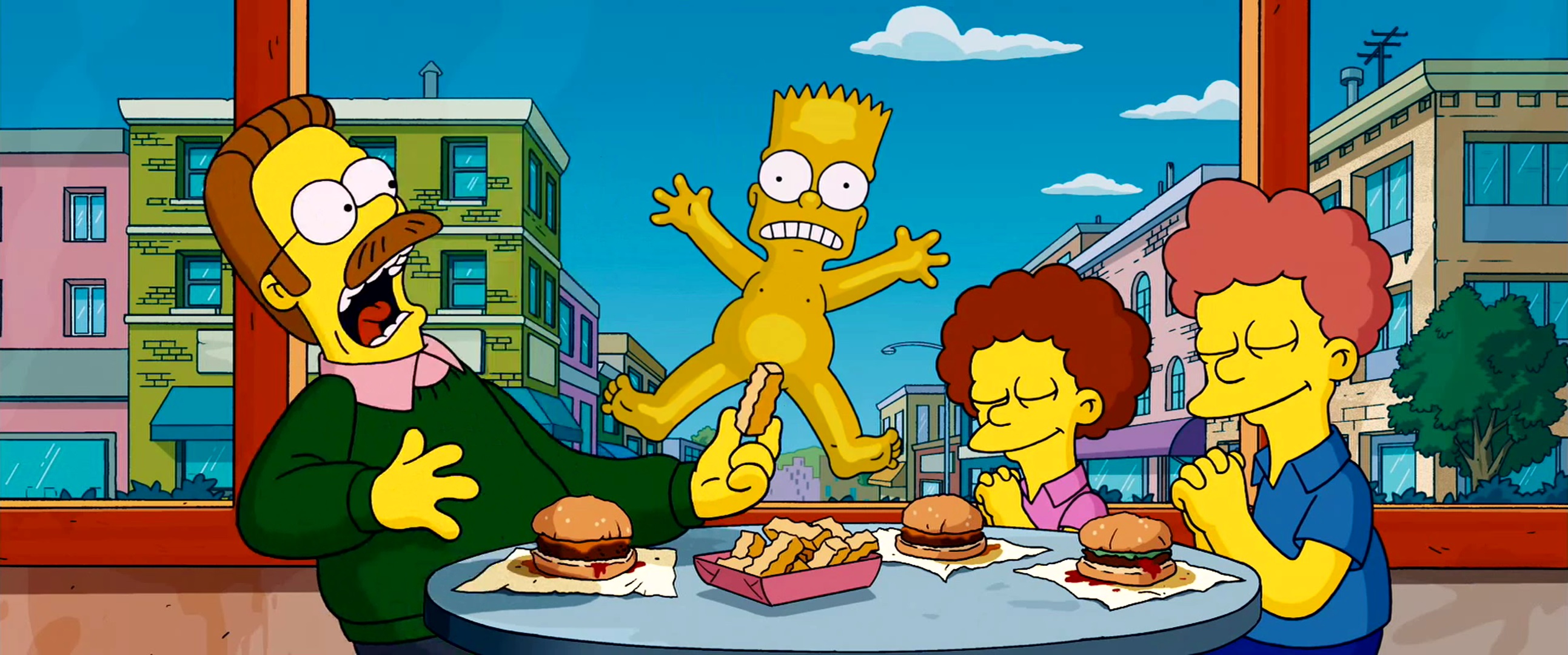
The big screen certainly offers the tv series a much wider canvas than usual. The creative team have made the decision to keep the same low-tech animated style that the characters had on the small screen. The changes come in that we get a few more hi-tech touches – like a number of 3-D animated shots, or subtleties of shadow on characters features, and in particular a rich range of colours. The big screen also allows much more detail where at various points – during the lynch mobbing of the Simpson house and the climactic scenes – we get almost every familiar character from the series together in a crowd scene. The movie version is allowed to get slightly edgier than its tv counterpart was – Bart can skateboard naked through the streets and be seen drinking whiskey, for instance.
Of course, there are always the usual gags packed throughout the background that there are in any episode of the The Simpsons. The film throws a number of jibes in the direction of Arnold Schwarzenegger’s political ambitions with the notion of a President Schwarzenegger. There are snide asides – like where Bart finds a black bra in the luggage on the train, places it on its head like a Mousketeer and announces “I’m the mascot of an evil corporation.” The Simpsons’ revel in Alaska contains an amusing parody of the cutely frolicking animals in Disney’s Snow White and the Seven Dwarfs (1937), while Homer visits a bar called Eski-Moes where he plays Grand Theft Walrus and shoots up the likeness of a Happy Feet (2006)-styled dancing penguin. There is the delightful throwaway gag where Marge rushes back into the burning house to get her keepsakes and cannot prevent herself from stopping and washing a dish left in the sink.
However, there are a number of disappointments too. The series has become such an established tradition that one expects various familiar elements. For some reason, the movie only gives us the start but not the rest of the classic opening credits sequence with its changing elements that has become an indispensable aspect of every episode of the tv series. The film is surprisingly free of the numerous celebrity cameos that appear throughout the series. One expected that the movie would have come packed with cameos but all that we get is Green Day who are drowned in Lake Springfield at the start and Tom Hanks introducing a public service announcement: “The US Government has lost its credibility and so decided to borrow some of mine.” (Apparently many more cameos were filmed but ended up being cut).
There are also times when the film ends up being just a little too cutely meta-fictional in reminding us of the fact that we are watching a film version of the tv series:– it opens on the movie version of Itchy and Scratchy, the parody cartoon show in the series where characters are always killing each other in absurdly ultra-violent means, where Homer turns to the screen and opines “I can’t believe we’re paying to see something we can get for free on tv”; in the partial repeat of the series’ opening credits, the lines that Bart writes on the school blackboard are “I Will Not Download This Movie”; at one point, a banner appears along the bottom of the screen advertising the tv series Are You Smarter Than a Celebrity?, followed by the legend “Yes, we now have advertisements during movies”; at the end, the Simpsons sit watching the credits with Lisa wanting to stay and be sure of the bit where no animals were hurt during the making of the film, where Maggie’s first word ends up being “sequel” and we then get a theatre usher complaining while cleaning up the popcorn.
The big screen has necessitated that The Simpsons gain a more classical story structure, which it tends to feel awkward having to do, like where Homer has to undergo an heroic arc. The film is also not that satisfying as a story. There are a number of subplots – Bart begins to regard Ned Flanders as a more ideal father figure than Homer, Lisa meets the perfect male counterpart in the form of Colin – that never get the full treatment they need. On the small screen, each of these would have been granted a half-hour episode apiece, which one suspects would have ended up giving them a more deserving treatment. The A-story that the film uses – jumping aboard trendy global warming awareness spoofing Al Gore’s hit documentary An Inconvenient Truth (2006) with Lisa giving a lecture entitled An Irritating Truth – is nothing earth shattering either.
One comes out feeling that a Simpsons movie should have had something a little more monumental than that. The creative personnel purportedly went through a 158 script drafts and cut enough material from the film to make an entire second feature so maybe it is just that after eighteen years on the small screen that The Simpsons have exhausted most of the good ideas available to them. For all that The Simpsons Movie should have been, one ends up feeling disappointed by the lack of real laughs and of being left with the sense of a film that is mostly coasting by on the expectation of its audience’s familiarity with the setting and characters.
Trailer here