

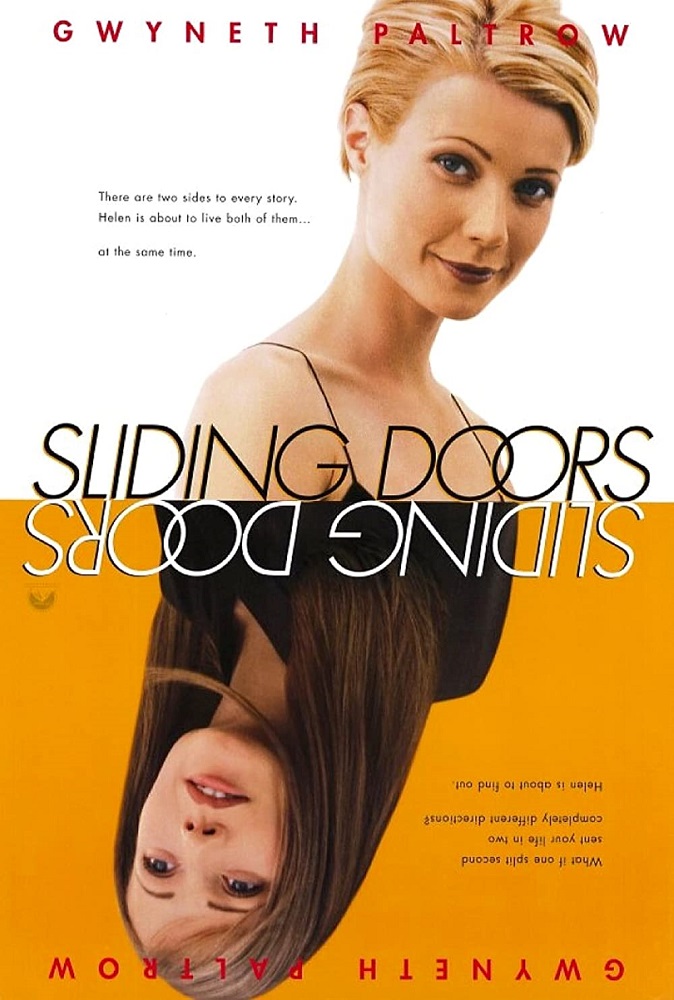
Crew
Director/Screenplay – Peter Howitt, Producers – Philippa Braithwaite, William Horberg & Sydney Pollack, Photography – Remi Adafarasian, Music – David Hirschfelder, Music Supervisor – Anita Camarata, Visual Effects – Cinesite, Production Design – Maria Djurkovic. Production Company – Intermedia Films/Miramax/Paramount/Mirage Enterprises.
Cast
Gwyneth Paltrow (Helen Quilley), John Lynch (Gerry Flanagan), John Hannah (James Hammerton), Jeanne Tripplehorn (Lydia), Zara Turner (Anna), Douglas McFerran (Russell)
Plot
Helen Quilley is fired from her job with a London PR firm and returns home. Depending whether or not she bumps into a child on the tubeway steps, she misses her train home. If she catches the tube, she gets home in time to catch her boyfriend with another woman and from there walks out, becomes involved with another man and successfully sets up her own business. In an alternate scenario, she misses the train, never discovers her layabout boyfriend’s continuing deception and continues on in a low-paying waitressing job.
I was preparing to start this review with something like “Sliding Doors conducts a unique venture into the concept of alternate timelines, the wildly divergent sets of circumstances that may result from a different choice made at a crucial point …”. At least, I would have thought it a more unique film had two weeks earlier I not seen the Hong Kong gangster film Too Many Ways to Be No. 1 (1997).
Too Many Ways to Be No. 1 was made a year prior to Sliding Doors and both films are remarkably similar. Both conduct two different divergent stories dependent on the central character making a crucial choice in a trivial matter at the start of the story. It is hard not to believe that Too Many Ways to Be No. 1 was not an influence over Sliding Doors, especially considering the timing and the sudden emergence of the uniqueness of this theme.
Of course, both films choose to tell the story in very different milieus. Too Many Ways is almost a parody of the hard-boiled Hong Kong gangster film, while Sliding Doors is a romantic comedy made in the shadow of Four Weddings and a Funeral (1994). Of the two, Sliding Doors is certainly the more conceptually audacious in that it tells its two stories concurrently, interweaving and allowing aspects of one story to mirror the other, while Too Many Ways settles less challengingly for merely telling its two stories consecutively. The same theme was also dealt with earlier by Alain Resnais’s Smoking/No Smoking (1993).

Of the two, Sliding Doors is invariably the lesser. It tries too hard to be another Four Weddings and a Funeral – yet another cosmopolitan London romantic comedy and cast with an eye toward international box-office (with the beautiful swan-necked Gwyneth Paltrow at least conducting a creditable British accent here). Director/screenwriter Peter Howitt writes some occasionally amusing one-liners but the characters are one-dimensional. The depth they are given only comes in terms of catchphrase descriptions – Jeanne Tripplehorn is The Bitch; John Hannah is Prince Charming – we never even find out what sort of businessman he is; and John Lynch is The Cheating Loser Boyfriend. John Lynch’s character is so one-dimensional and he given so little motivation in his cheating and indecision that one cannot help but wonder what it is that two different women see in him.
One finds it hard to swallow the basic premise of Sliding Doors. Screenwriter Peter Howitt asks us to believe that not only whether Gwyneth Paltrow misses the train or not makes the difference between two paths she leads (fair enough) but also the entire difference between whether she leads a successful life or not. One could maybe have bought it if the two pathways were not so categorically black-and-white – if she makes the train, she gets Prince Charming, makes a success of herself in business, gets a new sharp image; whereas if she doesn’t, she ends up unhappy, stuck in a low-paid job as a waitress and never finds out the truth about her useless, unfaithful boyfriend. It even makes the difference, for goodness sake, whether she gets pregnant to Prince Charming or to the loser boyfriend.
Underneath, Sliding Doors is a bland Yuppie daydream – beneath its romantic ambitions, it buys into the fantasy that success in life equates with success in business, a good image and true love; and Hell in life is being caught in a dead-end relationship and a thankless, minimum-wage job in the service industry. Sadly, the film buys into the Cinderella Complex – that a woman’s success and happiness in life is dependent on said success and happiness being delivered to her.
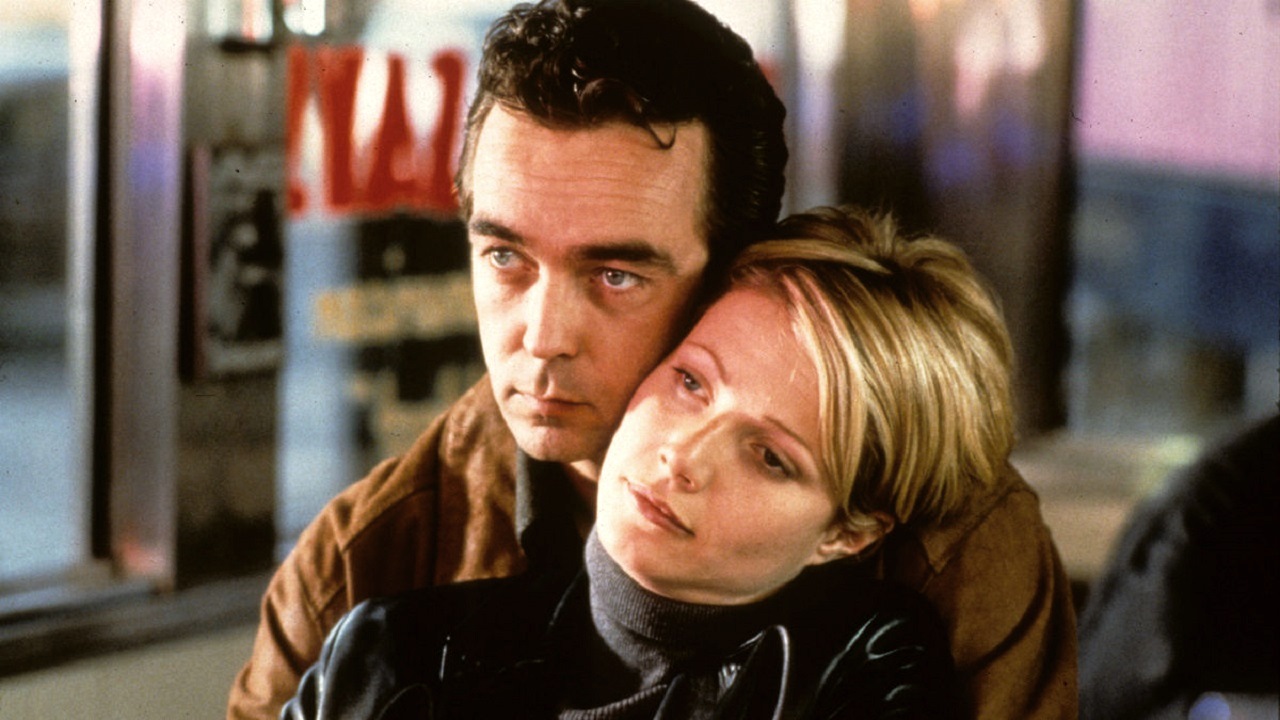
What Sliding Doors ends up saying is that success, fulfilment and uncovering the truth about the world are things that only occur by chance happenstance as opposed to being dependent upon one’s own decisions and self-determination, and that happiness is a result of external consequence rather than an attitude of mind. Personally, I don’t buy it.
Although, Sliding Doors was only a modest success, it did inspire several others ventures into this kind of woman’s alternate lifestyle fantasy. Others include the tv movie Twice Upon a Time (1998), Twice Upon a Yesterday (1998), Run Lola Run (1998), Me Myself I (1999) and Passion of Mind (2000), and four male versions, The Family Man (2000), Possible Loves (2001), The Butterfly Effect (2004) and Mr. Nobody (2009). (For a more detailed listing of these see Films About Alternate Timelines).
Director Peter Howitt next made the computer thriller Antitrust (2001), which was loosely based on the Microsoft trial, the spy comedy Johnny English (2003), the romantic comedy Laws of Attraction (2004) and the post-holocaust film Scorched Earth (2018).