
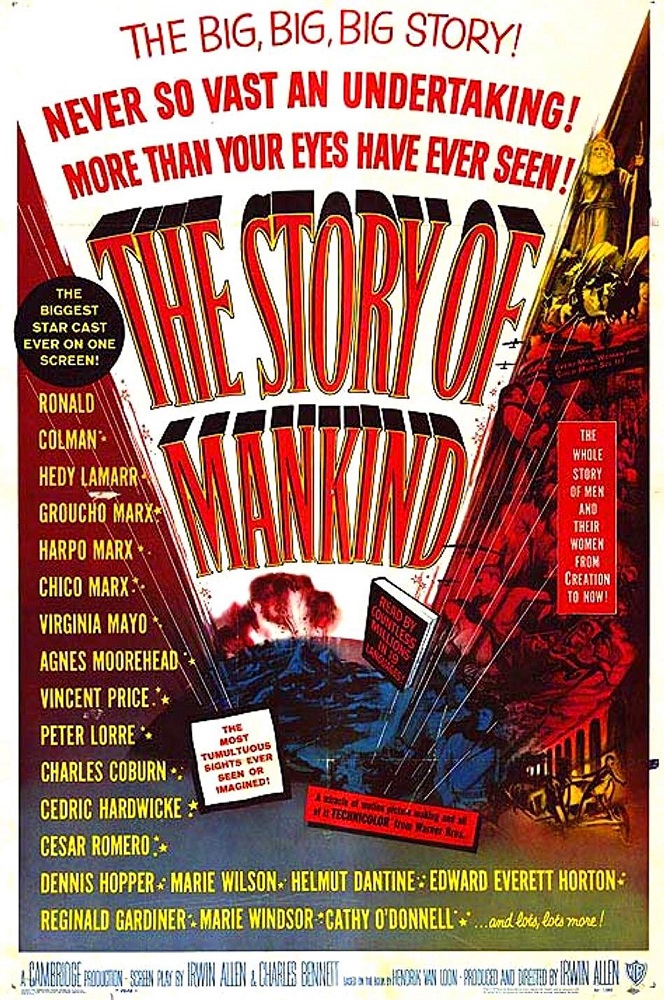
Crew
Director/Producer – Irwin Allen, Screenplay – Irwin Allen & Charles Bennett, Based on the Novel by Henrik Van Loon, Photography – Nick Musuraca, Music – Paul Sawtell, Makeup Supervisor – Gordon Bau, Art Direction – Art Loeb. Production Company – Cambridge.
Cast
Ronald Colman (The Spirit of Mankind), Vincent Price (Mr Scratch), Cedric Hardwicke (Judge), John Carradine (Khufu), Francis X. Bushman (Moses), Virginia Mayo (Cleopatra), Helmut Dantine (Mark Antony), Reginald Sheffield (Julius Caesar), Dani Crayne (Helen of Troy), Charles Coburn (Hippocrates), Peter Lorre (Nero), Hedy Lamarr (Joan of Arc), Anthony Dexter (Christopher Columbus), Edward Everett Horton (Sir Walter Raleigh), Agnes Moorehead (Queen Elizabeth I), Cesar Romero (Spanish Ambassador), Reginald Gardiner (William Shakespeare), Groucho Marx (Peter Minuit), Abraham Sofaer (Indian Chief), Harpo Marx (Isaac Newton), Dennis Hopper (Napoleon Bonaparte), Marie Wilson (Marie Antoinette), Austin Green (Abraham Lincoln), Jim Ameche (Alexander Graham Bell), Bobby Watson (Adolf Hitler)
Plot
A tribunal is convened in the heavens to decide what to do now that mankind has developed the H-Bomb 60 years before it is meant to. The tribunal incarnates The Spirit of Mankind, one man who represents the average qualities of humanity, to argue the case that mankind should not be allowed to obliterate itself, while The Devil, Mr Scratch, comes to argue in favour of mankind’s baser, most destructive tendencies. To make their case, the two of them choose examples that range throughout human history, from Ancient Egypt through the Roman Empire, the Dark Ages, the Renaissance, the Discovery of the New World and the colonization of the USA, and World War II.
The Story of Mankind survives today as a Golden Turkey Classic. Indeed, the Medved Brothers selected it as one of their The Fifty Worst Movies of All Time (1977). It was one of the first films of producer/director Irwin Allen. Irwin Allen would of course become best known during the 1960s as the producer of tv series such as Voyage to the Bottom of the Sea (1964-8), Lost in Space (1965-8), The Time Tunnel (1967-8) and Land of the Giants (1969-71), while in the 1970s, he singlehandedly created the disaster movie genre as producer/director of the likes of The Poseidon Adventure (1972), The Towering Inferno (1974) and The Swarm (1978). Irwin Allen had made a couple of feature-length documentaries prior to The Story of Mankind but this was his first film using actors.
Irwin Allen’s films are more akin to circuses than films. They are filled with wooden spectacle and hucksterish showmanship where Allen wheels out name stars as though they were headline attractions. Here Allen adapts Henrik Van Loon’s best-selling 1922 non-fiction book that was a potted overview of history designed for children. In typical fashion, Allen managed to talk 56 stars into devoting about a day apiece for $2500 each and then winding this in around stock and unused footage from various Warner Brothers historical spectacles.
Of course, trying to make an epic that covers all of human history but crams it into 100 minutes is naturally a slapdash operation – the Twentieth Century, for example, is skipped over in all of about five minutes. There is also the assumption that informs many world history accounts, that history is something that only happened to white people mostly in Europe (with a brief stopover in Ancient Egypt and Christian Jerusalem).
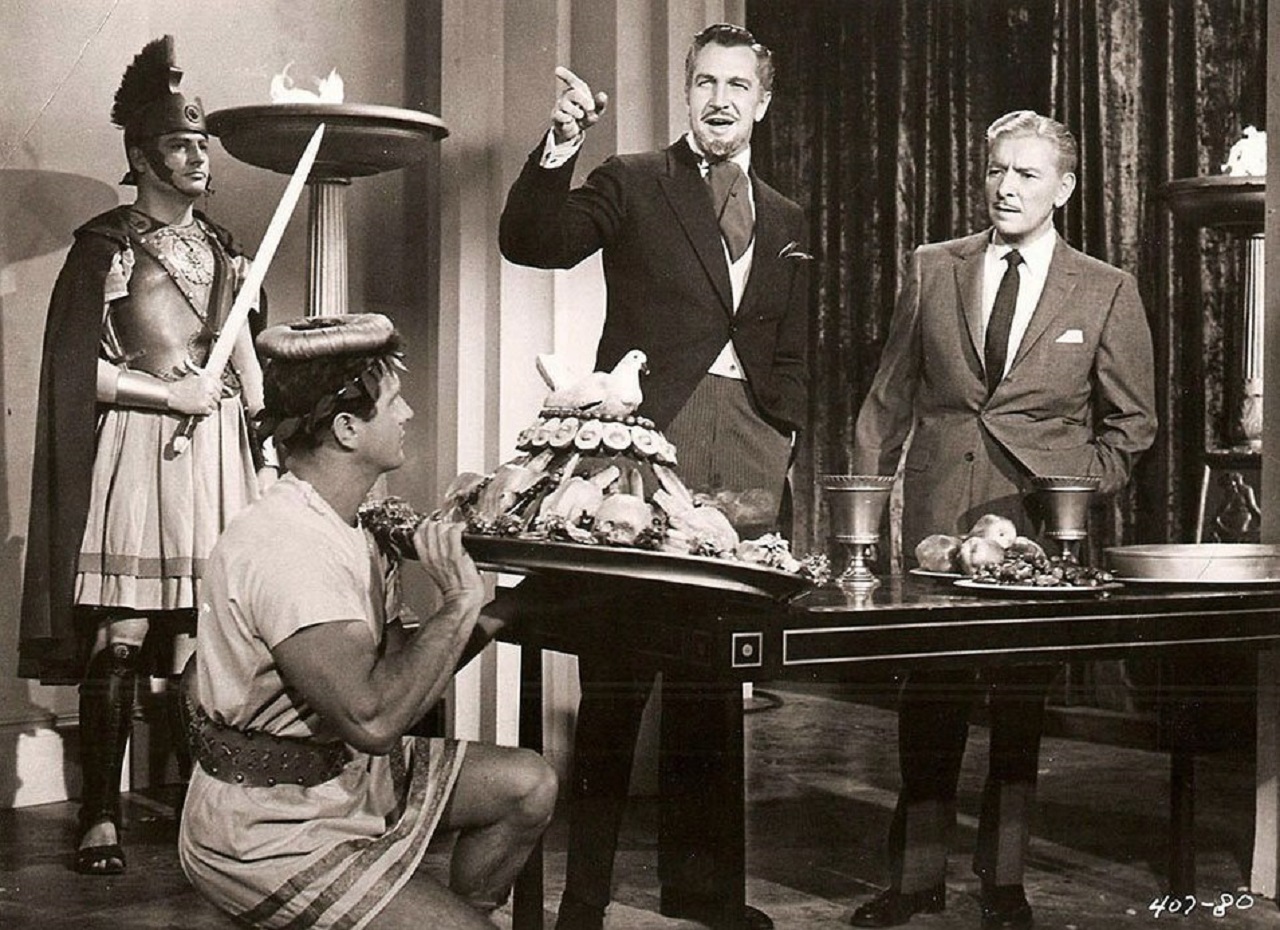
Where The Story of Mankind‘s Golden Turkey reputation comes is in the film’s disastrous miscasting. Irwin Allen has roped in a truly amazing cast. Virginia Mayo makes a petulantly girlish Cleopatra and Agnes Moorehead an appallingly over-the-top Queen Elizabeth I, while other casting is simply bizarre – in particular, Dennis Hopper as Napoleon. As such, The Story of Mankind could pass adequately, if stolidly, as an historical drama – that is until the introduction of the Marx Brothers about two-thirds of the way through. This proves to be disastrous miscasting that sinks The Story of Mankind – and something that has guaranteed the film Golden Turkey status.
In these scenes, Groucho Marx does his stand-up comedy thing as Peter Minuit, the man who brought Manhattan Island, which is terrible, all the more so because a comedy routine seems completely out of place in a film that had up until that point given all indication of taking itself seriously. Even worse is Harpo Marx’s appearance a few minutes later as Isaac Newton where Harpo plays the part doing his familiar silent mime and facial gymnastics. In no way does he suggest a scientific genius, all he is is a clown in an orange wig doing mime shtick and using his harp to slice the fallen apple. Chico Marx also makes a negligible appearance as a monk.
One also has a problem with the argument that the film makes. The Spirit of Man’s position, which one is clearly supposed to empathise with by virtue of him being a named a representative of all mankind, is one that holds an absurdly optimistic view of human nature. By contrast, The Devil’s position, which we are clearly meant to reject by virtue of it being voiced by The Devil – that humanity is selfish, short-sighted and petty – seems one that the film offers an overwhelming abundance of evidence for. Certainly, of the two positions presented, the latter is the one that seems the more realistic interpretation of history.
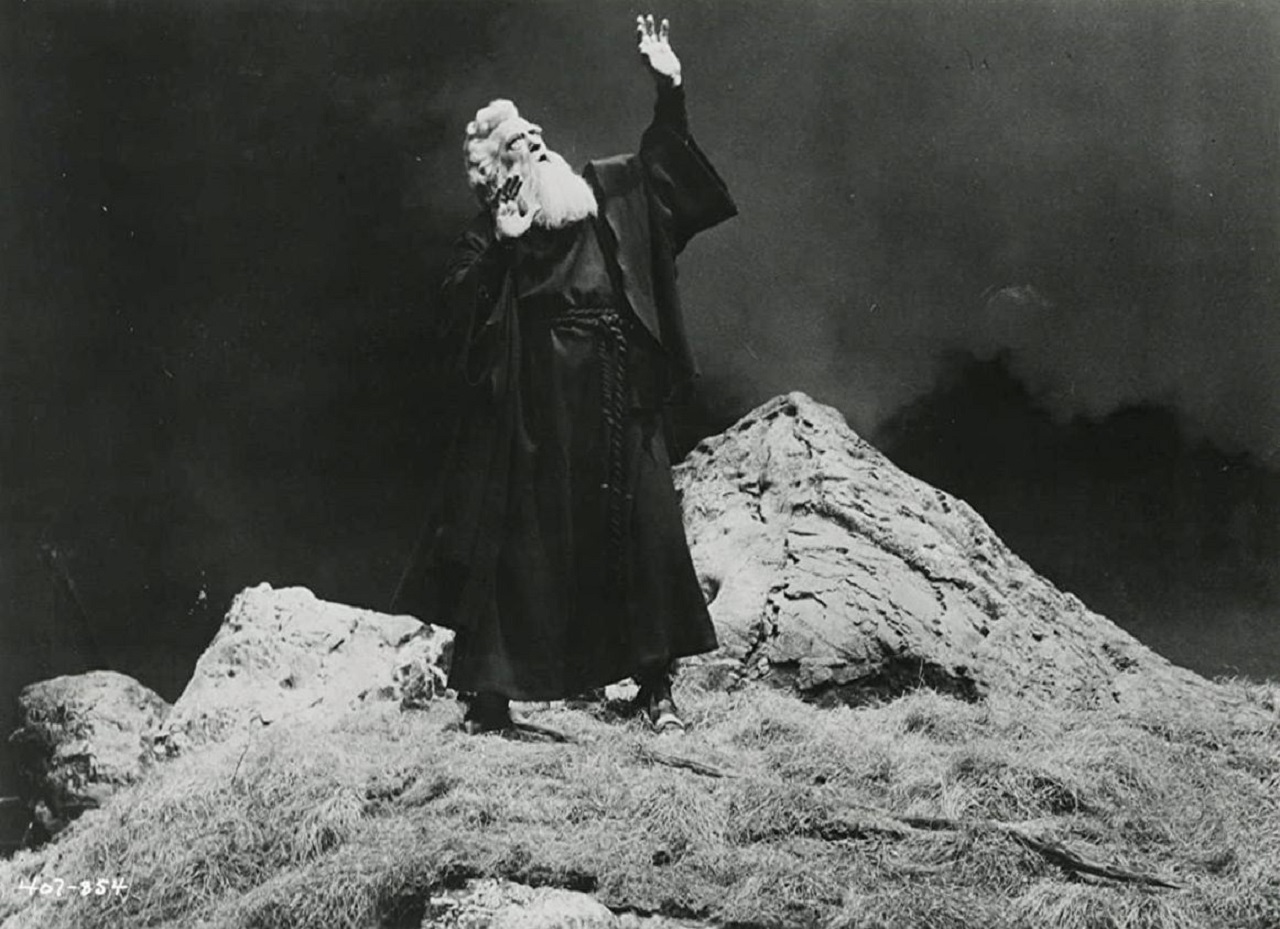
The Story of Mankind is also an historical epic that comes informed by the fears of the Nuclear Age. In the Henrik van Loon book, for instance, there are no heavenly tribunals, no judgments being passed on humanity, the book is simply a straight factual summation of history. There was an overriding sense in the 1950s of some great sense of a line having been crossed over, of a Pandora’s Box having been opened. As in a number of other films of the era such as The Day the Earth Stood Still (1951) and The Flight That Disappeared (1961), humanity is being judged for having invented The Bomb. The Story of Mankind makes it explicit with Cedric Hardwicke’s Judge directly turning to the screen at the end and telling the audience, “The choice is up to you.”
Irwin Allen’s other works of genre interest are:– as producer/director/writer of the remake of The Lost World (1960); as director/producer/writer of the film Voyage to the Bottom of the Sea (1961); as producer of the tv series’ Voyage to the Bottom of the Sea (1964-8), Lost in Space (1965-8), The Time Tunnel (1967) and Land of the Giants (1968-70); as director/producer of City Beneath the Sea/One Hour to Doomsday (1971), a failed tv pilot, which Allen then released cinematically; as producer of The Time Travelers (1976), another unsold tv pilot, written by Rod Serling; as producer of the tv mini-series The Return of Captain Nemo (1978), which was theatrically released internationally as The Amazing Captain Nemo (1978); as director/producer of the legendarily bad killer bee film The Swarm (1978); and as producer of an all-star tv mini-series adaptation of Alice in Wonderland (1985).