

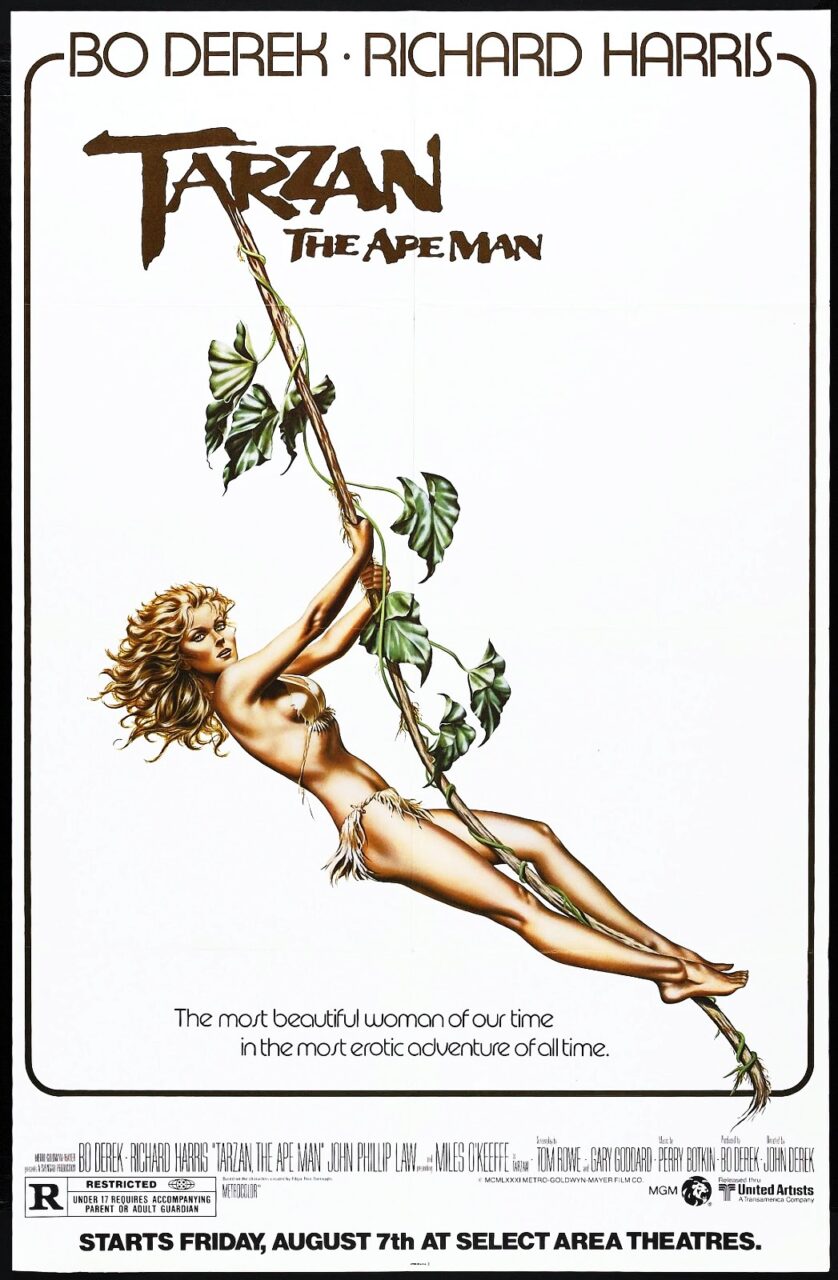
USA. 1981.
Crew
Director/Photography – John Derek, Screenplay – Gary Goddard & Tom Rowe, Based on the Novel Tarzan of the Apes by Edgar Rice Burroughs, Producer – Bo Derek, Music – Perry Botkin, Art Direction – Alan Roderick-Jones. Production Company – Svengali Productions.
Cast
Bo Derek (Jane Parker), Richard Harris (Captain James Parker), Miles O’Keeffe (Tarzan), John Phillip Law (Harry Holt), Akushula Selayah (Africa), Steven Strong (Ivory King)
Plot
West Africa, 1910. Jane Parker arrives in search of her father, the explorer Captain James Parker, who she has not seen since she he left her mother when she was a child. She learns that he is mounting an expedition to the unexplored territory of The Escarpment in search of the legendary elephant’s graveyard and joins them. As they set forth, they learn of the legend of a fabled white ghost that haunts the jungle and whose distinctive roar can be heard. As they head inland, the muscular jungle man Tarzan, the source of the roar, saves Jane’s life and then snatches her away. The two proceed to fall in love.
In the 00s, there was Paris Hilton; in the 1990s, there was Pamela Anderson; in the early 1980s, the equivalent was Bo Derek. Bo Derek was one of the genuine no-talent phenomena of the era. Bo came to fame in 10 (1979), a Blake Edwards comedy where Dudley Moore plays a man going through a midlife crisis who becomes fixated on her. Bo Derek’s supporting role in the film catapulted her to become an instant worldwide sex symbol. It was also at this very instant of Bo’s success that her career began to plummet. This was managed by her husband John Derek, a former actor who was thirty years her senior.
John Derek was a not very successful actor who had made four films as a director before casting the seventeen year-old Bo is one of his films. He then used the springboard of Bo’s newfound celebrity to boost his directorial ambition. He put Bo through four films. Each of these was worse than the last, including the excruciating likes of Fantasies (1981), the film John was shooting when he and Bo met, Tarzan the Ape Man here and the subsequent Bolero (1984) and Ghosts Can’t Do It (1989). All of these were founded on Bo Derek undressed – nothing else. The films are abysmal, made all the more so by Bo’s phenomenal lack of acting talent and their being sold around the premise of her willingness to shed her clothes at the drop of a hat. The expression on her face throughout these films is entirely vacant.
To say that Tarzan the Ape Man, the Dereks’ take on Edgar Rice Burroughs’ Tarzan of the Apes (1912), is their best film and Jane the best written role that Bo ever had is no particular recommendation. The Dereks managed to obtain a then modest $6.5 million budget for the film. This allowed them to go to Sri Lanka to shoot, which does afford some lavish location photography.
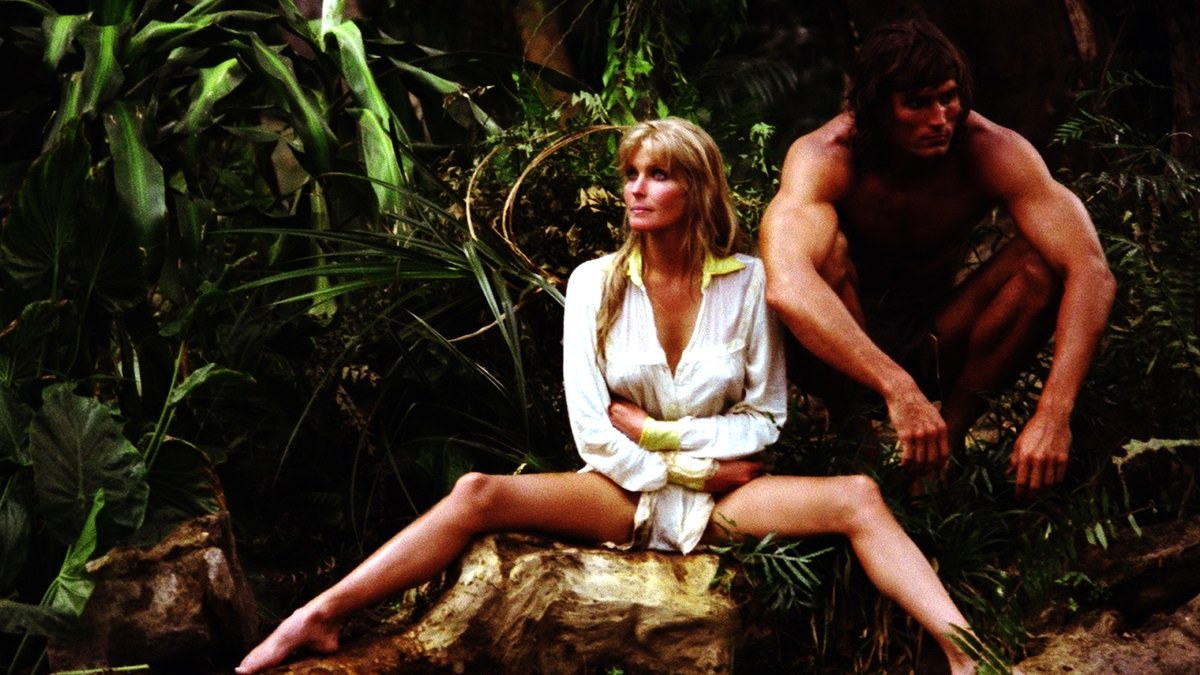
Alas, the film they produced is a ludicrously empty bore. For one, it is a misnomer to call it a Tarzan film – it should have been called Jane. Tarzan does not appear until halfway through the film and has no dialogue when he does. Even the film’s poster consists of Bo swinging through the jungle on a vine with Tarzan nowhere in sight. He is portrayed as the most musclebound and primitive of all screen Tarzans – the film never even deigns to offer any explanation of what he is doing in the jungle. The entire focus of the film is on Bo and providing scenes that give her almost any opportunity to shed her clothes.
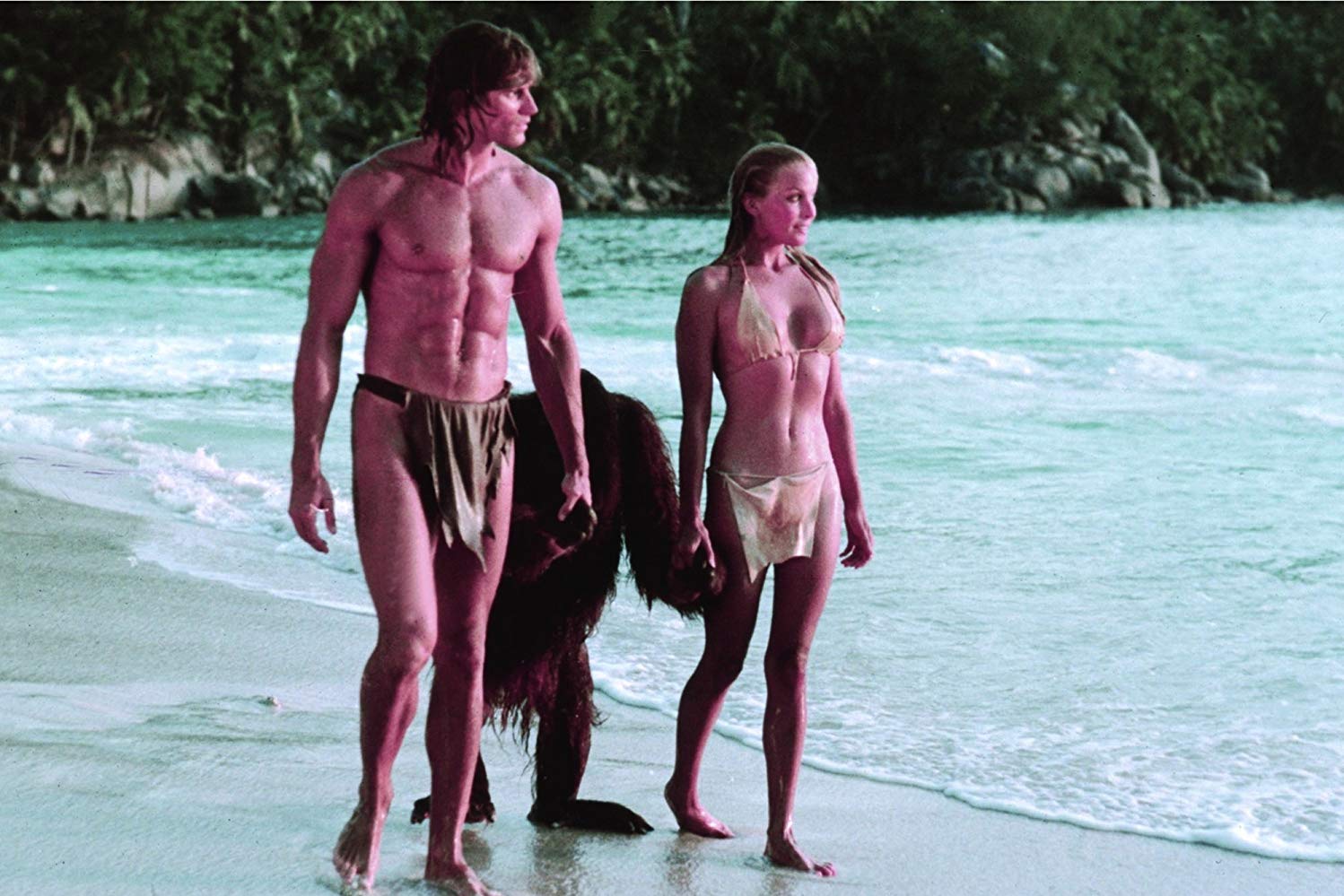
If nothing else can be said about John Derek as a director, he at least produces a beautifully photographed film (which John also conducted). It is perhaps the one Tarzan film that determines to make a virtue of the locations. As a result, the scenes of Bo Derek and Miles O’Keeffe running around naked have a natural freeness to them. Where Tarzan the Ape Man (1932), on which this film is closely modelled (see below), has coy and sweetly charming romanticism to it, this is more like a dreamy nudie film where it feels as though all of Africa is an Edenic playground for the two characters to freely romp.
Like the early nudie films, there is the pretence made that it is about nature, not about sexuality, and comes accompanied by an almost utopian belief that being in nature freed from the constraints of clothing equates with pure bliss. There is a replaying of the scene from the 1932 film where Johnny Weissmuller and Maureen O’Sullivan play together in the water but here it becomes about the virginal Bo Derek discovering eroticism. The only thing that ruins everything is an overblown score that keeps trying to pump routine scenes like Bo and Miles O’Keeffe meeting in the surf up into something monumental even when the epic flourishes of the soundtrack are not matched by the ordinariness of the happenings on the screen.
From the opening image where the roar of MGM’s trademark lion is replaced by the famous Tarzan yodel, Tarzan the Ape Man 1981 gives indication that it is no longer treating the Tarzan film seriously. Appreciation of Bo Derek’s figure aside, Tarzan the Ape Man quickly lapses into tedium. There is almost nothing that happens in the film – no drama, no story, nothing. There is barely even any action – Tarzan never gets to engage in any of his customary vine swinging.
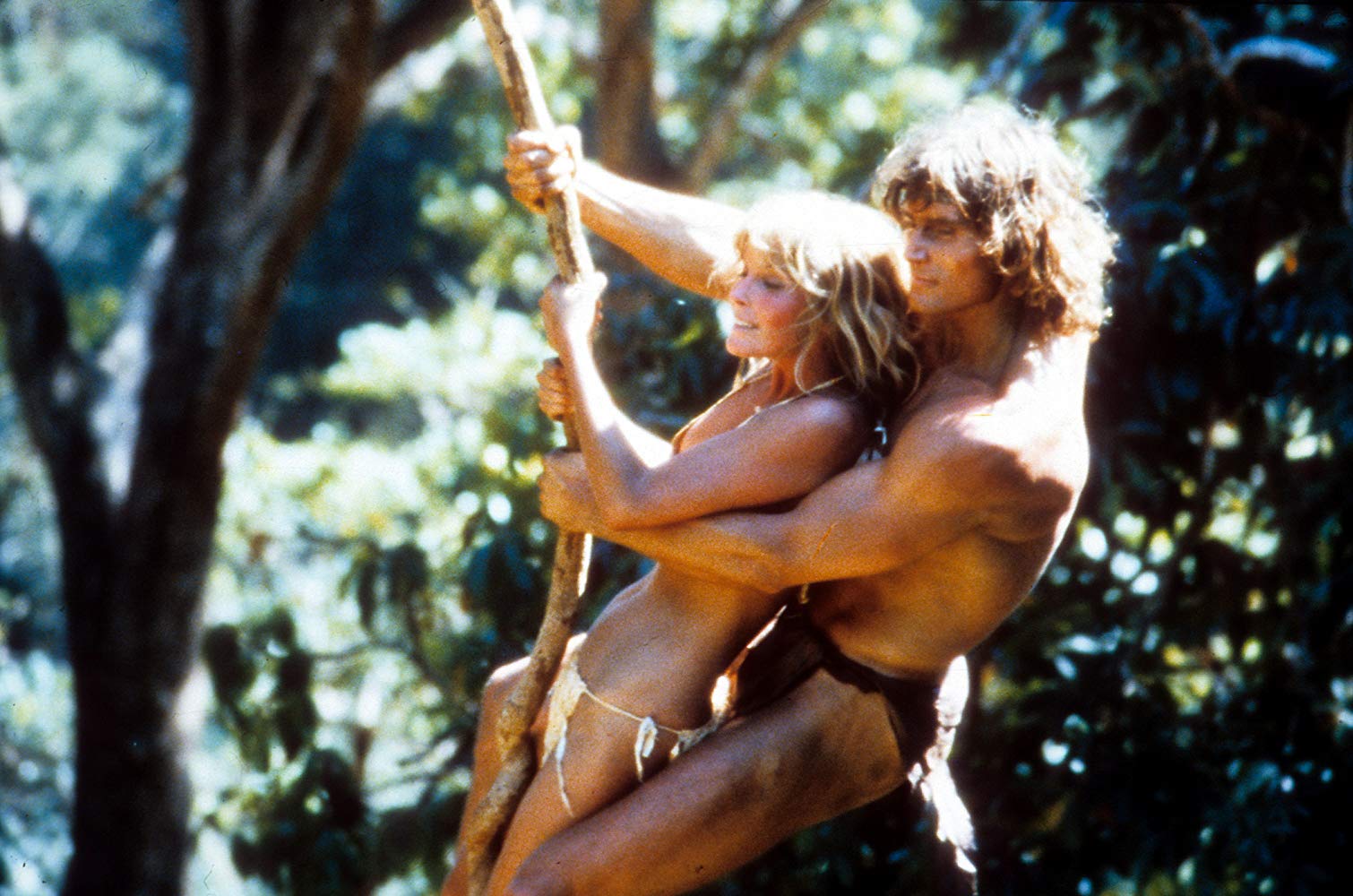
There is one laughable scene where Miles O’Keeffe pretends to wrestle a rubber snake in the water in slow motion that goes on and on for several minutes and looks completely unconvincing. There is a vaguely developed menace towards the end where Bo Derek is captured by a pygmy tribe who strip her naked and paint her body white but everything else is centred around the location scenery and Bo’s naked body.
The snake wrestling and pygmy village scenes are woeful in comparison to the 1932 film and its sequel Tarzan and His Mate (1934) where we had magnificent scenes with Johnny Weissmuller wrestling bare-handed with leopards and lions, fighting crocodiles under the water, and commanding an army of elephants to trample a pygmy village. Despite fifty years difference between the two versions, we have gone from an epic adventure to just an expensive nudie film.
Of equally awful fascination is the normally respectable Richard Harris who lets all stops go in a performance of spectacularly over-the-top hamming as though he was determined to compensate for the blankness of Bo Derek in terms of lack of restraint in his own performance. The film plummets from the opening scenes where we are introduced to Richard Harris running around in the water in a nightshirt with his bare buttocks showing yelling “where’s my cannon?” at the top of his voice. Particularly absurd are the scenes at the climax where Bo is being painted by the natives and the imprisoned Harris rambles on about merry-go-rounds, Aphrodite and Humpty Dumpty, before he is impaled on an elephant tusk.
The film appears to be construed more as a direct remake of the first Johnny Weissmuller film Tarzan the Ape Man (1932) than a new adaptation of the Edgar Rice Burroughs novel. Burroughs gave a far longer preamble to the story than appears in almost any of the films – half of the book is taken up by the story of how Tarzan’s parents, Lord Greystoke, John Clayton and his wife, are abandoned on the African coast; their death and the infant Tarzan’s being adopted and raised among the apes; followed by his discovery of his instincts as a hunter. In the book, Tarzan only encounters Jane and her father halfway through the story. The 1932 film truncated this and told the story through Jane’s eyes as she joins her father in Africa and they go on an expedition to The Escarpment and end up encountering Tarzan.
This film follows the Weissmuller version in telling the story of Jane and her father’s journey into the interior and her meeting with Tarzan almost point for point. Moreover, it introduces aspects that were unique to the Weissmuller version and copied by subsequent films but are not in the Edgar Rice Burroughs books – Tarzan’s home as being a forbidden and unexplored inland area known as The Escarpment; the purpose of the expedition being the search for the fabled elephant’s graveyard; the supporting character of Harry Holt; the idea of Jane reuniting with her father (who here gets a more elaborate expansion of his backstory wherein he becomes a philandering explorer who has not seen her since she was a child).
The Edgar Rice Burroughs estate were upset at the softcore treatment of the material and tried to sue to stop the film’s release. “It was quite incidental that out clothes were off in some scenes,” Bo Derek claimed in defence. “Our film was done in the finest of taste – taste the Pope would applaud,” claimed John. His Holiness’s comments are not on record but to some extent the Dereks have a point – the MGM/Johnny Weissmuller series portrayed Tarzan and Jane as little more than jungle dwelling suburbanites making a perfect home in their treehut, which became hysterically unreal throughout the sequels; the Dereks merely added a degree of frank and realistic adult reappreciation to the relationship.
The other film versions of the Tarzan story are:– Tarzan of the Apes (1918), the silent Elmo Lincoln version; Tarzan the Ape Man (1932), the classic version with Johnny Weissmuller who went onto appear in a further eleven Tarzan films; Tarzan the Ape Man (1959) starring Denny Miller; Greystoke: The Legend of Tarzan, Lord of the Apes (1984), a lavish version starring Christopher Lambert; the Disney animated version Tarzan (1999); and the motion-captured animated Tarzan (2013) starring Kellan Lutz.
Trailer here