
Crew
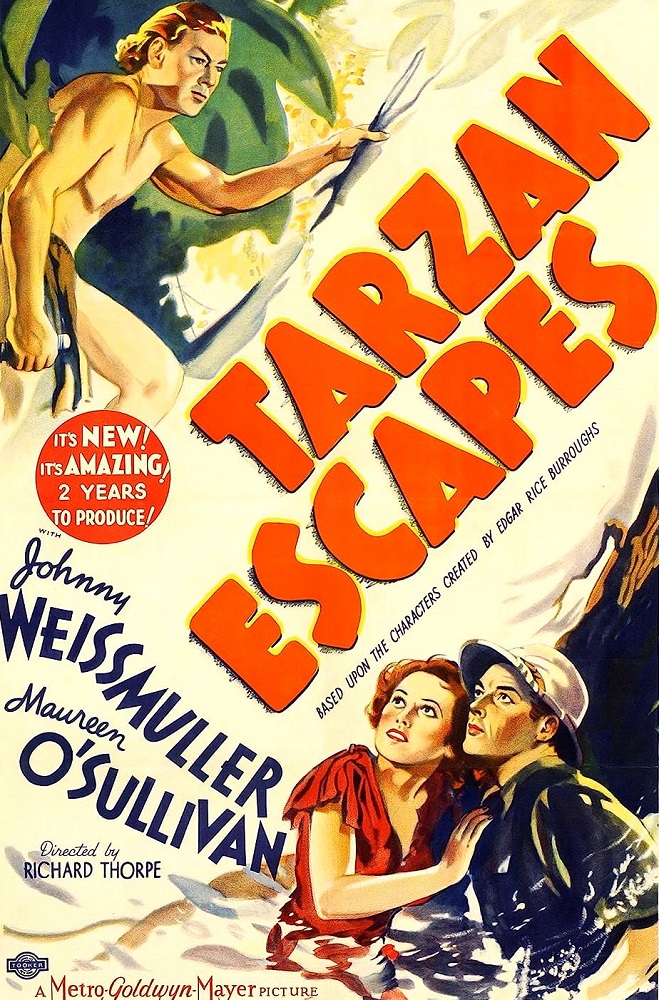
Director – Richard Thorpe, Screenplay – Cyril Hume, Photography (b&w) – Leonard Smith, Art Direction – Elmer Sheeley. Production Company – MGM.
Cast
Johnny Weissmuller (Tarzan), Maureen O’Sullivan (Jane), John Buckler (Captain Fry), Herbert Mundin (Herbert Henry Rawlins), Benita Hume (Rita Parker), William Henry (Eric Parker), Darby Jones (Bomba)
Plot
Jane’s cousins Eric and Rita come to Africa and mount an expedition to The Mutia Escarpment in order to persuade Jane to come back to England to claim a million pound inheritance, lest everything go to entomological research in her absence. They encounter Tarzan and plead with Jane to return with them. Tarzan is distraught when he realises that this means having to go and live in civilisation. As Jane wavers in her decision, the evil big game hunter Captain Fry tries to make Tarzan believe that Jane is betraying him.
Tarzan Escapes was the third of the Johnny Weissmuller Tarzan films. The first two entries, Tarzan the Ape Man (1932) and Tarzan and His Mate (1934), were the peak of the series and two of the best Tarzan films ever made. Tarzan Escapes has an interesting reputation. Apparently another version of the film was originally shot but the action scenes and violence reportedly proved too much for preview audiences. MGM fired original director Jim McKay and replaced him with Richard Thorpe (who would direct many of the subsequent Tarzan films). Thorpe is said to have reshot much of the film, although there is debate about how much of this he did do in actuality – the entire film or just a few scenes.
Though the Johnny Weissmuller Tarzan series started superbly, by this point the films have settled into the comfortable and unvarying formula that they would stay in for more than the next decade. The plot is a familiar journey across flat painted backdrops and rear-projected animal scenes – not to mention through heavily recycled footage of crocodile fights and rampaging native tribes from the previous two films, as well as from Trader Horn (1931). Indeed, with the incessant cannibalism of footage and the interchangeability of plots in the sequels, it becomes difficult to tell one Tarzan film from another. Part of the reason they probably introduced Boy in the subsequent film Tarzan Finds a Son (1939) must have been to have somebody else’s relatives to come visiting in each film.
Unlike the previous film, the quite adult Tarzan and His Mate, Tarzan Escapes is the point where the Hays Code kicks in – Jane’s leopard-skin bikini becomes a more modest mid-thigh length skirt. This is also where the jungle parody of middle-class life began, introducing the tree house with running water, whirling palm frond fans and an elephant-powered elevator.
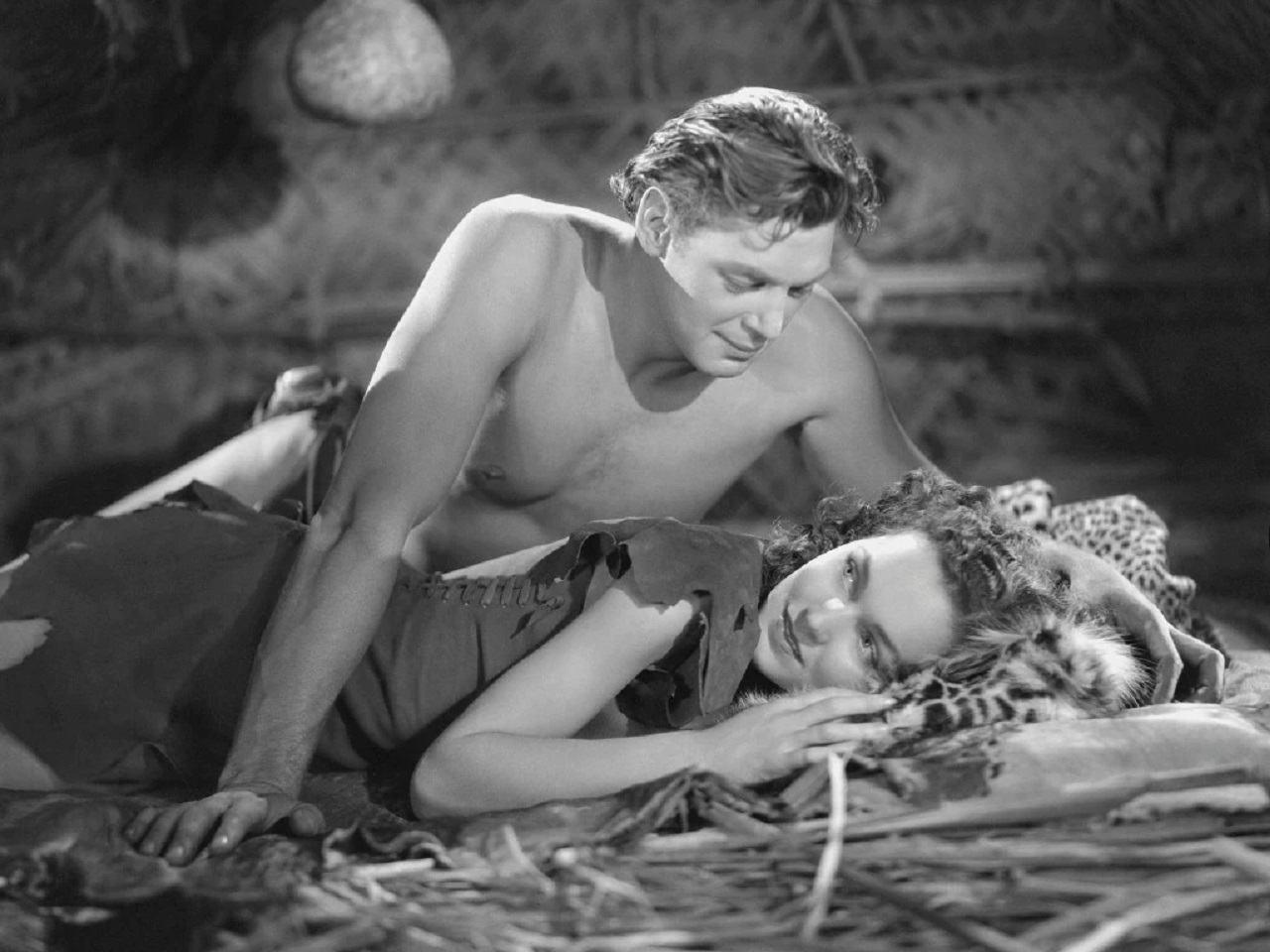
The demure jungle costumery, Johnny Weissmuller’s clean-shaven chin and Maureen O’Sullivan’s bare armpits add a bizarre height of unreality to what essentially becomes a jungle version of a Doris Day film. Some of the dialogue is hysterical, including Jane’s flowering into poetry: “Tarzan makes me alive. Like the rain at the end of the summer, like the wind touching the tops of trees …”
Director Richard Thorpe (1896-1991) had a career that lasted from the silent era during the 1920s to the 1960s. He made a number of classic films including The Prisoner of Zenda (1952), Knights of the Round Table (1953) and Jailhouse Rock (1957), along with a great many B Westerns. In genre material, Thorpe also made the mad scientist film Murder at Dawn (1932), the psycho-thriller Night Must Fall (1937) and four other Johnny Weissmuller Tarzan films with Tarzan Finds a Son (1939), Tarzan’s Secret Treasure (1941) and Tarzan’s New York Adventure (1942). He was also one of the original directors assigned to The Wizard of Oz (1939) but ended up being replaced.
The other Johnny Weissmuller films are:– Tarzan the Ape Man (1932), Tarzan and His Mate (1934), Tarzan Finds a Son (1939), Tarzan’s Secret Treasure (1941), Tarzan’s New York Adventure (1942), Tarzan Triumphs (1943), Tarzan’s Desert Mystery (1943), Tarzan and the Amazons (1945), Tarzan and the Leopard Woman (1946), Tarzan and the Huntress (1947) and Tarzan and the Mermaids (1948).