

USA. 1939.
Crew
Director – Richard Thorpe, Screenplay – Cyril Hume, Producer – Sam Zimbalist, Photography (b&w) – Leonard Smith, Art Direction – Cedric Gibbons. Production Company – MGM.
Cast
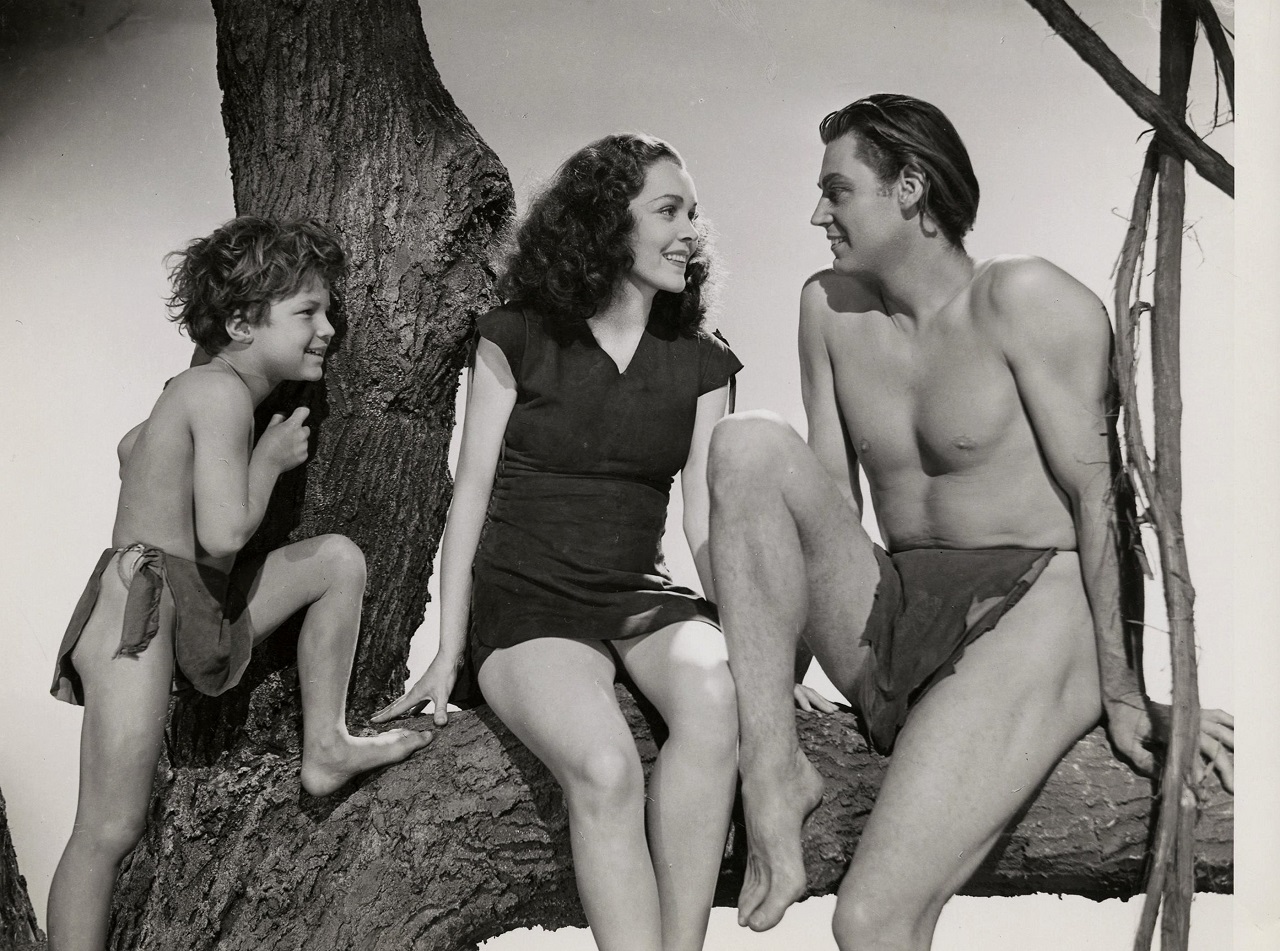
Johnny Weissmuller (Tarzan), Maureen O’Sullivan (Jane), John Sheffield (Boy), Henry Stephenson (Sir Thomas Lancing), Ian Hunter (Austin Lancing), Frieda Inescort (Mrs Lancing), Henry Wilcoxon (Mr Sande)
Plot
Richard Lancing, the Earl of Greystoke, and his wife are flying over The Mutia Escarpment when their plane develops engine trouble and crashes. The only survivor is their infant son, who is found by Cheeta. Tarzan and Jane decide to raise the child as their own, with Tarzan naming it simply Boy. Soon Boy is an adolescent and enjoying the vine-swinging jungle life, just like his foster parents. An expedition made up of the Lancings’ relatives comes to The Escarpment to determine whether the Lancings are dead. Tarzan and Jane try to hide Boy’s origin. When the Lancings discover his true identity, the more ruthless members of the family are determined to adopt him in order to get their hands on the inheritance money.
Tarzan Finds a Son was the fourth of the Johnny Weissmuller Tarzan films. (See bottom of the page for the other entries). Even though it was fairly early on in the series, the stories had started to become hackneyed – the plot about greedy white people coming to The Escarpment and trying to obtain a treasure (or in this case possession of Boy) from Tarzan and employing ruthless methods already feels like it was old hat only four films into the series.
What makes Tarzan Finds a Son such an entertainingly silly entry is the beginning of the Jungle Happy Families business. Tarzan and His Mate (1934) was the height of the Johnny Weissmuller series and holds an often adult sense of eroticism. However, in 1934, the Hays Code had come into effect and imposed a sense of morality on films. Article III of the Hays Code declared that: “The sanctity of the institution of marriage and the home shall be upheld. Pictures shall not infer that low forms of sex relationship are the accepted or common thing.” This meant that Jane was not allowed to do anything like get pregnant because she and Tarzan had not been officially married – and so the film contrives to allow them to have a baby in what must be one of the most novel variations yet on the delivery by stork story.
In the subsequent Tarzan films, a bizarre parody of a domestic family unit was always happening alongside the adventure stuff. This is something that reaches particularly nutty heights here. The scenes involving the raising of the baby are hilarious – Cheeta milks the gazelle, while Tarzan builds wooden baby bottles and cribs and then offers the baby a leg of meat to stop it crying. Jane gives speeches about how miraculous it was that a collection of diapers and safety pins also happened to survive the crash. Meanwhile in the tree hut, an elephant winches an elevator up and down, Cheeta spins a wooden fan made out of leaf fronds, Jane fries giant ostrich eggs, chipping them open with a stone axe, and the first thing the other woman does after arriving is to offer to help Jane in the kitchen.
The one disappointment about Tarzan Finds a Son is the action element. For some reason, Richard Thorpe has filmed the fight and swimming scenes partially undercranked, an effect that only looks silly. The rear-projection work representing the African landscape is particularly poor – in one shot, a back-projected rhino charges a standing Johnny Weissmuller and then runs over the top of the camera (which has clearly been placed on the ground) while Weissmuller remains standing, giving the impression of a rhino that is the size of a house.
Maureen O’Sullivan had just married John Farrow and wanted to quit Hollywood to settle down and raise a family. She made repeated efforts to get out of her contract but MGM insisted that she stay around for another two films until Tarzan’s New York Adventure (1942). An ending was shot wherein Jane was killed but purportedly Edgar Rice Burroughs intervened, objecting the filmmakers had no right to kill the character off, and so a new ending was shot in which Jane recovers – so what we get is scene where Maureen O’Sullivan is fatally wounded by a spear-attack and then the next minute has recovered, dismissing it with a “I feel much better now.” Peculiarly, Boy and the Lancings become the holders of the Greystoke baronial title that is customarily held by Tarzan in the original Edgar Rice Burroughs stories.
The other Johnny Weissmuller Tarzan films are:– Tarzan the Ape Man (1932), Tarzan and His Mate (1934), Tarzan Escapes (1936), Tarzan’s Secret Treasure (1941), Tarzan’s New York Adventure (1942), Tarzan Triumphs (1943), Tarzan’s Desert Mystery (1943),Tarzan and the Amazons (1945), Tarzan and the Leopard Woman (1946), Tarzan and the Huntress (1947) and Tarzan and the Mermaids (1948).