

Crew
Director – Richard Thorpe, Screenplay – Myles Connolly & William R. Lipman, Story – Myles Connolly, Producer – Frederick Stephani, Photography (b&w) – Sidney Wagner, Music – David Snell, Special Effects – Arnold Gillespie & Warren Newcombe, Art Direction – Cedric Gibbons. Production Company – MGM.
Cast
Johnny Weissmuller (Tarzan), Maureen O’Sullivan (Jane Parker), John Sheffield (Boy), Charles Bickford (Buck Rand), Paul Kelly (Jimmie Shields), Chill Wills (Manchester Mountford), Cy Kendall (Colonel Ralph Sargent), Virginia Grey (Connie Beach), Russell Hicks (Judge Abbotson)
Plot
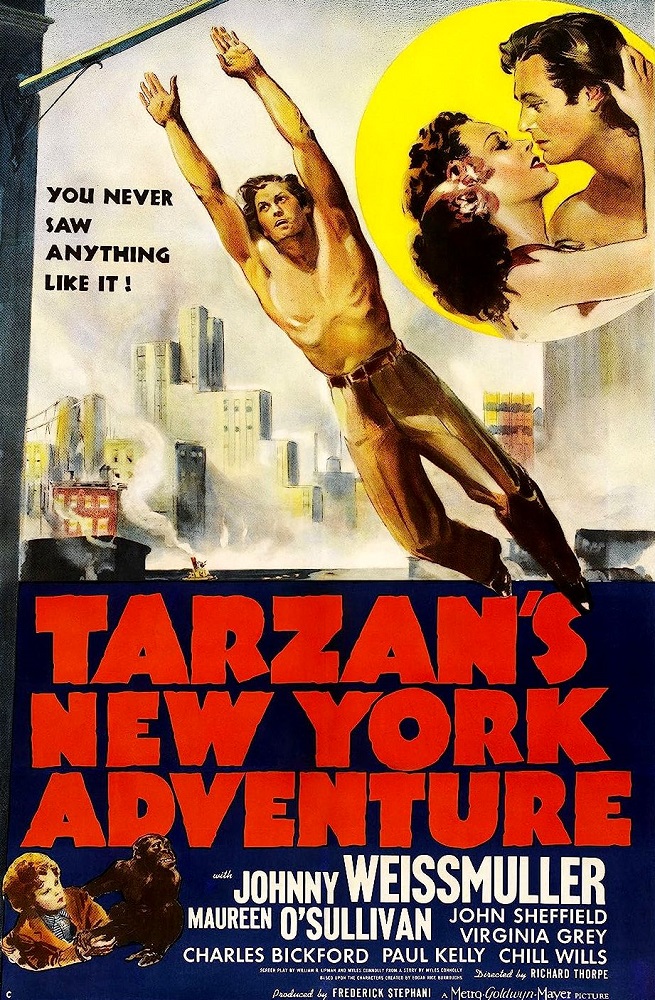
Tarzan, Jane and Boy’s jungle idyll is interrupted by the arrival of big game hunter Buck Rand who has come to Africa to capture animals for a zoo in New York City. Rand is impressed by Boy’s ability to handle animals. He ruthlessly abandons Tarzan and Jane in a brush fire and then convinces Boy that they are dead and to return to New York with him. However, Cheeta rescues Tarzan and Jane. With Cheeta in tow, they head to New York to get Boy back. Once there, they find that Rand has filed papers to adopt Boy. They must go into court to fight for custody. In court, Rand tries to argue that they are not fit parents because the jungle is not a proper environment in which to raise a child.
Tarzan’s New York Adventure was the sixth of the Johnny Weissmuller Tarzan films. (See below for the other Johnny Weissmuller Tarzan films). It was the last of the series to feature Maureen O’Sullivan’s Jane after O’Sullivan decided to opt out of playing the role. (The role of Jane was retired from the series for several years after this). It was also the Tarzan series’ last outing at MGM, before RKO Radio Pictures picked the rights up and Johnny Weissmuller and John Sheffield moved there for the remainder of the series.
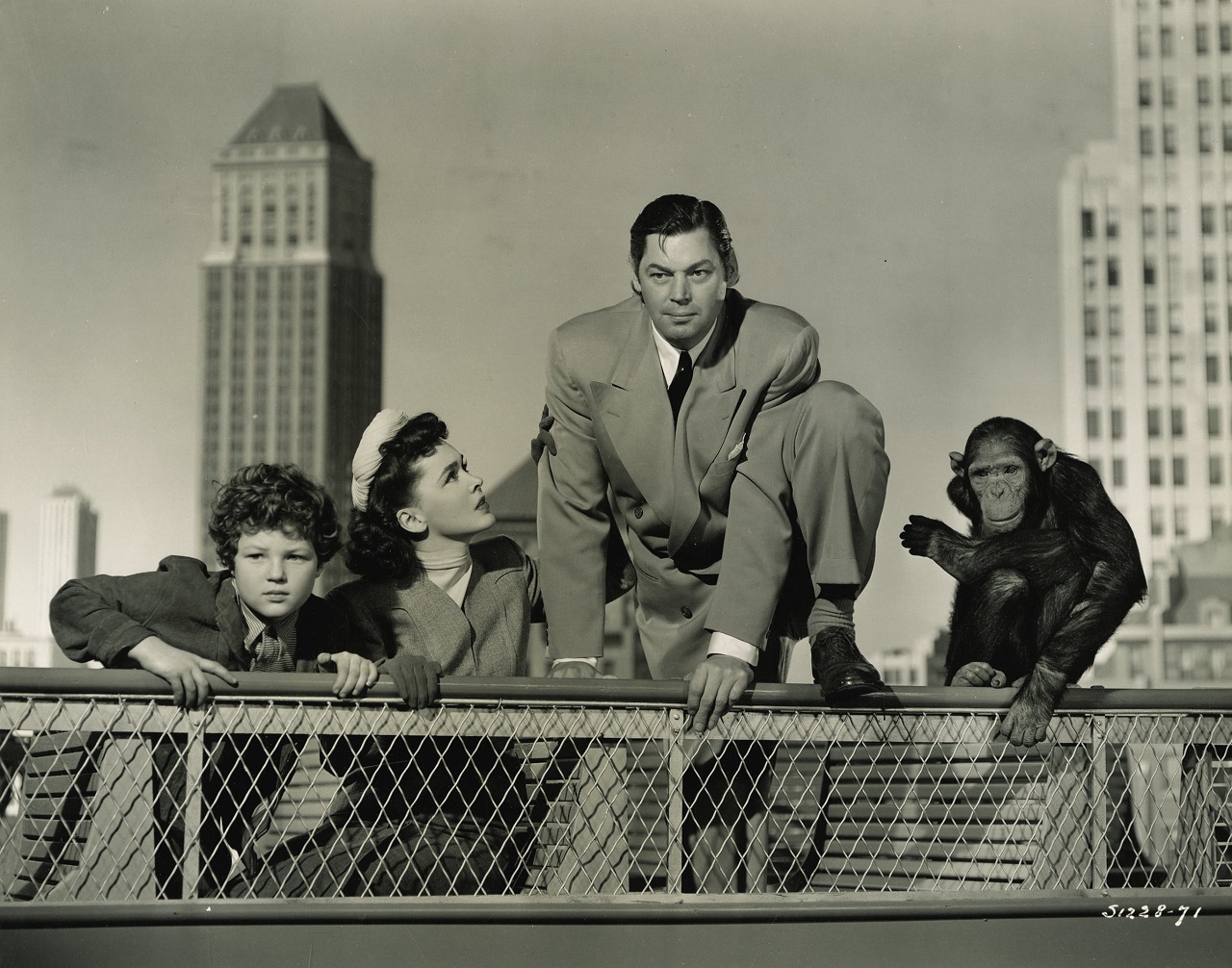
Most of the Johnny Weissmuller Tarzan films, excepting the first two entries, are banal – indeed, the Tarzan sequels tend to fade into one another and are difficult to tell apart. Tarzan’s New York Adventure is at least distinguished from the routine melodrama of the others by the novelty of its premise. This comes in playing the comic relief of Tarzan and Cheeta out against civilised society, the only time that the series bothered to move out of the usual studio backlot jungle locations and tried to shake up the formula. (We even get to see Johnny Weissmuller outfitted in Western street wear for the only time in the series).
The film derives a good deal of comedy from Tarzan’s reaction to civilisation – with Jane taking him to be outfitted with a suit, he thinking music on a radio is a native war chant, or not understanding that he is meant to take his clothes off before having a shower. On the minus side, more time that any of the other films is given over to the comedic lowjinks of Cheeta who predictably causes chaos in hotel rooms and nightclubs, not to mention a somewhat racist scene where he ends up talking down the phone to porter Mantan Moreland. Where in the rest of the series, the emphasis was on adventure, the majority of Tarzan’s New York Adventure comes in playing Tarzan for comedy, which becomes a riff on the Outsider Encounters Civilisation routine later popularised by Crocodile Dundee (1986) and sequels.
The titular adventure is predictable and silly. Even then much of this is not taken up by adventure so much as it is a court battle over custody for Boy. There is not a great deal of believability to the plot – Cheeta manages to pass through US Customs without any period of quarantine, for instance. The fuzzy niceness tends to stick in one’s craw – the judge in the custody dispute is so clearly on the plaintiff (Tarzan)’s side, even interrupting proceedings to enquire how the fishing in Africa is, that he should be disbarred from the bench in any real world setting.
The dialogue is often risible – Maureen O’Sullivan bears the brunt of this with lines like “I think Tarzan would like some plums for breakfast,” or “It would break my heart to see your courage caught in the quicksand of civilization.” On the plus side, there is some good stunt work, including Johnny Weissmuller seen swinging on ropes through the streets of New York City and memorably his dive off the Brooklyn Bridge. The end credits urge people to buy war bonds and stamps.
The other Johnny Weissmuller Tarzan films were:– Tarzan the Ape Man (1932), Tarzan and His Mate (1934), Tarzan Escapes (1936), Tarzan Finds a Son (1939), Tarzan’s Secret Treasure (1941), Tarzan Triumphs (1943), Tarzan’s Desert Mystery (1943), Tarzan and the Amazons (1945), Tarzan and the Leopard Woman (1946), Tarzan and the Huntress (1947) and Tarzan and the Mermaids (1948).