

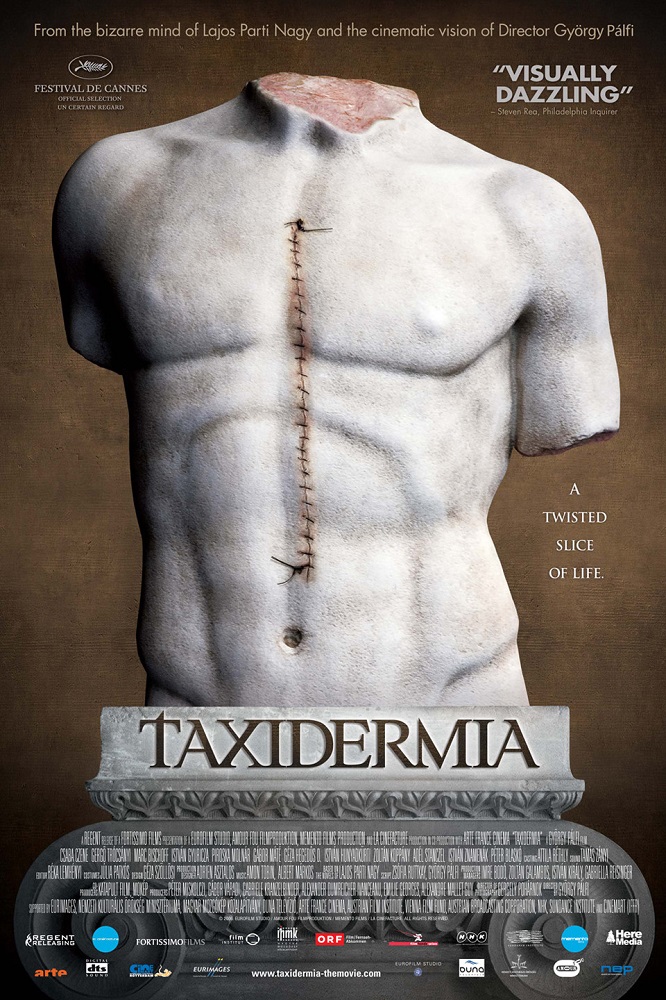
Crew
Director – György Pálfi, Screenplay – György Pálfi & Zsófia Ruttkay, Based on Short Stories by Lajos Parti Nagy, Producers – Alexander Dumreicher-Ivanceanu, Emilie Georges, Gabriele Kranzelbinder & Alexander Mallet-Guy, Photography – Gergely Pohárnok, Music – Amon Tobin, Makeup Effects – Ivan Pohárnok, Production Design – Adrienn Asztalos. Production Company – Eurofilm Studio/Memento Films/La Cinefracture/Amour Fou Filmproduktion.
Cast
Gergely Trócsányi (Kalman Balatony), Marc Bischoff (Lajoska Balatony), Csaba Czene (Vendel Morosgovanyi), Adel Stanczel (Gizella Aczel), Gabor Máté (Older Kalman Balatony), Zoltan Koppany (Bela Miszlenyi), Géza D. Hegedüs (Dr Andor Regoczy)
Plot
Vendel Morosgovanyi, a solider on a duty at a remote farmhouse in icy winter, tries to relieve his growing sexual frustration with anything he can find. His superior officer, Balatony, gives birth to a son who has to have a tail removed from his body. The son Kalman grows up during the Soviet era to become a top competitor in state-sponsored eating competitions. Kalman competes with his rival and good friend Bela Miszlenyi for the hand in marriage of woman’s competitor Gizella Aczel. Kalman wins her and they marry and give birth to a son Lajos. In the present-day, Lajos has become a shy, socially awkward taxidermist who tends Kalman, who has become grotesquely fat and lives in the basement, where he tries to grow giant-sized cats but has become so large that he is unable to move.
Taxidermia was the second film from Hungarian director György Pálfi. Pálfi came to attention a few years earlier when he made Hukkle (2002), which enjoyed modest success at international film festivals. Hukkle (meaning ‘hiccup’ in Hungarian) was shot without any dialogue where Pálfi made the whole film as a symphony of sound effects composed from out of the environment around a village during the cycle of one day. There was no real plot to Hukkle, although an enigmatic murder mystery of sorts did eventually weave itself in around the rhythm of the sound effects.
Pálfi completed Taxidermia with money from a Sundance grant and various pan-European companies. The first two segments of the film are based on short stories by Hungarian writer Lajos Parti Nagy who is known for his surreal and grotesque sense of humour. Pálfi has woven Parti Nagy’s stories together into one portmanteau narrative that loosely spans three generations of a family.
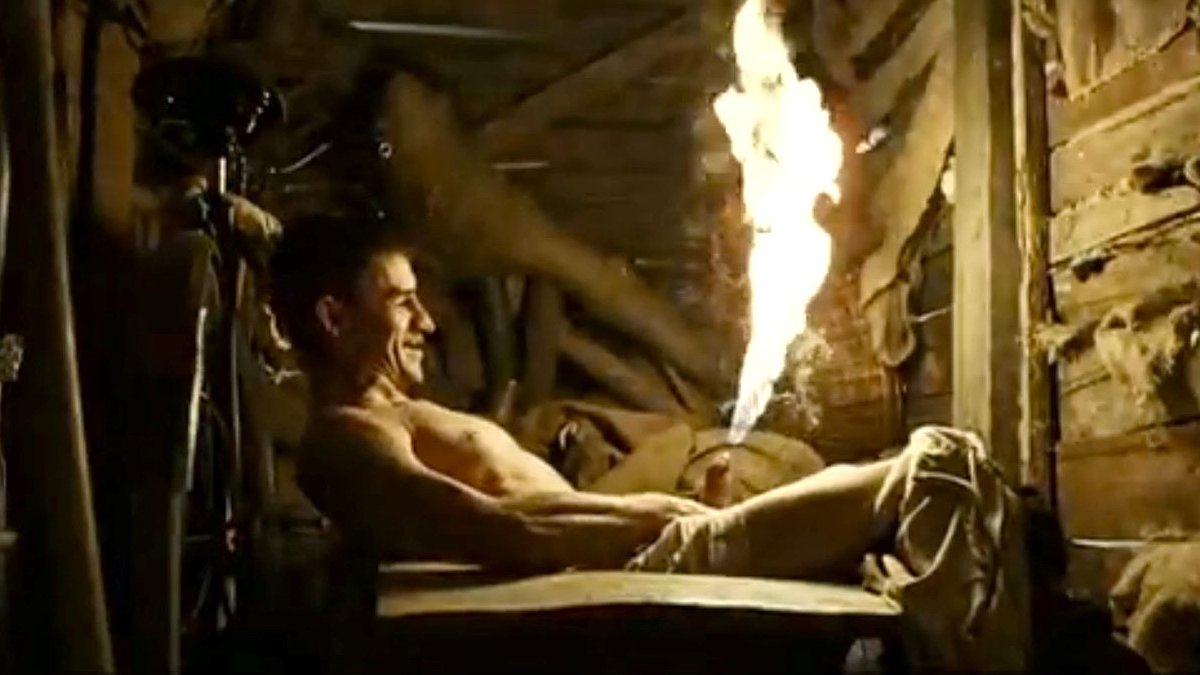
György Pálfi is determined to shock and outrage sensibilities. Indeed, Taxidermia is not too far removed in this respect from an early John Waters film. The first segment, which seems to be set around the time of World War II, sets the pace. We get an assortment of images of a sexually frustrated Csaba Czene – him in a barn sucking the flame from a candle into his mouth and then his penis suddenly erupting with a jet of flame as he masturbates; being interrupted outdoors in the snow as he strips his pants off and breaks the frozen ice on a trough of water so that he can dip his penis inside; he getting turned on by the sight of the daughters playing outside and filling a knot hole in the barn wall with grease and a cloth so he can thrust into it; masturbating on his back in the open and his ejaculate flying up to the stars; a sexual fantasy where he is making love to an eager and frustrated fat woman, only to be revealed to in actuality be humping a bath containing the remains of a slaughtered pig. There is even a scene where Hans Christian Andersen’s The Little Match Girl is turned into a sexual fantasy with undeniably paedophiliac overtones.
There are other odd images that run throughout – the captain’s son who has to have a pig-like mutant tail chopped off at birth and a gross sequence where we see the pig being gutted in great detail, its intestines removed and children playing with the trotters. (Gross-out images of food and eating are a constant theme throughout Taxidermia).
The second episode, which is set at some point during the Soviet regime in Hungary, drops the gross-out sexual element and concentrates on the story of Gergely Trócsányi as the captain’s son who has become a competitor in Soviet eating competitions. Certainly, the gross-out element is not far away – there are numerous scenes of the competitors slopping up unappetisingly presented bowls of food and Pálfi loves panning his camera around and watching them throwing up after each competition.
Much of the story in this episode is concerned with Gergely Trócsányi’s attraction to and marrying of female competitor Adel Stanczel. This is relatively more straightforward in comparison to the deadpan sexual shock tactics of the first episode. The romance that takes up the episode does slow the film down somewhat, although Pálfi does have fun with the absurdity of a montage of classic romantic poses enacted by two overweight people.
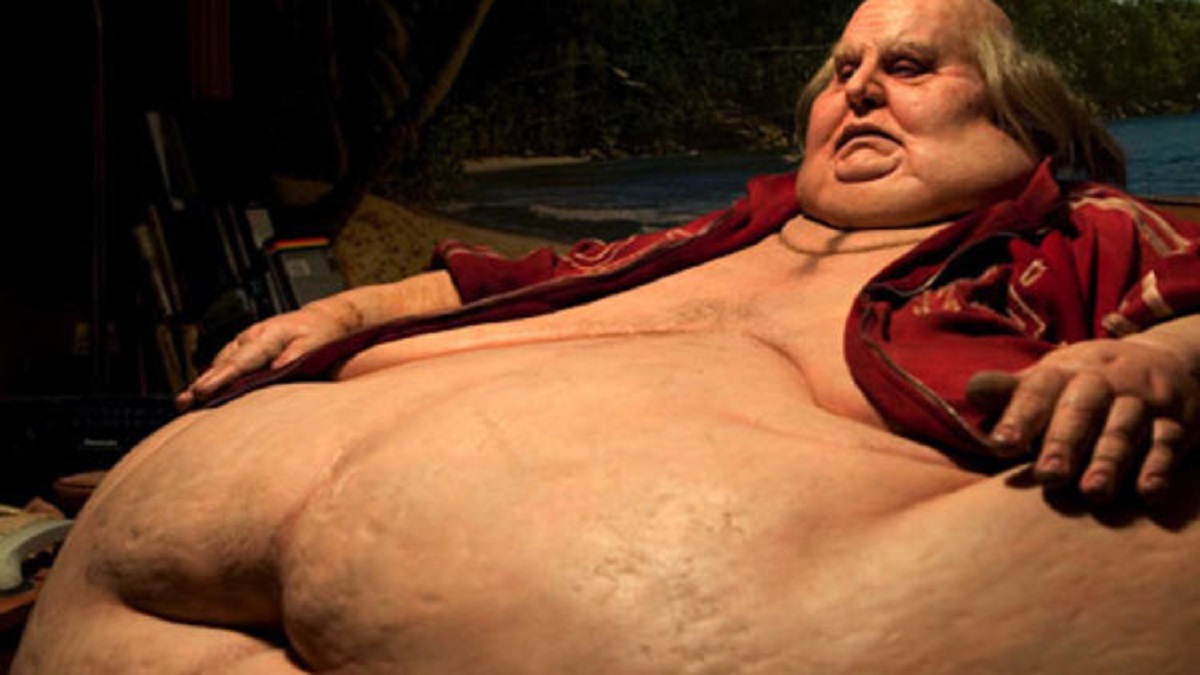
The third episode takes place in the present day and concerns Gergely Trócsányi’s son, played by the pale, thin and nervously withdrawn Marc Bischoff. Gergely Trócsányi is present but has become an old man who has grown so fat he has a stomach that protrudes about the size of a small car and raises cats who have grown as large as medium-sized dogs. The film is at its most horrific at the end of the episode where we get the wonderfully grotesque image of the old man found after he has been abandoned for several days and the cats have gnawed a huge hole in his stomach.
The episode culminates on the amusingly surreal scene where we see a montage of shots of flesh being sewn together in nauseating detail before the camera pulls back to show it is Marc Bischoff operating on himself, ending when he activates a remote control device that decapitates his own head and arm to leave a completed taxidermic statue. Pálfi goes out on an amusingly sardonic note, making a few digs about serious Art as the two stuffed bodies are displayed at a museum before an admiring audience.
György Pálfi next went onto direct I Am Not Your Friend (2009), an improvisational experiment with his cast; Final Cut: Ladies and Gentlemen (2012), a film that told a narrative edited out of footage from Hollywood classics; returned to grotesque surrealism with Freefall (2014); the science-fiction film His Master’s Voice (2018); and the post-apocalyptic Perpetuity (2021).
Trailer here