

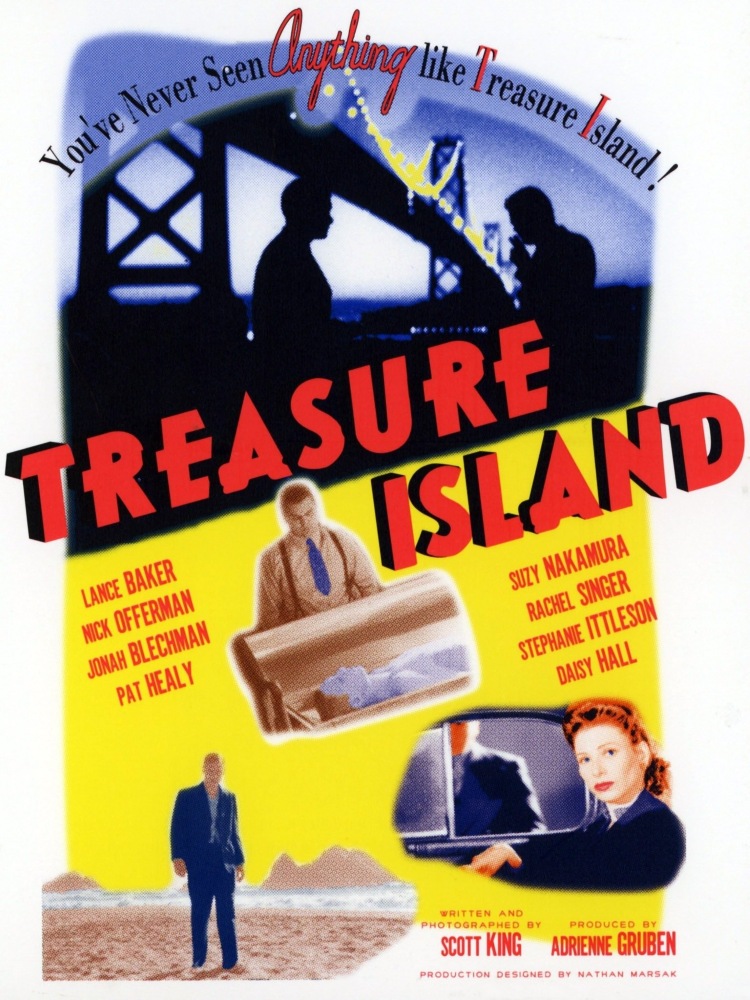
USA. 1999.
Crew
Director/Screenplay/Photography (b&w) – Scott King, Producer – Adrienne Gruben, Music – Chris Anderson, Production Design – Nathan Marsak. Production Company – King Pictures.
Cast
Lance Baker (Frank Guntherson), Nick Offerman (Sam), Jonah Blechman (The Body), Daisy Hall (Patty), Suzy Nakamura (Yo-Ji), Rachel Singer (Anna), Stephanie Ittelson (Stella), Pat Healy (Clark)
Plot
Frank and Sam, two cipher experts stationed at a naval base on San Francisco’s Treasure Island during World War II, are assigned the job of creating personal papers to be placed on a corpse that is to be dropped in the Pacific Ocean with the intent of giving the Japanese misleading ideas about the American offensive. However, as both work on fabricating the corpse’s identity, the body comes to life. Frank is married to two women, the disfigured Anna, and Yu-Ji, an Asian woman he hides from the Japanese internment camps, while he also pursues a third woman Stella. The body then starts trying to undermine his relationships. Sam and his wife Patty frequently invite other armed servicemen home to engage in threesomes but the body then starts to put homosexual ideas into Sam’s head.
Let’s get it clear right from the start – Treasure Island is nothing to do with Robert Louis Stevenson’s Treasure Island (1883), pirates, or even for that matter treasure or islands. The film does however use the location of Treasure Island, a small artificial landfill island located in San Francisco Bay that was the site of an actual WWII Naval codebreaking operation. Of course, the coincidence of names with Stevenson’s classic may well be entirely intentional, for Treasure Island is a surrealist film and one where director/writer Scott King confessedly takes delight in standing expectation on its head.
People compared Treasure Island with the works of directors like David Lynch and Guy Maddin. There are undeniable similarities, especially with the weird disjunctive atmosphere of Lynch’s Eraserhead (1977) and the kitsch deadpan of Guy Maddin. Despite King’s bold claim “You’ve never quite seen anything like Treasure Island,” what the film ends up resembling is the work of England’s Dennis Potter, tele-scribe of masterworks like Pennies from Heaven (1978), Blue Remembered Hills (1979), The Singing Detective (1986), Track 29 (1988), Blackeyes (1989), Lipstick On Your Collar (1993) and Karaoke (1996). Potter loved to disrupt normal, everyday events with surreal blurrings of fiction and the real, or have characters burst into musical daydream.
Of course, Scott King lacks the brilliance of a Dennis Potter. Although you cannot deny that he tries hard – at times, Treasure Island is such a dense text of surrealistic juxtapositions that are constantly playing with expectations that you almost cry out for a set of primer notes to keep track of all of King’s allusions and images. Treasure Island acts as a deconstruction of 1940s thrillers – the idea is taken from the film The Man Who Never Was (1956), which was about the true-life plan to manufacture the identity for a corpse and plant papers on it to mislead the Germans about the Allied Invasion during the War. In Scott King’s stated intentions “I wanted it to be like a 1940s B thriller but one in which you were never sure what could happen – that Montgomery Clift could come in, but drop his pants.”
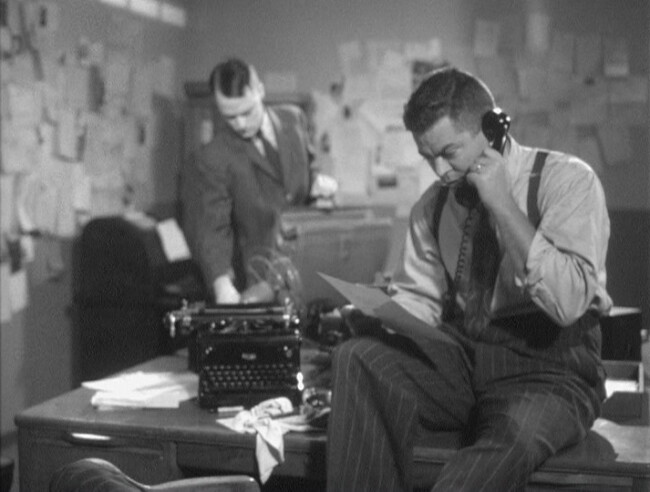
King’s greatest forte here is a sense of deadpan humour. There are some hysterical sex scenes with Nick Offerman and his wife Daisy Hall asking people to join in or making out in a church, which are played in banally flat 1940s style dialogue. King also statedly wanted to make a film where the audience could never guess what was stable from one moment to the next. There are some occasionally clever moments – notably a scene where Nick Offerman is having a conversation with the body in his living room where it seems that what is happening is going on inside his head until his wife enters and starts wondering what the body is doing there, a scene that leaves one with a marvellously achieved sense of bewilderment as to what on earth is going on. There is another such scene during a military trial where the camera pans along a stony-faced line of accused military, which suddenly jarringly shows one man in golliwog makeup. There are also some fine scenes with conversations between Nick Offerman and Pat Healy that take place on one level with Offerman inquiring about joining the Air Force but are played in such a way that there is an undeniable sense of repressed homosexual attraction.
The problem with Treasure Island is that Scott King is a filmmaker who has too many ideas. The film is packed to brimming point with things that King is trying to tell us and the effect is akin to watching an exhibition of surrealist art where the artworks are being whisked by us every fifteen seconds without any chance to absorb the juxtapositions. There is meaning clearly there but the film needs multiple readings for much of it to become apparent. Many things are never clear – you are never sure who all of Lance Baker’s wives and girlfriends are. Is he a bigamist or are some of these flashbacks? It only becomes apparent in the Q&A session with Scott King after the screening of the film that Lance Baker is meant to be multiply married and continuing a double-life and that the dead body represents a fear of his losing his control of them.
A film like this filled with constantly shifting reference points is hard to follow. Surrealism, after all, means nothing if there is no clearly established point of normality for it to be placed in contrast to. One can appreciate Scott King’s intent – and there are frequent abovementioned moments when the disorientation he aims at works – but the more packed the film becomes, the greater is the danger of intent becoming lost in affect and – as King freely admits – of audiences walking out. At least, King also candidly admitted, this screening at San Francisco’s Lumiere theatre had the lowest audience walkout rate of any showing up to that point.
Scott King has yet to make another film.
Trailer here