


USA. 2011.
Crew
Director/Screenplay – Terrence Malick, Producers – Dede Gardner, Sarah Green, Grant Hill, William Pohlad & Brad Pitt, Photography – Emmanuel Lubezski, Music – Alexandre Desplat, Senior Visual Effects Supervisor – Dan Glass, Digital Visual Effects Supervisor – Bradley Freidman, Visual Effects – Double Negative, Evil Eye Pictures, Method Studio, One of Us & Prime Focus, Special Effects Supervisor – Don Hastings, Production Design – Jack Fisk. Production Company – River Road Entertainment/Cottonwood Pictures, LLC.
Cast
Brad Pitt (Mr O’Brien), Jessica Chastain (Mrs O’Brien), Hunter McCracken (Young Jack), Laramie Eppler (R.J. O’Brien), Sean Penn (Jack O’Brien), Tye Sheridan (Steve O’Brien), Fiona Shaw (Grandmother)
Plot
It is the 1950s. The O’Brien family are shattered with the death of one of their three sons. The anguished mother contemplates on creation and why this was allowed to happen. In reflecting on things, she traces from the evolution of life on Earth to the birth of her eldest son Jack. As Jack grew up, he came to resent his father’s authority and soon let this turn to anger and trouble making. In the present-day, the middle-aged Jack, now a successful architect, reflects back on what he has lost and seeks to reconnect with it.
I am convinced that Terrence Malick is the greatest living American director. Malick first appeared with Badlands (1973), loosely based on the crime spree of Charles Starkweather in the 1950s, and this has grown into a cult film over the years. Malick’s first genuine masterpiece was the Depression era Days of Heaven (1978), a film that blew me away with the pure power of cinema when I first saw it. Oddly, Malick then retreated from filmmaking for twenty years and went to teach in France (although did write a number of unproduced screenplays during this time, including biopics of Che Guevara and Jerry Lee Lewis and an adaptation of the novel The Moviegoer (1961) by Walker Percy). This is something almost unprecedented in any filmmaker – many have vanished but few have come back in such amazing ways and still at full strength.
If you were to look for another artist to compare Terrence Malick to, it would surely be J.D. Salinger – Malick shuns the public eye so much that he has it contractually stipulated that he will not promote his films and no images of him can be used for publicity purposes. It is not even known why he removed himself from filmmaking for twenty years (although vast cost overruns due to Malick’s shooting methods and an editing schedule that dragged out for two years on Days of Heaven, which made Malick unpopular with the studios, is speculated as being the cause).
Malick made his triumphant return with the war film The Thin Red Line (1998), followed by the Pocahontas-John Smith story The New World (2005) and The Tree of Life. All of these are works that have received stunning reviews. The Tree of Life is purportedly something that Terrence Malick nurtured for three decades, all the way back to a project named Q that he touted not long after Days of Heaven, which would have told the story of the origins of life on Earth and later became the basis of The Voyage of Time (2016). The Tree of Life won the Palme d’Or after premiering at the 2011 Cannes Film Festival.
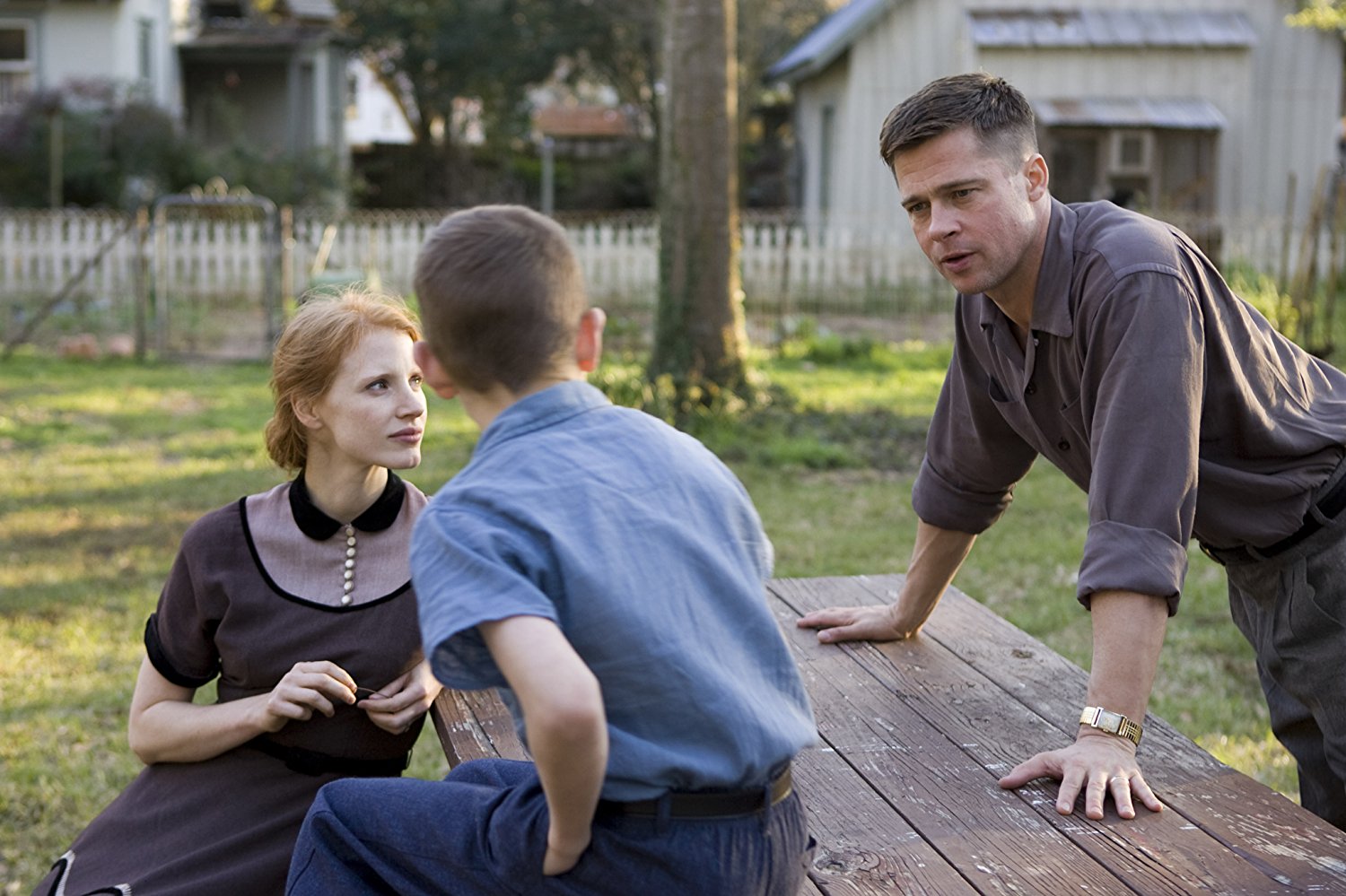
Terrence Malick’s films are myths. Almost all of them play out as though they are variants of the Garden of Eden and the Fall from Grace. They are less dramatic narratives than they are montages of scenes with people drifting through a rapturous world of beauty and nature. His characters are innocents, Adam and Eve in Eden before the notion of First Sin ever entered – be it killers on the run lost in the desert in Badlands; the contrast of soldiers amid the lushness of nature at Guadalcanal as war rages in The Thin Red Line; the untapped, virgin wilderness of the newly discovered America in The New World; two people in love in To the Wonder (2012). Original Sin and resulting loss of innocence exists in terms of the darkening of this world (the brutality of war, the law eventually catching up to arrest Richard Gere and Martin Sheen that culminates both Days of Heaven and Badlands, the falling out of love in To the Wonder, the writer drifting through Hollywood in Knight of Cups (2015) searching for his past).
The Tree of Life is almost Terrence Malick’s 2001: A Space Odyssey (1968). It is not a film that fully, easily sits as being fantasy – and certainly not science-fiction as some people initially pegged it as being. You can maybe draw comparisons to Darren Aronofsky’s The Fountain (2006) – a tree features as a central symbol in both films, while both have a story that is stretched out across multiple eras and is concerned with a mystical respect for nature and the meaning of it all. Perhaps more than 2001, the creation sequence most resembles the Rite of Spring episode in Disney’s Fantasia (1940).
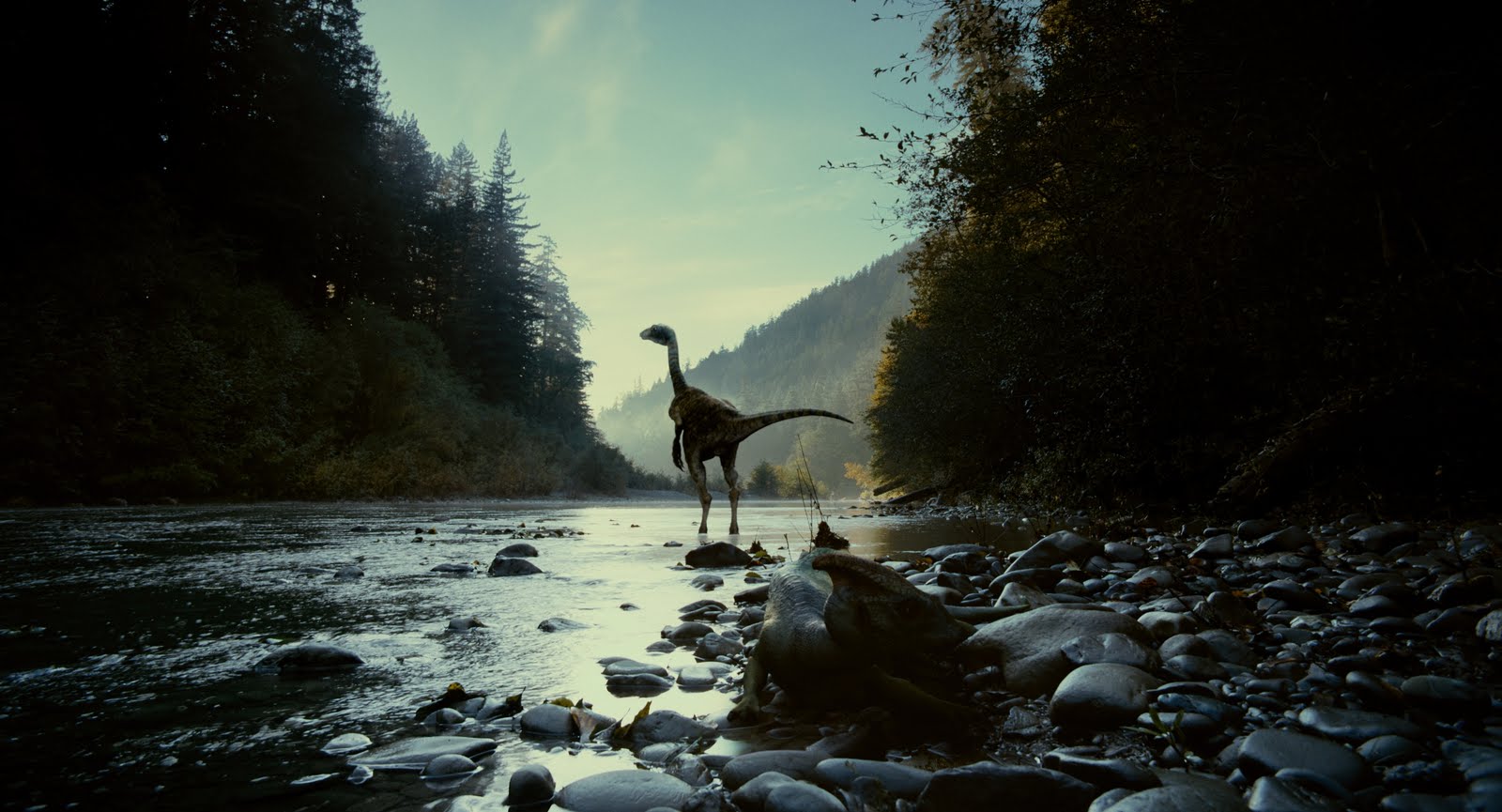
The talking point of The Tree of Life is the twenty minute section not too far in that goes from Jessica Chastain’s whispered voiceover asking why this can be allowed to happen, that then moves out to a series of montages of starscapes and nebulae. This travels from the beginning of Creation where we watch the formation of planets out of primordial images of fire and turbulence, before moving down to the Earth, seeing the formation of simple cellular lifeforms, their merging into more complex beings, the arrival of the first land creatures then several scenes with the dinosaurs before Malick cuts back to space and shows the meteor strike that eliminated the dinosaurs. Like 2001, this section is spread out across several epochs and is not clearly narratively connected to the rest of the story. It is guess work trying to figure out how this slots into the meaning of everything else. The meaning I take comes from Jessica Chastain’s voiceover at the start of the sequence, a prayer that seems to go out to the entirety of creation, asking how in this exquisitely beautiful and Edenic world, pain and suffering can be allowed to enter people’s lives.
The Tree of Life may well be the best film made yet about the enduring myth of the Lost American Childhood. You get the impression that what we are seeing is taken from Terrence Malick’s own childhood. The film takes place in Waco, Texas during the 1950s – Malick was born in Illinois, the oldest of three brothers, but grew up in Waco, before the family moved to Austin where his father was a petroleum company executive. During the 1950s, Malick would have been the same age as the child protagonist here. You expect that the central character’s often sternly traditional raising, his rebellion against this, and his desire to reconnect with that sense of lost innocence in later life is the quest that has driven much of Terrence Malick’s psyche and work. The death of the brother frames events in the film and is echoed by Malick’s life where his younger brother Larry committed suicide in 1968 while in his twenties after failing in his studies of classical guitar.
The Tree of Life is a frustrating film in attempting to get a fix on it. (Not unlike 2001 either). It is not a film that has clearcut things to it like a narrative where everything is spelt out, even a clearcut resolution. Far more so than his other films, Terrence Malick leaves things for us to guess. The plot is exasperatingly elusive; the entire film only takes place in Malick’s montages. The dialogue that one hears throughout comes less from the things that are written for the characters as conversation than it does in the whispered voiceovers that almost seem like eavesdroppings of people’s inner thoughts. Here and in his other films, Malick creates montages of scenes of intimacy – quiet, idyllic moments of poetry or scenes that seem like nostalgic drifts through artefacts of memory (his films always evoke bygone eras). The Tree of Life is almost entirely filled with these – images of mother Jessica Chastain with the children tracing the patterns on a china plate, playing with goldfish, the parents gardening, the family playing together and spraying one another with a hose. These montages gradually darken – the playful innocence becomes boys making mischief, fearfully and then gleefully throwing stones through a shed window, tying a frog to a skyrocket, Hunter McCracken daring Laramie Eppler to place his finger over the end of an air rifle.
Terrence Malick has a very non-traditional means of shooting a film – he essentially abandons a script and allows his cast to improvise scenes in-field. He will film hundreds of hours of footage and frequently discards subplots and entire character threads – here you gain the impression that Fiona Shaw’s grandmother had far more scenes that she did, given the employment of such a name actor, but she only appears in about two scenes. Similarly there seem frequent plot strands where details are missing – one of the kids turns up with a patch of his hair burned where you get the impression that this was an accident with the fireworks the other kids were playing with.
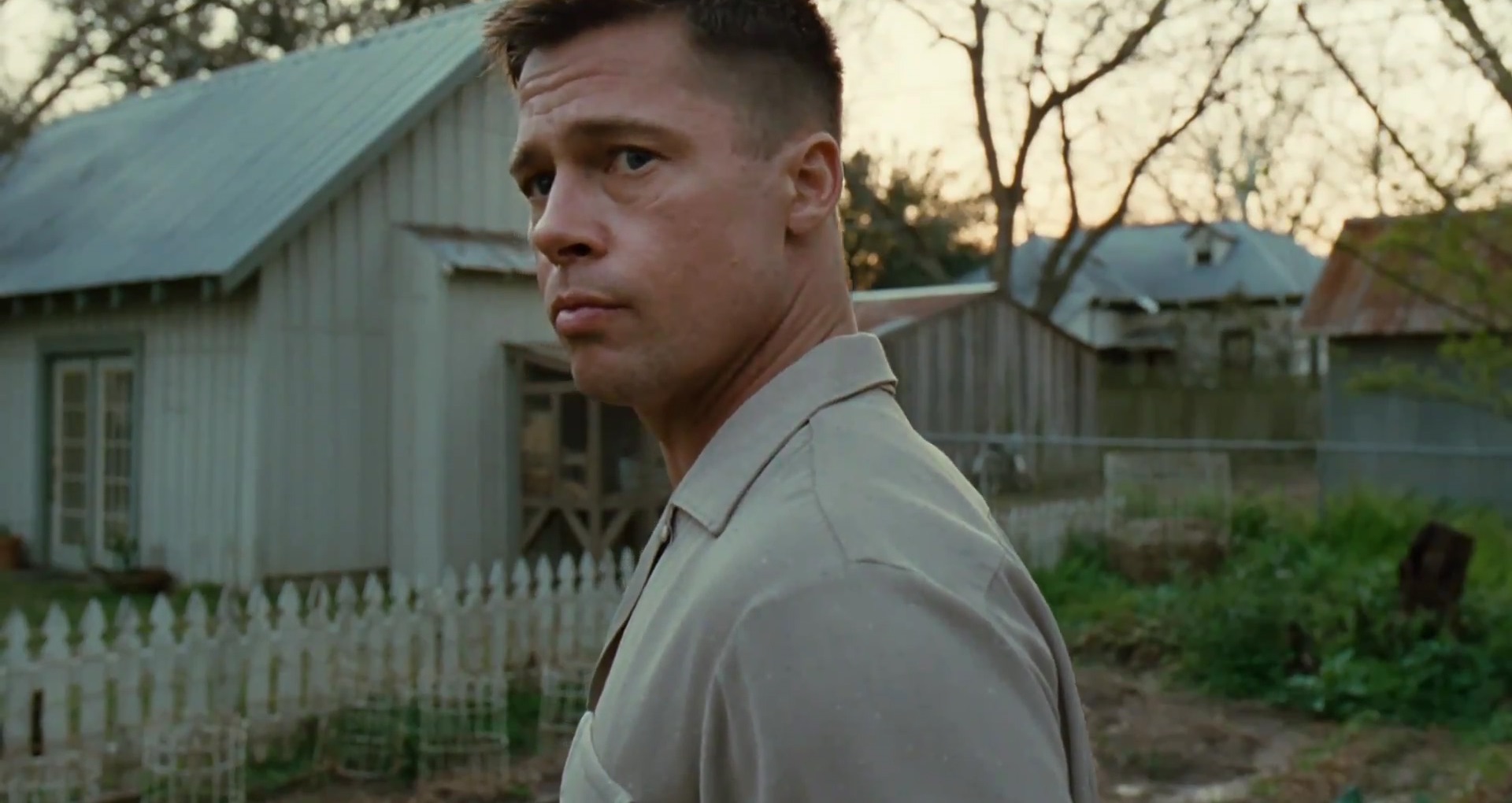
Other plot aspects that would be crucial in a far more conventional mainstream film are absent. Brad Pitt’s father is upset by losing his job and says “I have dishonoured everything” but what he means by this – whether it is his business decisions or his eruption into violence against the children – and how this impinges on the collapse of his business is not clear. Even when it comes to the events that start the film off – the death of the brother – we are given no details. We never learn how they died, or even for that matter which brother was killed. It is only clear, for instance, on finding that they share the same name on the end credits that we realise that Sean Penn’s adult character is meant to be the grown-up version of Hunter McCracken. There are also odd touches of surrealism – one moment where Jessica Chastain momentarily takes to the air and twirls around under the tree, another where for some reason we see a body in a glass coffin in the woods like something out of Snow White – that seem to belong to another film altogether.
Even the performances from the name actors in the film – Brad Pitt, Sean Penn – seem to eschew big acting fireworks and be subordinate to the director – Pitt, for instance, is good but never opens up with a big scene that he shows his Acting off (in fact, I ended up admiring the performance from the then unknown Jessica Chastain (whose profile rose meteorically with this film) more so than I did either of these known names). Eventually you give up hoping that these aspects will fall into place and go with the sheer visual splendour of the intimacy of a childhood that Terrence Malick evokes. The poetry of the film weaves a spell that soon enchants you. What results is surely the only mainstream-released film of the year that doesn’t seem to clearly be about anything but still has far more to say than all of the other films released at the multiplex this year run end to end.
The debate that seems to play throughout the film is the one laid down in one of the earliest voiceovers – “There are two ways through life. The way of nature and the way of grace. You have to choose which way to follow.” Later this is embodied by the polarities represented by mother Jessica Chastain’s peaceful non-violent means and father Brad Pitt’s association with authority, industry and the great American dream of self-determination, which is seen is akin to the forces of nature ie. evolution and Darwinian survival of the fittest. The Tree of Life seems to be a work that looks upon the beauty of Creation and asks fundamental questions such as – how can pain be allowed to enter a perfect world? How does sin enter a world of innocence? The scenes toward the end where we see the idyllic world the children have grown up in sullied by first Brad Pitt’s flare-up of temper and then Hunter McCracken looking on life around him and rhetorically asking God “Why should I be good if you aren’t?” is a startling moment of character change that strikes considerably.
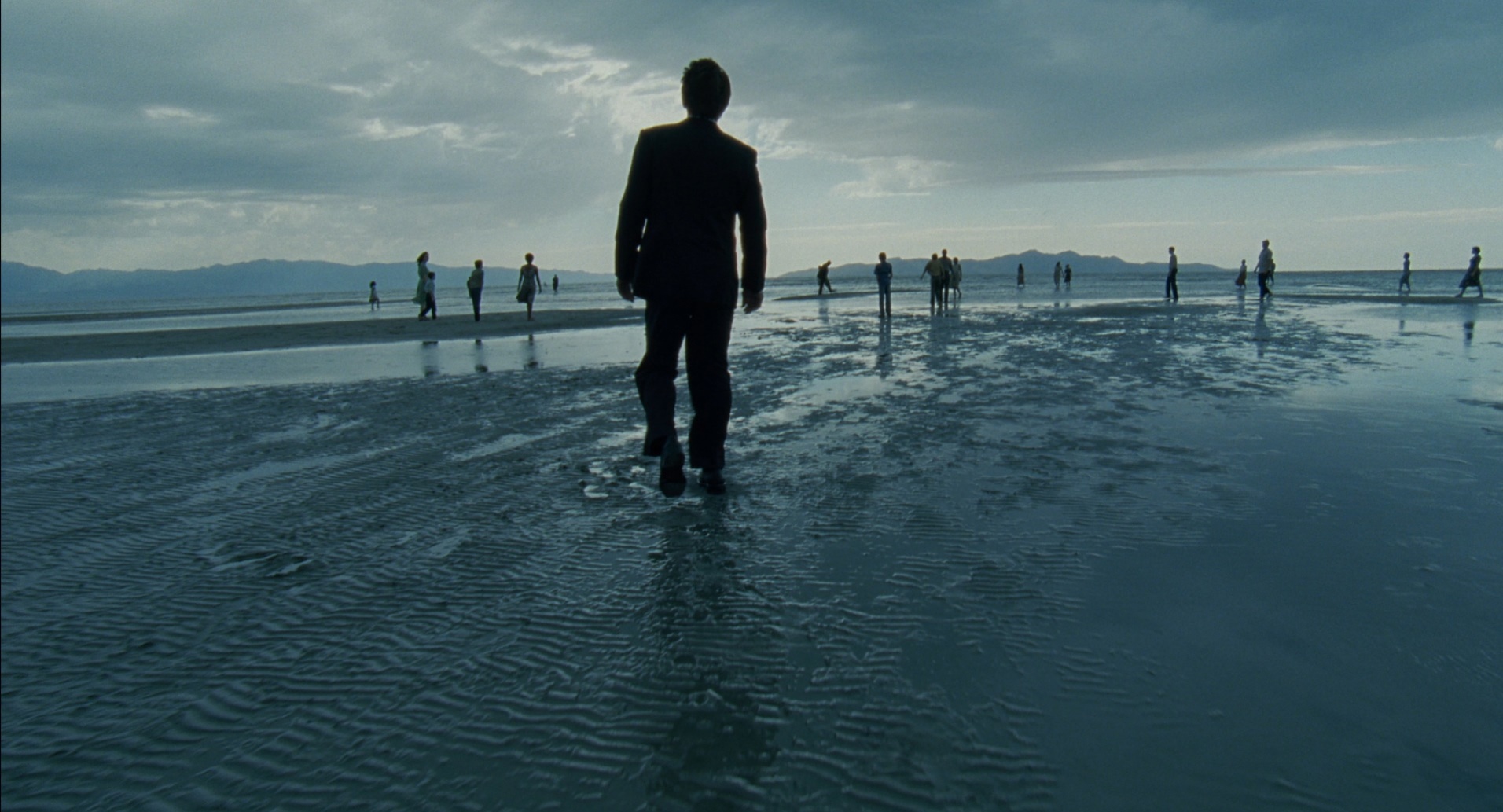
The film reaches a puzzling ending where almost all of the characters – both their older and younger selves – meet on a beach. This we take to be something happening on a surrealistic level where it becomes apparent that this is some type of Christian reuniting in the afterlife. The odd thing about The Tree of Life is that with its questions and allegories about sin, grace, innocence and hope in the resurrection, even the opening quote from The Book of Job, it may well be the most overtly Christian and religious film of the year – yet at the same time, one that will almost certainly go over the heads of and be celebrated by mainstream critics as opposed to the church masses that flocked to and made The Passion of the Christ (2004) a hit a few years ago.
The Tree of Life was nominated for a host of critical awards, including for Best Picture and Best Director for Terrence Malick at the 2011 Academy Awards.
Since his return to filmmaking, Terrence Malick has as of the 2010s burst into an explosion of hyperactivity as though determined to make up for his long absence. His next film was To the Wonder (2012), which, along with The Tree of Life and Knight of Cups (2015), forms a loose trio of autobiographical films. Malick returned to matters concerning the life and death of the universe with the documentary Voyage of Time (2016). This was followed by the dramatic Song to Song (2017) set around the Austin Musical Festival and A Hidden Life (2019) about a conscientious objector during World War II.
(Winner for Best Film in this site’s Top 10 Films of 2011 list. Winner for Best Director (Terrence Malick), Nominee for Best Actress (Jessica Chastain) and Best Cinematography at this site’s Best of 2011 Awards).
Trailer here