
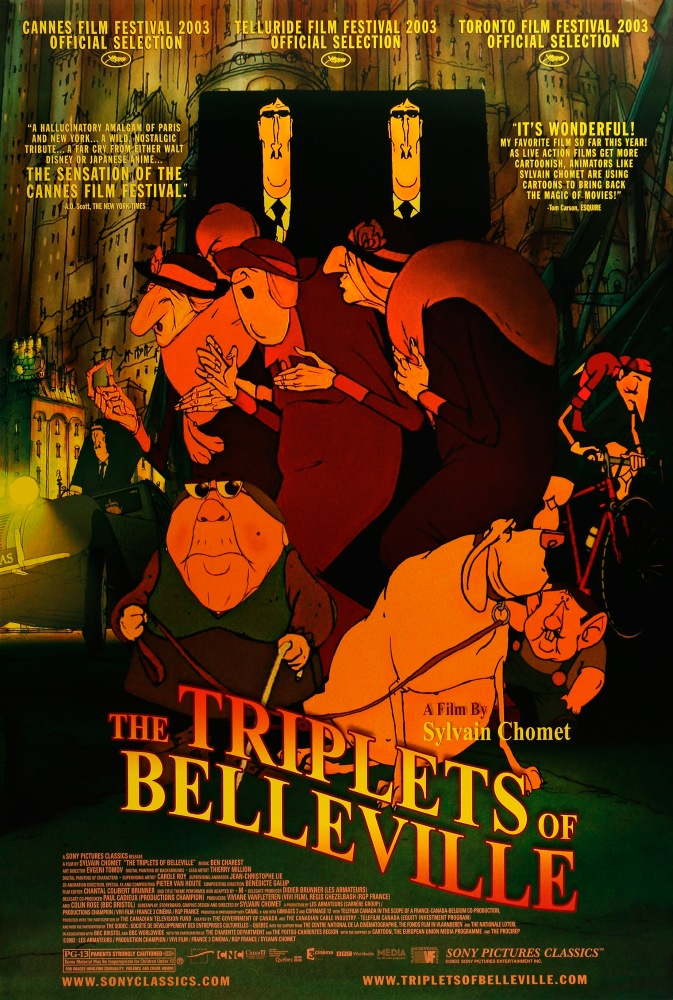
(Belleville Rendez-Vous/Les Triplettes De Belleville)
Crew
Director/Screenplay/Animation Supervisor – Sylvain Chomet, Producer – Didier Brunner, Music – Benoit Charest, Production Design – Evgeni Tomov. Production Company – Les Armateurs/Production Champion/Vivi Film/France 3/RGP/BBC Bristol.
Plot
Young Champion grows up with his grandmother Madam Souza. She discovers that he has a love of cycling and trains him to become a cycle racer. As an adult, Champion enters the Tour de France. However, in the middle of the race, Mafia heavies abduct he and two other cyclists. Madam Souza uses Champion’s dog Bruno to follow his trail, which takes them to the city of Belleville. While settling down to sleep outdoors, Souza is found by the aging sisters who were once famous as the singing trio The Triplets of Belleville and is given a couch to stay in their rundown apartment. She later joins their percussive performing act. Meanwhile, the Mafia have drugged Champion and the other cyclists and are forcing then to race on mechanical cycles for people to gamble on.
The Triplets of Belleville is one of the most unique animated films to come out in some time. The Triplets of Belleville was the brainchild of Quebecois director Sylvain Chomet. Chomet was a former employee of Disney’s now defunct Toronto-based animation house who quit after feeling deep creative dissatisfaction and then went away to set up his own animation project.
What Chomet has created is a genuinely off-the-wall film. Sony Pictures Classics picked up distribution rights in the US but didn’t seem to know what to do with the film and dithered around for some time before releasing it, their principal problem seeming to be an inability to decide whether to promote it as a children’s film or an arthouse release pitched to adults. The film was eventually rewarded with a host of awards, including a nomination for the 2003 Academy Award for Best Animated Feature.
The only antecedent to The Triplets of Belleville might be the stylised look of Richard Williams’ neglected animated masterpiece The Thief and the Cobbler (1994). The film also owes something to the surreal comic visual antics of Jean-Pierre Jeunet and Marc Caro, in particular their The City of Lost Children (1995) with its setting in a stylised but almost familiar world. Sylvain Chomet acknowledges the influence of French comedy director/actor Jacques Tati – and there are a number of Tati references throughout.
Most of all, The Triplets of Belleville seems like an animated version of the cartoons of Gerald Scarfe. The hero Champion is a perfect Scarfe line-drawn figure with a tiny body, a long proboscis-like nose and massively pumped up leg muscles; and elsewhere there are bizarre visions of elongated stretch-freighter ships; while the cityscapes are marvellously rendered and rich with over-exaggerated detail.
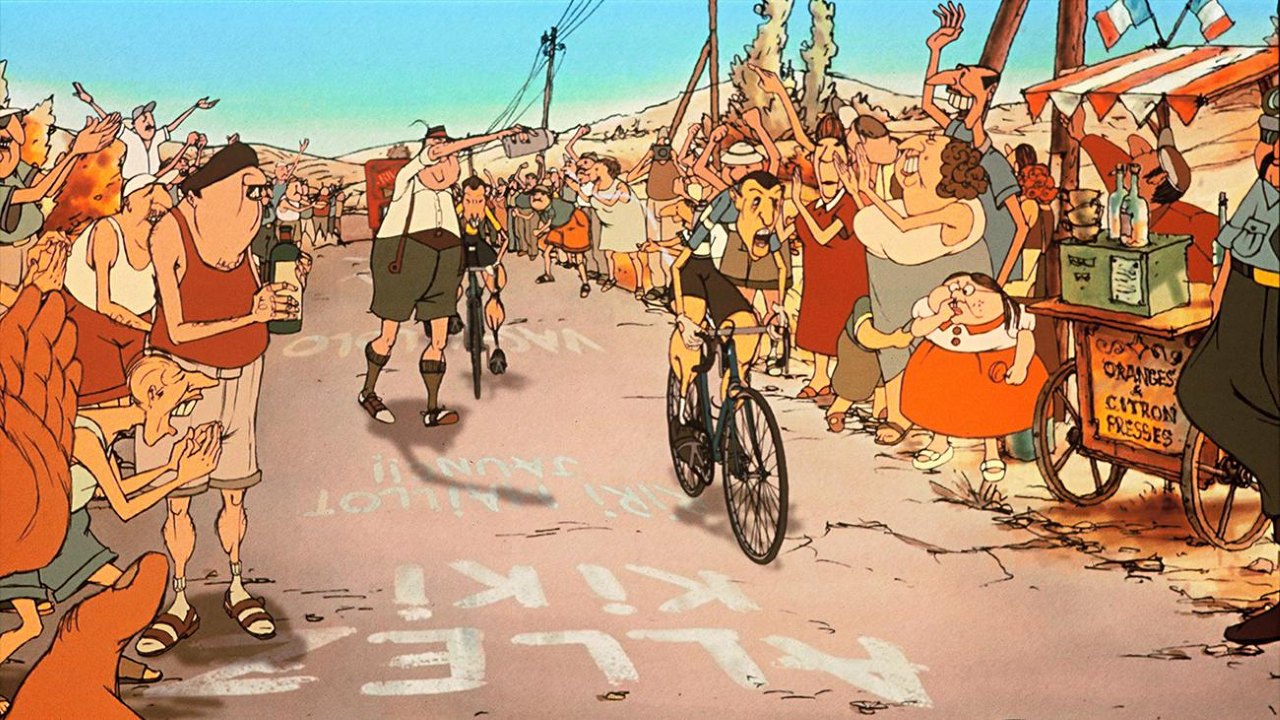
There is virtually no dialogue throughout the film – only the odd word, or dialogue that comes from external sources rather than the characters, and all the rest is music and sound effects – to such an extent that distributors have not needed to dub or subtitle the film for English-language release. The sequences that Sylvain Chomet sets up are utterly hysterical – Madam Souza’s massage of Champion that involves mallets, eggbeaters and eventually a lawnmower run up and down his back; the running gag throughout the race sequences with Madam Souza and her whistle, which continues on as the mechanic changes the tire; the wonderfully deadpan sequence with one of the sisters hunting frogs for dinner with grenades; and of course the gonzo chase that climaxes the film with most of the characters escaping aboard a stage that is being pedalled through the streets by the cyclists on exercise machines before a projection screen while being pursued by Mafia heavies in stretch Citroens.
The characters are caricatured with delightfully surreal effect – from the Mafia heavies who walk around as a single block of black shoulders with heads protruding at chest height, to the mechanic with mouse ears, the granny and her clubfoot, the dog, even a bizarre waiter who appears to have no backbone. There are all manner of delightful background gags that play throughout – the opening sequence that features a parody of Josephine Baker and Fred Astaire (who is promptly devoured as his dancing shoes run away from him), to the city of Belleville, which seems like a parody of New York City (although here the Statue of Liberty is overweight and holds a hamburger); and a witty gag that plays at the very end after the credits have finished rolling about a character that most people have forgotten. This is a film so rich in visual invention that it requires multiple viewings to absorb it all.
Sylvain Chomet subsequently went onto direct the superb The Illusionist (2010). Chomet next broached live-action with the appealingly quirky and surreal Attila Marcel (2013).
(Winner in this site’s Top 10 Films of 2003 list. Nominee for Best Musical Score at this site’s Best of 2003 Awards).