
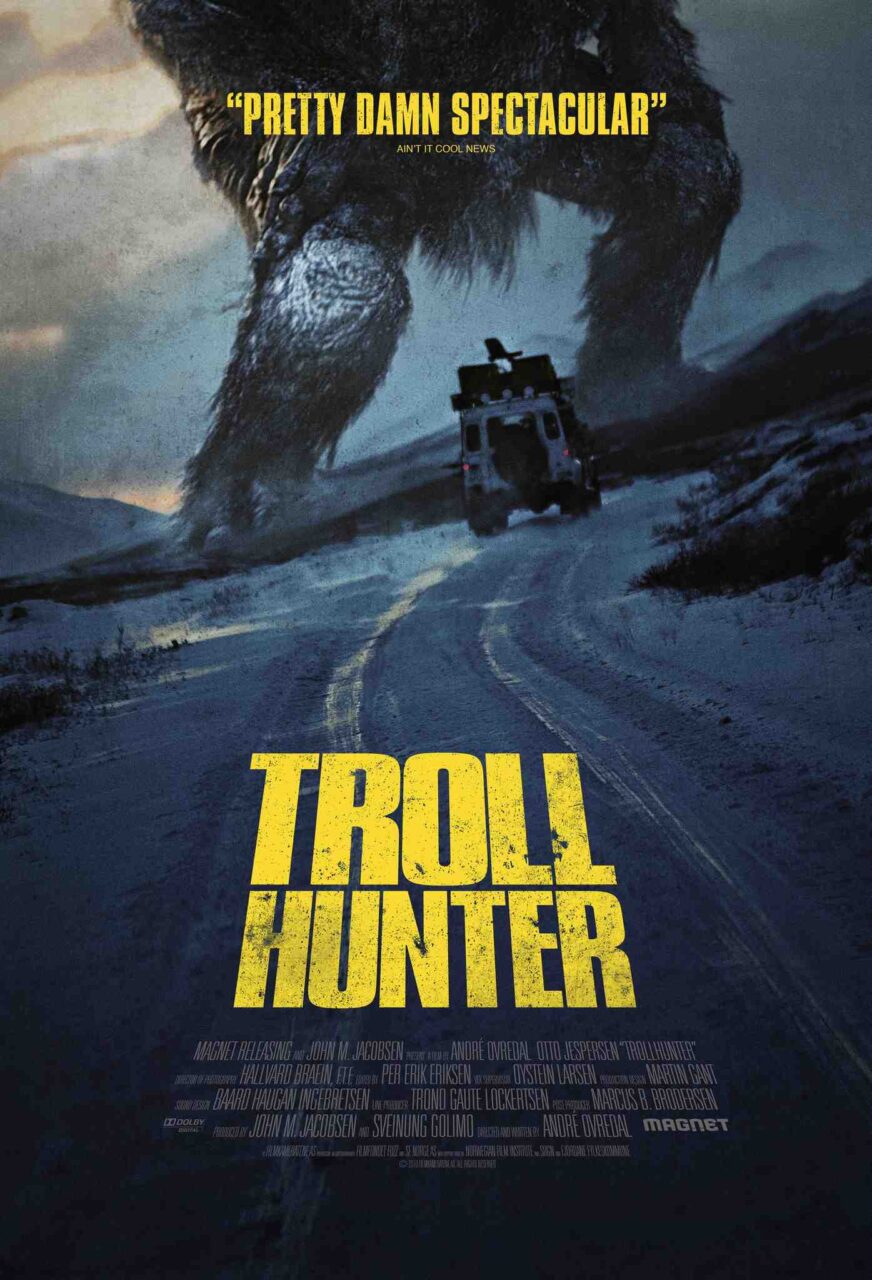
(Trolljegeren)
Norway. 2010.
Crew
Director/Screenplay – Andre Øvredal, Producers – Sveinung Golimo & John M. Jacobsen, Photography – Hallvard Bræin, Visual Effects Supervisor – øystein Larsen, Animation Supervisor – Nina Bergström, Visual Effects – Filmkameratene Animasjon, Gimpville, Storm Studios (Supervisor – Espen Nordahl), Storyline Studios & Superrune, Special Effects Supervisor/Production Design – Martin Gant. Production Company – Filmkameratene AS/Filmfondet Fuzz/SF Norge AS.
Cast
Otto Jespersen (Hans), Glenn Erland Tosterud (Thomas), Johanna Mørck (Johanna), Hans Morten Hansen (Finn Haugan), Urmila Berg-Domaas (Hilda), Knut Nærum (Engineer), Thomas Alf Larsen (Kalle)
Plot
Footage that was found on two hard discs in 2008 has been released after having been verified as authentic. It depicts a three-person team from the University of Volda who set out to document the activities of illegal bear poachers. The licensed bear hunters in the region put them on the trail of Hans who is believed to be a poacher. The taciturn Hans refused any comment on camera so the group covertly filmed him. They followed Hans into a field one night, only to be attacked by a creature. After finding their vehicle had mysteriously been totalled, Hans gave them a ride, explaining that he was a troll hunter. Thinking the notion absurd, the trio asked to film Hans and he agreed. As they followed him, they were startled as he came up against a troll some 40 feet high, before reducing it to stone with an ultraviolet light flash gun. Hans went on to explain how he was an agent of the covert Troll Security Team, tasked with stopping the incursions of trolls and covering up all evidence from the public. He taught them much about the behaviour of trolls, how they eat stone but will also feast on people and animals, and the means of trapping them. Hans believed that something was causing the trolls to become unsettled and took increasingly risky steps to find what this was.
This Norwegian effort was another venture into the Found Footage film. The genre was started off by the huge hit of The Blair Witch Project (1999) before the genre went meteoric with Paranormal Activity (2007). Since then a variety of genre themes have been worked over via the handheld, found footage approach – the snuff movie thriller and serial killer film in The Great American Snuff Film (2003), Amateur Porn Star Killer (2007) and The Poughkeepsie Tapes (2007); the monster movie in Incident at Loch Ness (2004), Cloverfield (2008) and The Tunnel (2011); the Japanese monster movie and superhero film in Big Man Japan (2007); the ghost story in Paranormal Activity and sequels, Lake Mungo (2008), Gacy House (2010), Haunted Changi (2010) and Grave Encounters (2011); the zombie film in Diary of the Dead (2007) and [Rec] (2007); the psycho stalker film in Evil Things (2009) and 388 Arletta Avenue (2011); the UFO film in The Fourth Kind (2009); the possession and exorcism film in The Last Exorcism (2010), Anneliese: The Exorcist Tapes (2011), Back from Hell (2011) and The Devil Inside (2012); the NASA Moon Landing and alien possession film in Apollo 18 (2011); the psychic powers film in Chronicle (2012); the vampire film in Afflicted (2013) and Black Water Vampire (2014); the Frankenstein film in The Frankenstein Theory (2013) and Frankenstein’s Army (2013); the Satanic pregnancy film in Delivery (2013) and Devil’s Due (2014); the UFO conspiracy film in Area 51 (2015); the time travel genre in Project Almanac (2015); and the lost world adventure in the tv series The River (2012); even an entire anthology of Found Footage horror tales in V/H/S (2012).
Although almost exclusively used in the horror/fantastic genre, the approach has also been used by many works outside the genre – everywhere from the sitcom in tv’s The Office (2001-3), the Gulf War film in Redacted (2007), internet dating in Catfish (2010), the frat boy comedy in The Virgin Hit (2010), not to mention works like Borat: Cultural Learnings of America for Make Benefit Glorious Nation of Kazakhstan (2006) and Brüno (2009).
As the title states up front, The Troll Hunter is about a man who hunts trolls. As the film started in, I was wondering where on Earth it was going with this as an idea – we have a film that gives all appearance of taking itself seriously and by its very nature (the Found Footage form) is attempting to appear realistic, yet also concerns itself with something wildly fantastical like the appearance of fairytale trolls in the real world. You wonder is it maybe going to be like The Blair Witch Project, which offered up various spooky hauntings and events but kept all of them hidden and off-screen.
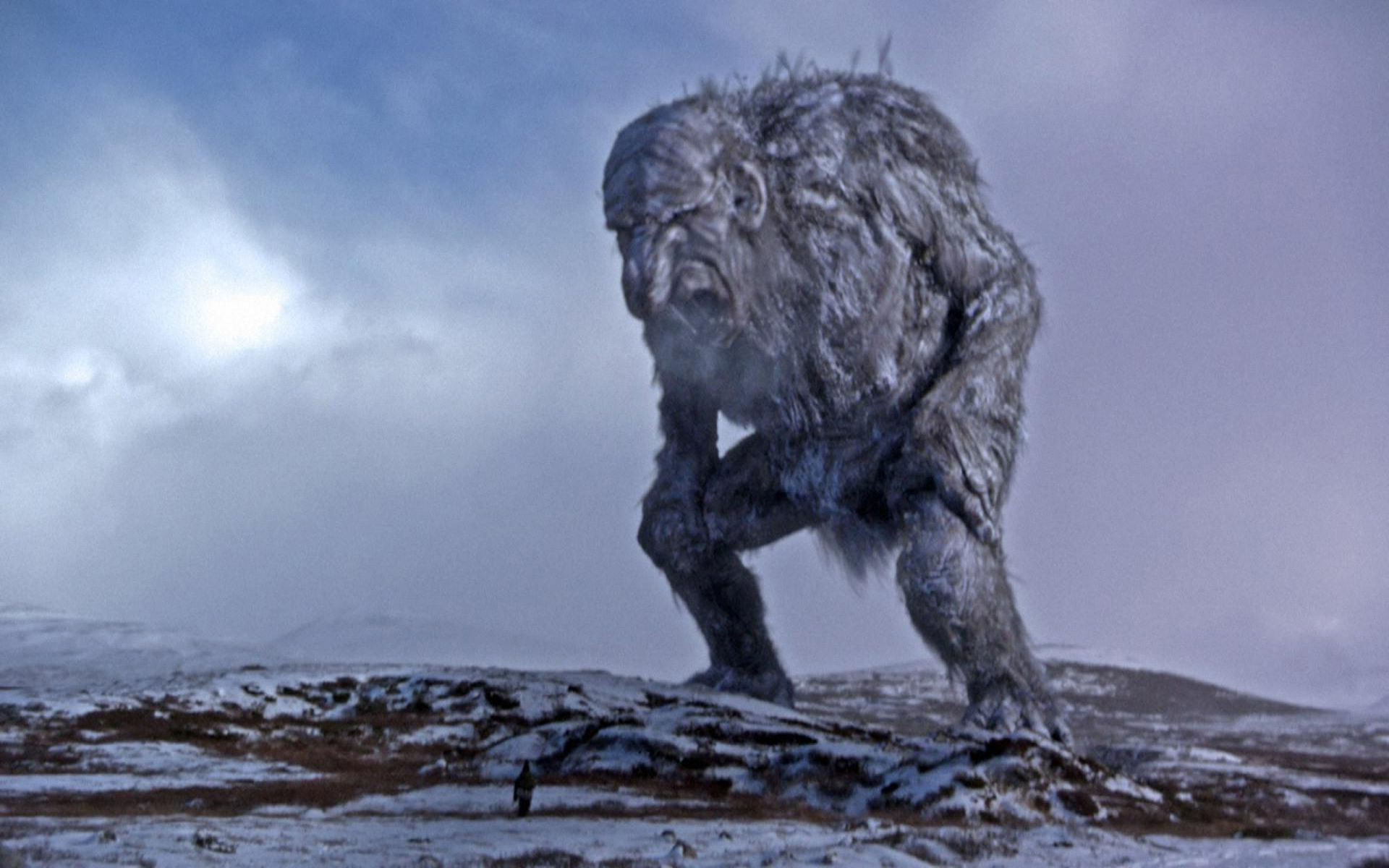
Nevertheless, at the 27 minute, as we do get images of a troll around 50-60 feet in height rampaging through a forest and then being turned to stone by Otto Jespersen with ultraviolet lamps – here the film’s model appears to be akin to Cloverfield and its integration of visual effects into ragged, handheld video footage. The troll itself looks ridiculous, more like a plasticine model, but on closer inspection requires some highly adept and sophisticated effects to integrate it with the filmed footage. Andre Øvredal does a fine job in directing the troll appearances – there is a particularly harrowing sequence where a troll emerges onto a bridge and appears to batter Otto Jespersen to death, and a tense sequence with the giant troll attacking the jeep at the climax.
The film plays out the idea of trolls in the modern world in complete seriousness. The script is constantly toying with a sense of its own mythology and creating all manner of made-up rules about troll behaviour and methods for hunting the trolls – scenes with Otto Jespersen setting bear traps with chunks of concrete and charcoal; searching local papers for clues about odd incidents that denote troll activity in the area; leaving out old tires, which the trolls regard as a delicacy; mapping the layout of rocks in an area with transparencies to tell if trolls have disturbed them. There is even a remarkable scene where veterinarian Urmila Berg-Domaas gives in perfect straight-faced a logical, scientific explanation as to why trolls turn to stone in sunlight.
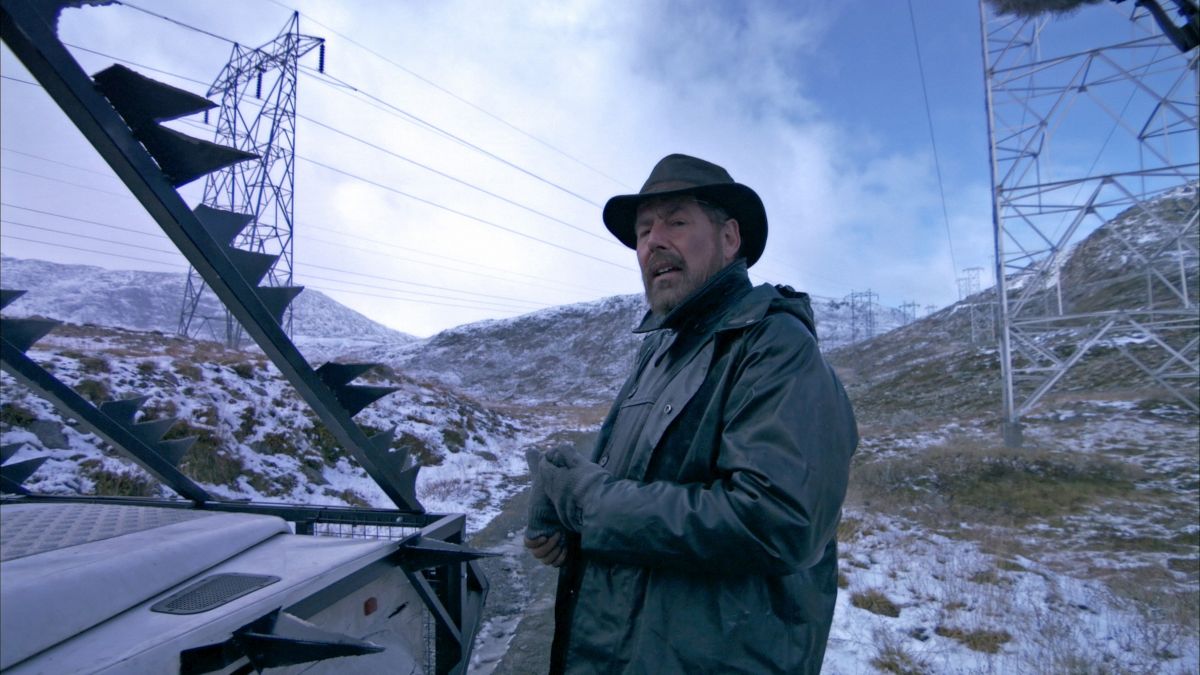
Things get increasingly more tongue in cheek towards the end – like where the cameraman is killed because he did not admit he was a Christian and where the crew then bring in a Muslim camerawoman as replacement; and a particularly amusing climax where Otto Jespersen drives off into the snowy mountains in his Landrover playing recordings of hymns to lure the giant troll.
The Troll Hunter was a surprising word of mouth hit – to the extent that it was even given a theatrical release in the US. It was only the second film from director Andre Øvredal, who had previously co-directed the psychological thriller Future Murder (2000). Øvredal subsequently went on to make the horror film The Autopsy of Jane Doe (2016), the Guillermo Del Toro scripted Scary Stories to Tell in the Dark (2019), Mortal (2020) about a man with godlike powers and The Last Voyage of the Demeter (2023), as well as produced the horror film Umma (2022).
Trailer here