
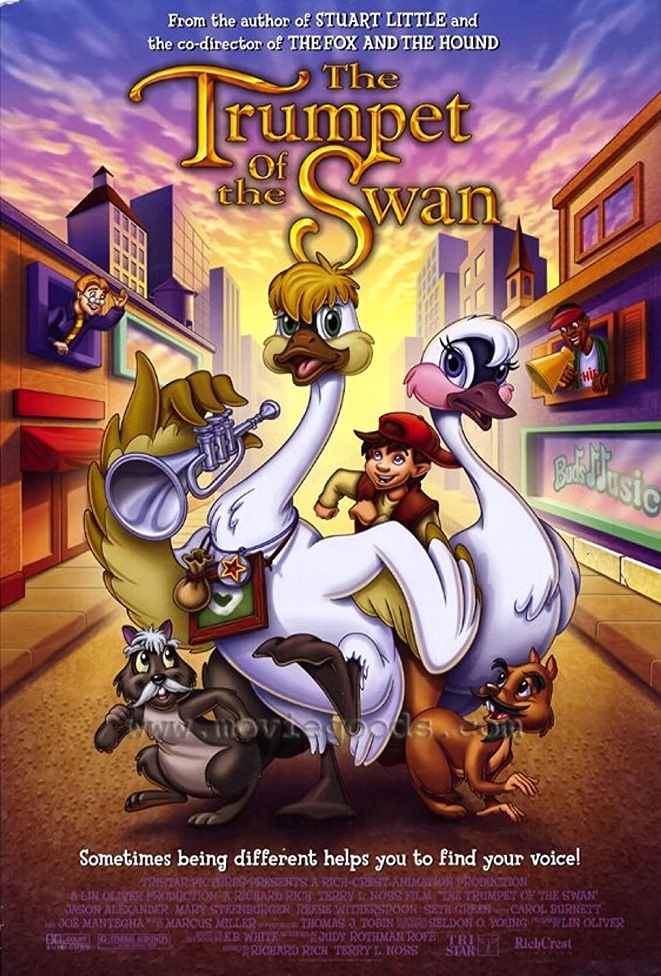
Crew
Directors – Terry L. Noss & Richard Rich, Screenplay – Judy Rothman Rofé, Based on the Novel by E.B. White, Producer – Lin Oliver, Music – Marcus Miller. Production Company – RichCrest Animation/Tiny Tots Productions Inc.
Voices
Dee Baker (Louie), Sam Gifaldi (Sam Beaver), Jason Alexander (Father), Reese Witherspoon (Serena), Seth Green (Boyd), Mary Steenburgen (Mother), Joe Mantegna (Monty), Carol Burnett (Mrs Hammerbotham), David Jeremiah (The Squirrel), Melissa Disney (Billie), E.G. Daily (Ella), Corey Burton (Senator)
Plot
A mother and father trumpeter swan give birth to three chicks. Two of these come emerge normally but the youngest Louie has no voice. Feeling useless, Louie befriends Sam Beaver, a human boy at a nearby summer camp. Louie realizes that he can read human writing and learns to write using his paws. At the end of the summer, the other swans migrate to Red Rock, Montana and Louie and Sam are reunited. When Sam realises that Louie can write, he takes him along to school to learn. Louie begins to fly about with a small chalkboard around his neck but is disappointed when the other swans fail to understand what he writes. In determination to give Louie voice, his father breaks through the window of a music store in Billings and takes a trumpet. Louie learns to play this. When he realises that the trumpet is stolen, Louie tries to find a way to pay the money back to the storeowner. Sam suggests that he go to Boston. There the unscrupulous Monty discovers Louie’s trumpet playing skills and promotes Louie as a novelty talent on the stage. Louie then learns that back among the herd, his beloved Serena is about to marry the self-important Boyd because she believes that Louie has left her.
Richard Rich is one of the generally overlooked independent names in animation. Rich began his career working for Disney as an assistant director on The Rescuers (1977) and then as a co-director on films like The Fox and the Hound (1981) and The Black Cauldron (1985). Rich subsequently went solo, creating his own studio Rich Animation Studio, under which banner he has made films such as The Swan Princess (1994) and its five video-released sequels The Swan Princess and the Secret of the Castle/The Swan Princess: Escape from Castle Mountain (1997), The Swan Princess III (1998), The Swan Princess Christmas (2012), The Swan Princess: A Royal Family Tale (2014), The Swan Princess: Princess Tomorrow, Pirate Today! (2016), The Swan Princess: Royalty Undercover (2017), The Swan Princess: A Royal Myztery (2018) and The Swan Princess: Kingdom of Music (2019).
While The Swan Princess was successful, the subsequent The King and I (1999) was a flop that put Rich Animation into bankruptcy. The company was subsequently relaunched as RichCrest Animation and under this banner Rich went onto to make The Scarecrow (2000), The Trumpet of the Swan here and Muhammed: The Last Prophet (2004), as well as to produce Alpha and Omega (2010) and then directed three video sequels Alpha and Omega 2: A Howl-iday Adventure (2013), Alpha and Omega 3: The Great Wolf Games (2014), Alpha and Omega: The Legend of the Saw Toothed Cave (2014) and Alpha and Omega: Family Vacation (2015).
The majority of Richard Rich’s work has centred around short animated films that illustrate tales from The Bible and The Book of Mormon (Rich is a practicing Mormon), as well as the occasional biography of famous historical figures like Beethoven, Abraham Lincoln, George Washington, Benjamin Franklin, Alexander Graham Bell and Florence Nightingale.
With The Trumpet of the Swan, Rich co-directs with Terry L. Noss who started out as Rich’s assistant editor back at Disney and has remained a regular producer/editor for Rich ever since. The two of them turn to a 1970 children’s book from E.B. White, the author who also wrote the books of Stuart Little (1945) and Charlotte’s Web (1952), both of which have been multiply filmed – see Charlotte’s Web (1973), Stuart Little (1999) and sequels, and Charlotte’s Web (2006).
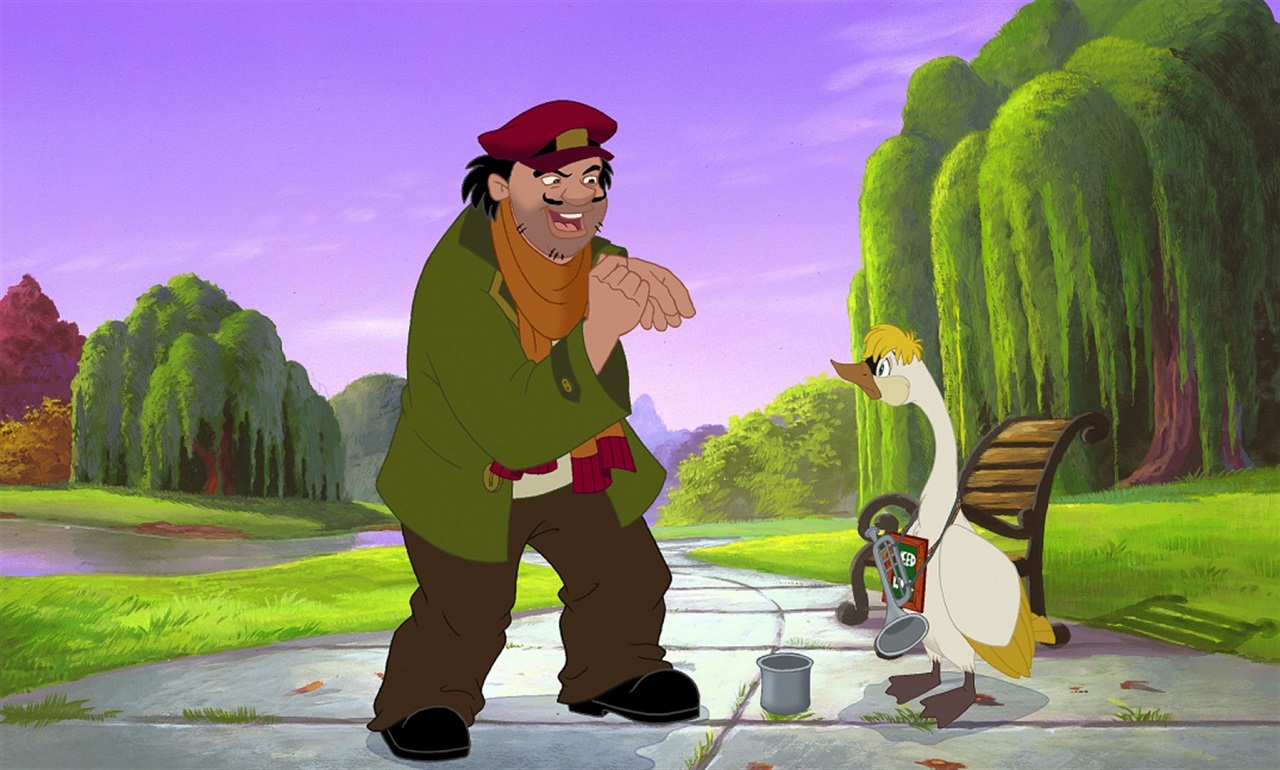
The Trumpet of the Swan received a theatrical release in many parts of the world but it feels more like its true destination is as a video release. The animation is limited, down around the style of standard tv animation, not the expansive quality that one would expect of a theatrical release. The story generally follows the basics of E.B. White’s book but Rich and Noss condense the scope in order to tell it within a 75-minute timeframe. Unfortunately, they pitch most of the film at a level designed for young children and the film is likely to be insipid for anybody older than that.
There is the dreaded insertion of some exceedingly banal songs. There is also something about the film that seems to be trying too hard – the inclusion of a kid who wears a baseball cap backwards, or a raccoon that talks like a hip streetwise African-American, which seem to be characters inserted because the filmmakers are desperately trying to appeal to either a certain demographic or register a cool. The film’s most saccharine moment is when a lovelorn Louie misses his beloved Serena and the soundtrack starts singing her name, as her appearance comes silhouetted in the stars above.
Trailer here