

aka The Tulse Luper Suitcases: A Life in 16 Parts
UK/Portugal/Luxembourg/Hungary/Italy/Germany/Russia/Netherlands. 2003.
Crew
Director/Screenplay – Peter Greenaway, Producer – Kees Kassander, Photography – Reiner van Brummelen, Music – Borut Krzisnik, Visual Effects – Stereomatrix (Supervisor – van Brummelen), Special Effects – NASA FX, Production Design – Marton Agh, David Bassan, Billy Lelieveld, Pirra & Bettina Schmidt. Production Company – BS Productions – Barcelona/Delus Productions S.A./Focus Film/Gam Film SLA/12A Film Studios/Net Entertainment/Eurimages/The Arts Council of Wales/The Rotterdam Film Fund.
Cast
J.J. Feild (Tulse Luper), Caroline Dhavernas (Passion Hockmeister), Drew Mulligan (Martino Knockavelli), Scot Williams (Percy Hockmeister), Jordi Molla (Jan Palmerion), Jack Wouterse (Erik van Hoyten), Nigel Terry (Sesame Esau), Steven Mackintosh (Gunther Zeloty), Raymond J. Barry (Stephen Figura), Yorick van Wageningen (Julian Lephenic), Barbara Tarbuck (Ma Fender), Valentina Cervi (Cissie Colpitts), Deborah Harry (Fastideaux)
Plot
The story of Tulse Luper. Born in 1921, Luper grew up in England after World War I. He became an obsessive collector of objects and left behind 92 suitcases filled with various objects before he disappeared in 1989. In the 1930s, Luper travelled to Moab, Utah in search of lost Mormon towns. Instead he was accused of peeping on the underage Passion and was taken by the German-American Percy Hockmeister, where he was stripped, his genitalia covered with honey and he left tied up in the desert. After being rescued from his plight and given a ride by Passion, he was arrested for underage consort. He escaped jail and was allowed to go free as long as he acted as an agent for Sesame Esau in Europe. Luper travelled to Antwerp, where he maintained a successful cover as a British journalist. He then became caught between the rise of the Nazis and Fascists, which included Hockmeister amongst their number, and was made a prisoner at the Antwerp railway station.
Peter Greenaway is a cultish name among arthouse directors. Greenaway first emerged with a host of short films and then gained a name with the exquisitely barbed Jacobean drama The Draughtsman’s Contract (1981), which is his best film. However, it was with films such as The Belly of an Architect (1987), Drowning by Numbers (1988), Prospero’s Books (1991) and in particular the arthouse hit of The Cook, The Thief, His Wife & Her Lover (1989) that audiences began to discover Greenaway’s eccentricities.
Peter Greenaway films are more like arcane rituals than films – they come exquisitely dressed and beautifully photographed but it is alwats like Greenaway is always playing an obscure game with the audience – making us count numbers throughout the film, having characters change the colour of their outfits to match the surroundings every time they move into a different room, reciting rules for imaginary games, even one entire film The Falls (1980) that consists of deadpan imaginary biographies. Greenaway is like a combination of some demented Dutch master and an obsessive-compulsive disorder sufferer.
Into the 1990s and 00s, Greenaway’s films – the likes of The Baby of Mâcon (1993), The Pillow Book (1996), 8½ Women (1999), Nightwatching (2007) and Eisenstein in Guanajuato (2015) – have not held the same interest for audiences that they used to, where he was seen variously accused of retracing old ground and not holding the sharpness he once did.
The Tulse Luper Suitcases is part of a massively ambitious undertaking on Greenaway’s part. The Moab Story (although that subtitle is never mentioned on the credits) is not merely one film but the first chapter of a work that was released in three parts. Furthermore, Greenaway at one point planned that the films would be followed by a tv series and a total of 92 dvds, cd-roms and books (92, being the atomic number of uranium, has a repeated significance throughout this and other Greenaway). It is a mind-boggling conception. The only other works to have emerged so far were the other films, The Tulse Luper Suitcases, Part 2: From Vaux to the Sea (2004) and The Tulse Luper Suitcases Part 3: From Sark to the Finish (2004), as well as an edited down version of the saga, A Life in Suitcases (2005), as well as two books, , a website and an internet game The Tulse Luper Journey.
It could be observed that from around 1995 onwards Peter Greenaway has increasingly become a director who has abandoned narrative and most other considerations. His films now seem like they play exclusively to Greenaway fans. It is hard, for instance, to imagine audiences coming to an appreciation of Greenaway after watching The Tulse Luper Suitcases. Certainly, The Moab Story was greeted with some incredibly negative reviews when it premiered at the Cannes Film Festival in 2003 and received a mixed reception the world over, not even being granted a proper arthouse release. The two subsequent films had even more of a struggle finding audiences.
The Tulse Luper Suitcases: The Moab Story is not entirely unrewarding but is a difficult film to like. It is certainly the ultimate Peter Greenaway film – and this may well be its downfall. While earlier Greenaway films paid more attention to plot, with the games and rituals playing around the side, The Tulse Luper Suitcases: The Moab Story is all game. Greenaway goes crazy with his lists. We gets lists everywhere – Luper’s 92 suitcases, with Greenaway frequently breaking away to list all of the contents of each suitcase; pop-up lists numbering and naming every character as they appear; numbers appearing on the screen throughout to count all the blows that Luper receives every time he is hit or kicked.
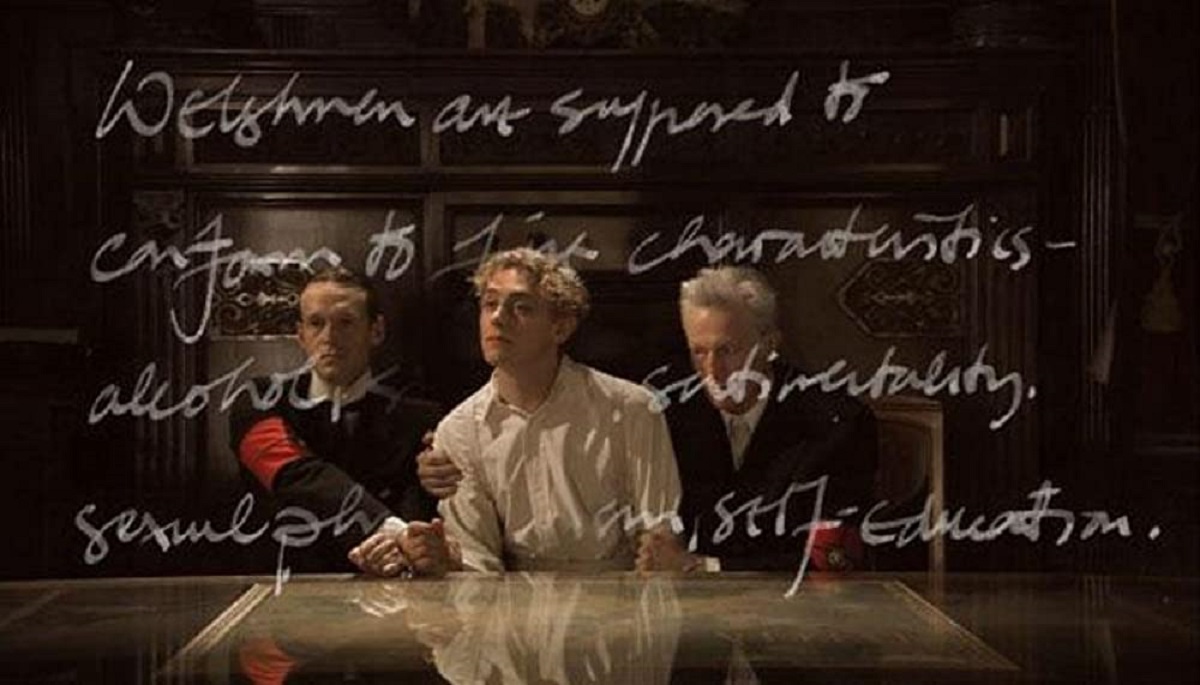
From Prospero’s Books onwards, Greenaway has started to use the screen more in a multi-media sense and The Moab Story goes visually mad with pop-ups offering information, multiple screens and numerous points-of-view of people being interviewed where the same line they are saying is multiply laid over. Dialogue comes in several different languages. Printed information, random lines of dialogue and even pieces of script flow through the backgrounds or are overexposed over shots – in one scene, Greenaway even has characters saying their dialogue as a secretary types it up and it appears on the screen.
The sets are created in a deliberately stagy, artificial way – Luper’s childhood takes place amid a series of brick backyards and alleyways with no houses, all constricted within a 30-50 foot space built on a stage, while the offices at the railway station are simply a series of shelves and desks on a blank stage. The sets of the Moab jail and the Antwerp railway station are constructed as though they were stage sets and Greenaway’s camera frequently remains at a distance moving only along a right-left dolly but rarely into closeup, while maps and various pictures are randomly projected onto the walls. Greenaway draws his cast from different nationalities – the Utah natives are rarely played by Americans, for instance, and the actors cast play with outrageously fake and over-the-top accents, which adds to the bizarre unreality of it.
Greenaway even gets in a number of self-referential jokes – as to how Luper’s ideas were remade as various of his own films, including shorts like Vertical Features Remake (1976), Water Wrackets (1976) and the feature A Zed and Two Noughts (1985), while The Belly of an Architect‘s location also getting a mention. There is also an appearance from Cissie Colpitts, a character name that reappears throughout Greenaway’s work – the three murderous wives in Drowning By Numbers were all named Cissie Colpitts and she also appears in one of the mock-biographies in The Falls.
All of this makes for a dense and visually busy film, although quite what it was about seemed to elude most audiences. There is a nominal plot connecting it altogether, although it is clearly something not important to Peter Greenaway. I sort of liked The Moab Story, although it took a good deal of effort. A very dry and arcane sense of humour sometimes comes through. It is also an enormously indulgent film and liking it is limited to extent to which we are prepared to give Peter Greenaway his head for his eccentricities. I was willing to, but I don’t know if I would be willing to for a further two films consisting of the same thing, let alone sitting down to read the books, multimedia or view the accompanying tv series. I have followed Peter Greenaway’s career with interest but certainly if this is the direction that he is progressing in as a director, I cannot honestly say that I feel hugely interested in seeing what else he has to say.
Peter Greenaway’s other films of genre interest are:– the surreal post-holocaust ‘documentary’ The Falls (1980); The Cook, the Thief, His Wife & Her Lover (1989); several episodes of the modernised tv series A TV Dante (1989-91); Prospero’s Books (1991), Greenaway’s interpretation of Shakespeare’s The Tempest (1611); and the miraculous child film The Baby of Mâcon (1993). The Greenaway Alphabet (2017) is a documentary about Greenaway.
Clip from the film here
And here:-