

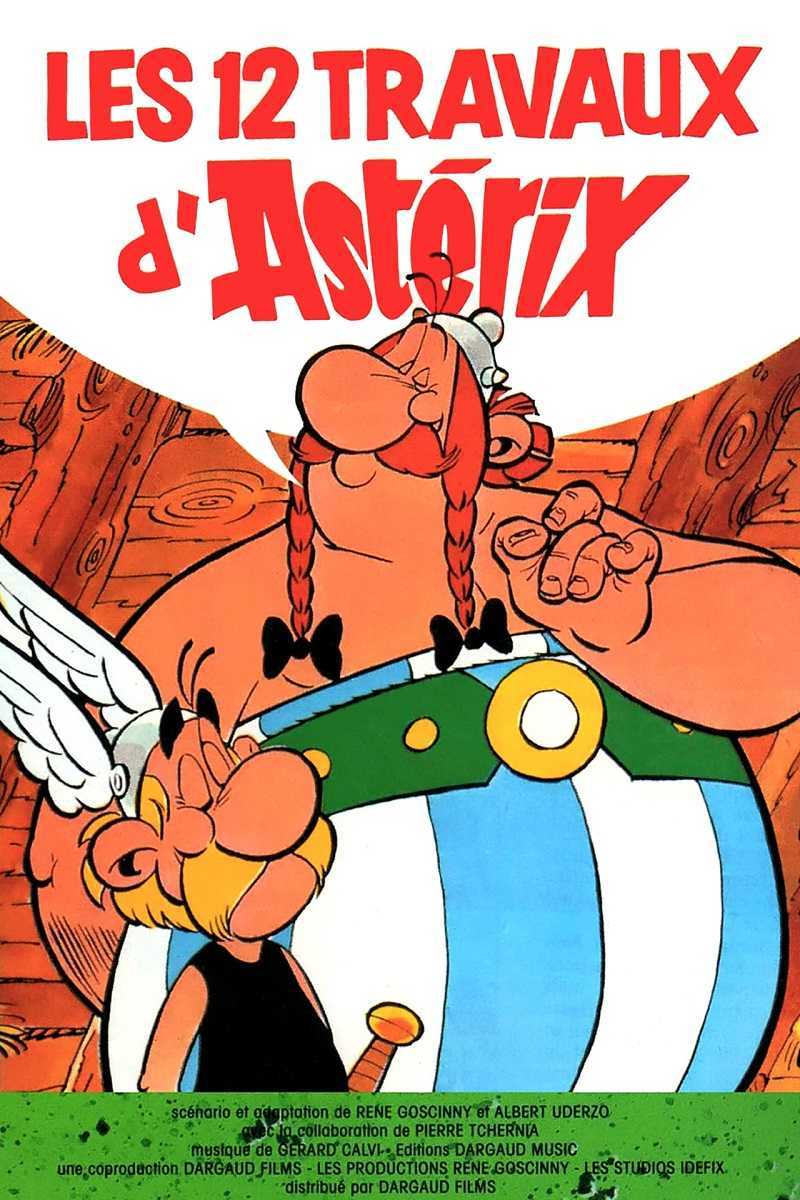
aka Asterix’s Twelve Tasks
(Les Douze Travaux d’Asterix)
France. 1976.
Crew
Directors – René Goscinny, Henri Gruel, Albert Uderzo & Pierre Watrin, Screenplay – René Goscinny & Albert Uderzo, Screenplay Collaboration – Pierre Tschernia, Producers – Georges Dargaud, René Goscinny & Albert Uderzo, Music – Gerard Calvi. Production Company – Studios Idefix/Dargaud Films/René Goscinny Productions.
Plot
Caesar is trying to work out what to do about the Gauls who refuse to surrender and come under Roman authority. His senators make the comment that with the magic potion, the Gauls are like gods. This gives Caesar the idea of issuing a challenge to the Gauls – if they can perform twelve tasks like Hercules, then he will admit that the Gauls are superior and surrender Rome to them. Asterix and Obelix set out to complete the challenge. They undertake the twelve tasks, which include such things as outrunning an Olympic runner; throwing a javelin further than the world champion; beating a judo expert; surviving the Island of Pleasure; coping with the intense hypnotic stare of an Egyptian; finishing one of the gigantic meals prepared by Mannekinpix; passing through the cave of The Beast; surviving The Place That Sends You Mad; crossing a river of crocodiles on an invisible thread; climbing a mountain to answer an old man’s riddle; spending a night in a haunted battlefield; and entering the Circus Maximus in Rome.
The Twelve Tasks of Asterix was one of a number of films based on France’s popular Asterix comic-books by René Goscinny and Albert Uderzo. From their first appearance in 1959, the Asterix comic-books run to 41 books, the first 24 from Goscinny and Uderzo, the subsequent ten from Uderzo after Goscinny’s death in 1977 and the rest from other writers after the sale of the copyright. The Asterix comic-books concern a village of characters in Gaul (modern-day France) in the first century A.D. who stand up against the Roman occupation with the aid of a magic potion that gives them super-strength. These have become much-loved children’s books and are read in multiple languages the world over.
Goscinny and Uderzo collaborated with the Belgian animation company Dargaud Films to make several Asterix films, beginning with Asterix the Gaul (1967) and the subsequent Asterix Vs Caesar (1985), Asterix in Britain (1986) and Asterix and the Big Fight (1989). With the subsequent Asterix and Cleopatra (1968) and The Twelve Tasks of Asterix here, Goscinny and Uderzo even signed on as co-directors. (For this film, they even created their own animation studio Studios Idefix). The other Dargaud films were adapted from existing Asterix comics but with The Twelve Tasks of Asterix, Goscinny and Uderzo created an original work directly for the screen. They later adapted this into a comic-book Asterix Conquers Rome (1976), although this is generally regarded as standing outside of regular Asterix canon by fans because it makes changes to continuity.
There have been other animated films from the French company M6 Studio with Asterix Conquers America (1994) and Asterix and the Vikings (2006) and then the CGI-animated Asterix: The Mansion of the Gods (2014) and Asterix: The Secret of the Magic Potion (2018) from other companies. There have also been a series of live-action Asterix films starring Gerard Depardieu as Obelix with Asterix and Obelix Vs. Cesar (1999), Asterix & Obelix: Mission Cleopatra (2002), Asterix at the Olympic Games (2008), Asterix and Obelix: God Save Britannia (2012) and one without him Asterix & Obelix: The Middle Kingdom (2023).
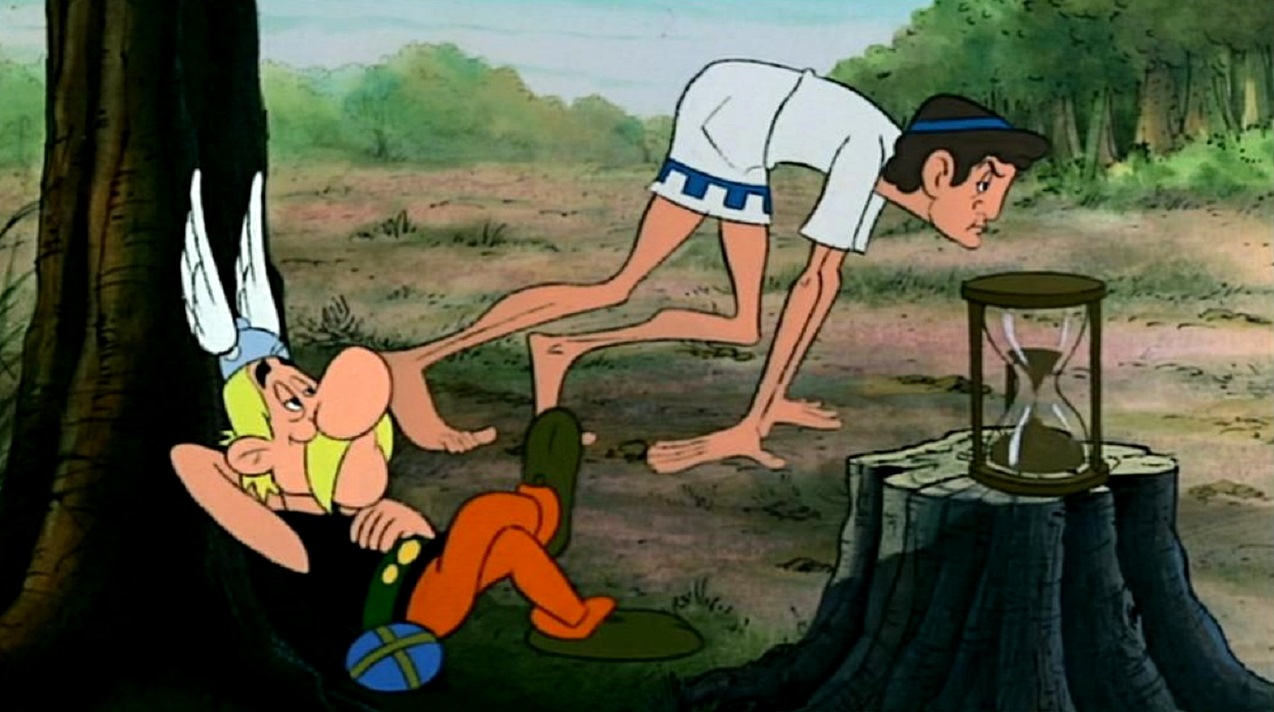
Of all the various Asterix films, one has to assume that the two directed by Goscinny and Uderzo would be the ones that come the closest to what the creators intended their vision to look like. Because of this, The Twelve Tasks of Asterix was worth anticipating – equally it also makes the film a letdown. Certainly, the film is very faithful to the look of the characters, as you might expect. On the other hand, the film has clearly been made on limited resources and the animation directed down at a simplistic level, which makes it a considerable disappointment.
The story is extremely episodic, only ever being arranged around the various tasks. The early sequences seem lacking in the usual wit and visual gags of the comic-book. The problem here is largely one where the plainness of the animation is not able to provide the texture and depth that Goscinny and Uderzo gave to their comic-book panels. There is also much more of a reliance on standard cartoon-type gags over the historical and absurdist puns that run through the comic-book.
Nevertheless, there are occasional moments when the film transcends this. One of these is the arrival at The Place That Drives Your Mad (a bureaucracy), which turns into something like slapstick Kafka. There is the other odd sequence – one with an Egyptian that hypnotises people into becoming animals; or the encounter with Mannekinpix, a chef who creates massive banquets of camels and elephants and whose efforts Obelix manages to exhaust. It is here that the film starts to work with the zany absurdity to be found in the comic-books. On the other hand, some of the sequences fail to work – such as the venture into a cave to meet The Beast, which is no more than a surreal gag where Asterix and Obelix encounter some psychedelic visuals and then briefly end up on a subway platform.
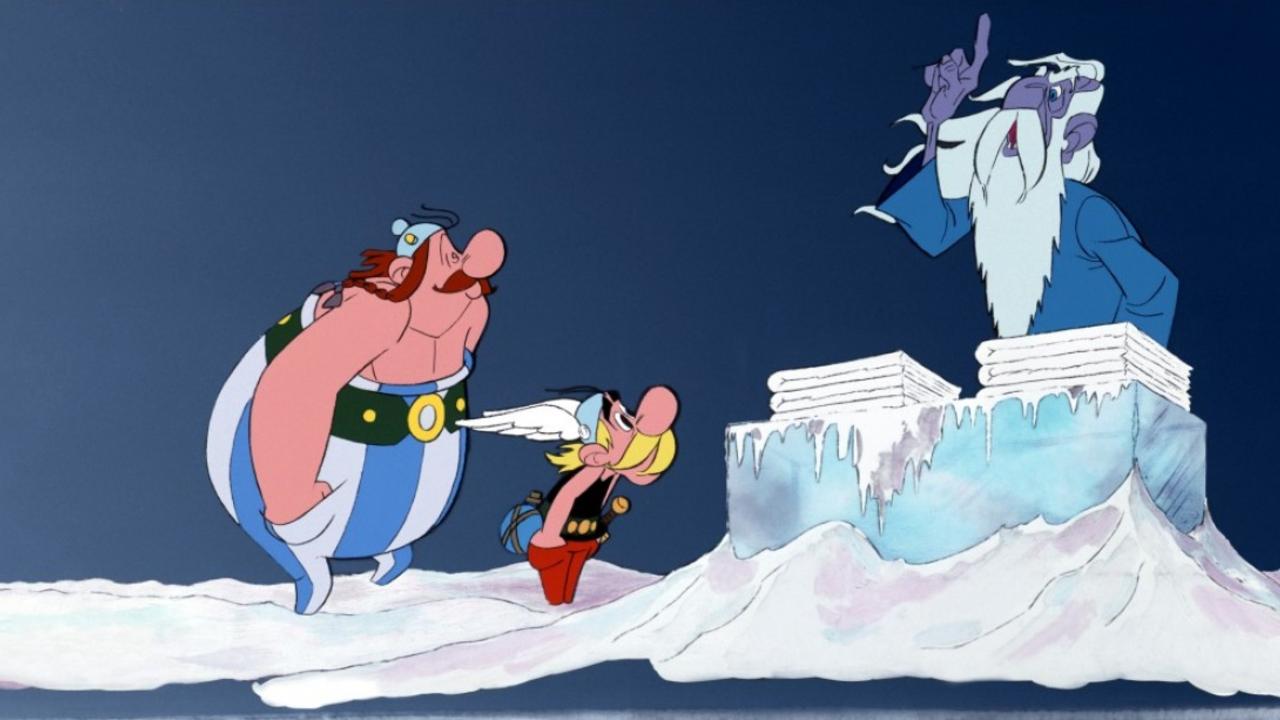
The film also throws in gags that are constantly breaking down the fourth wall. As well as the abovementioned subway sequence, there is a scene where characters land in the background and comment: “No, I see 50 B.C.,” whereupon the junk in the forest vanishes. The sequence where Asterix and Obelix climb the mountain to meet old wise man ends up in a debate about what detergent to use, whereupon the old man breaks into the spiel of a commercial.
The film also shoots its own suspension of disbelief in the foot at the very end where Obelix asks: “Are we really the masters of Rome?” whereupon Asterix answers: “Let’s face it – this is a cartoon and anything goes.” Gags like this are insulting in that they regard the audience as idiots for taking the film seriously.
There is also a certain element of racist humour, like the scene where it is commented that the books have been translated into all languages and Asterix mimics slanted eyes as they get to Chinese. In the English language version seen here, the characters have been given British accents, resulting in the peculiarity of Asterix coming out sounding like Ringo Starr.
(Review copy courtesy of Kathy Tipping)