
Crew
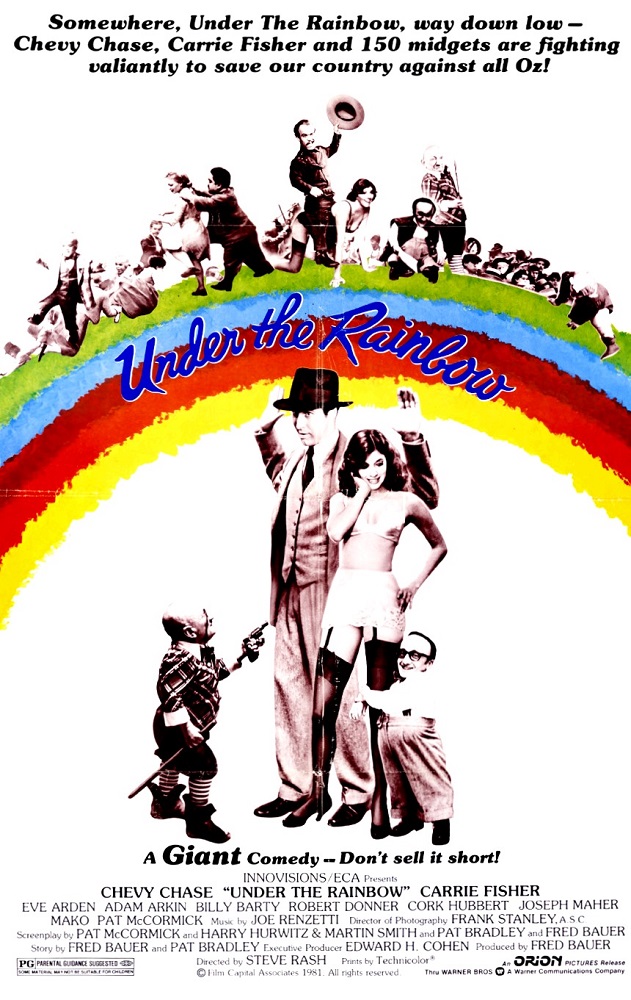
Director – Steve Rash, Screenplay – Fred Bauer, Pat Bradley, Harry Hurwitz, Pat McCormick & Martin Smith, Story – Fred Bauer & Pat Bradley, Producer – Fred Bauer, Photography – Frank Stanley, Music – Joe Renzetti, Special Photographic Effects – James E. Ules, Special Effects – Phil Cory, Production Design – Peter Wooley. Production Company – Innovisions/ECA.
Cast
Chevy Chase (Bruce Thorpe), Carrie Fisher (Annie Clark), Billy Barty (Otto Kriegling), Cork Hubbert (Rollo Sweet), Joseph Maher (Duke Ferdinand), Eve Arden (The Duchess), Robert Donner (The Assassin), Mako (Nakomuri), Adam Arkin (Henry Hudson)
Plot
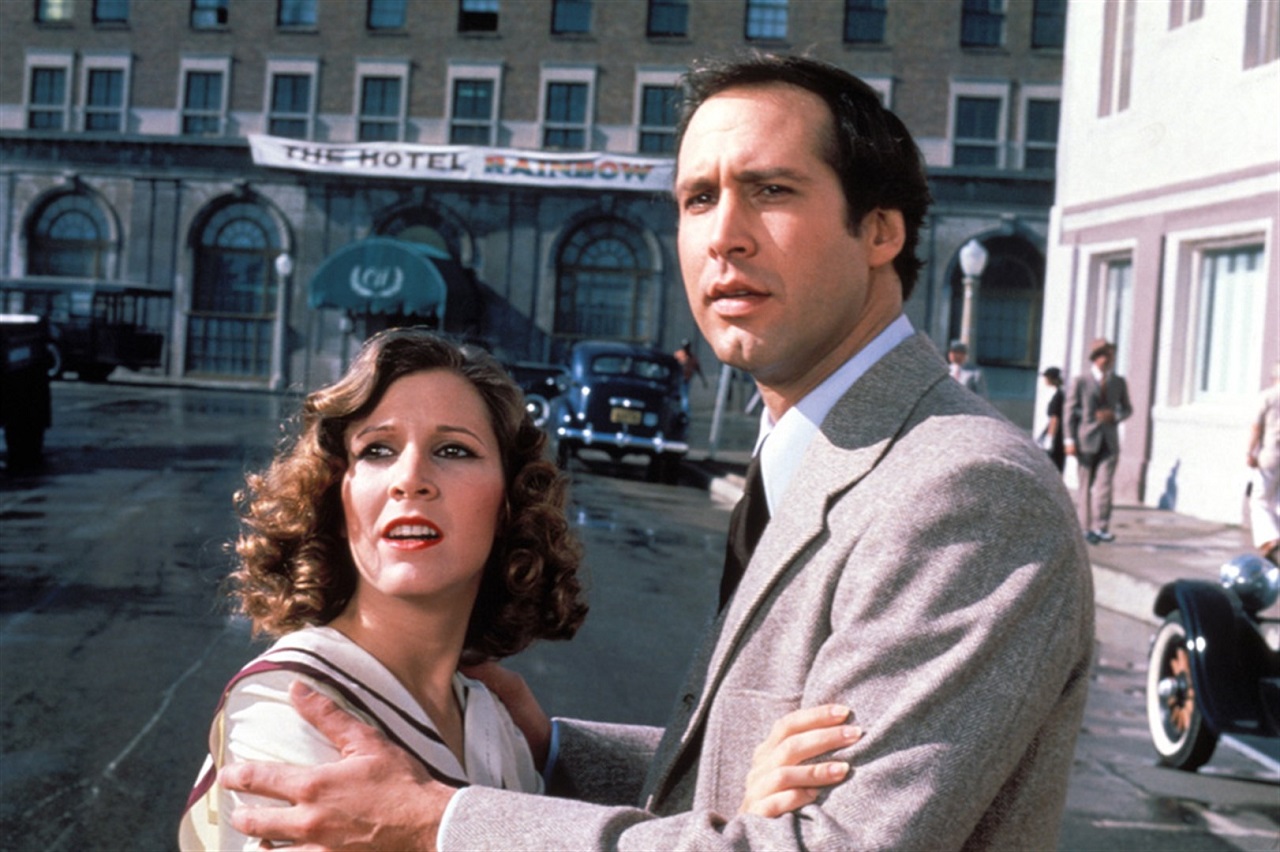
In 1939, Rollo Sweet leaves Depression-wracked Kansas for Hollywood as part of a casting call for little people required for the roles of The Munchkins in ‘The Wizard of Oz’. Casting assistant Annie Clark is given the job of finding accommodation for all the little people and signs them into the Rainbow Hotel opposite the studio. At the same time, Secret Service agent Bruce Thorpe is assigned the role of guarding The Duke and Duchess of Luchau who are fearful of assassins. He signs into the Rainbow Hotel with them but they are followed by a lone assassin. Meanwhile, Adolf Hitler sends the dwarf agent Otto Kriegling to Hollywood to rendezvous with a Japanese agent and exchange a crucial map of the Nazi invasion plans. Otto’s search for the Japanese agent becomes confused as a busload of Japanese tourists also signs into the hotel. Amid the chaos caused by the partying little people, the map is accidentally left inside Annie’s copy of the script.
Most of Hollywood filmmaking is inherently conservative rather than creative and boundary breaking – the majority of films are either copies of what has gone before or designed to bank on something that has been commercially proven. There are times however when things make you scratch your head and wonder what on earth was going through the heads of those responsible that caused all sense to momentarily flee and allow projects to be greenlit. One such occasion must surely have been Under the Rainbow.
The film has been construed as a screwball comedy in the 1940s tradition set around the dwarfs who were cast as the Munchkins in The Wizard of Oz (1939). One is not sure what lay behind this thinking – maybe someone was trying to imitate the semi-success enjoyed by Steven Spielberg’s equally overblown screwball comedy 1941 (1979) about the Japanese invasion of L.A.. Everything about Under the Rainbow reads as a total disaster. It was afforded a $20 million budget, which was sizeable in 1981 – by comparison, Spielberg’s Raiders of the Lost Ark (1981) made the same year only had an $18 million budget. Although when released, the film only earned $3 million in domestic box-office rentals.
Certainly, Under the Rainbow has a very mild basis in truth. It is true that the 100+ midgets and dwarfs were recruited to play the Munchkins and were housed at a hotel just opposite the MGM studio. (In fact, the film uses the same location where the little people were lodged – the now disused Culver City Hotel). There have been rumours over the years that the little people were engaged in drunken orgies but Wizard of Oz historians have determined these are a complete fiction – at most, the little people threatened to go on strike at one point after rumours circulated that they would not be paid.
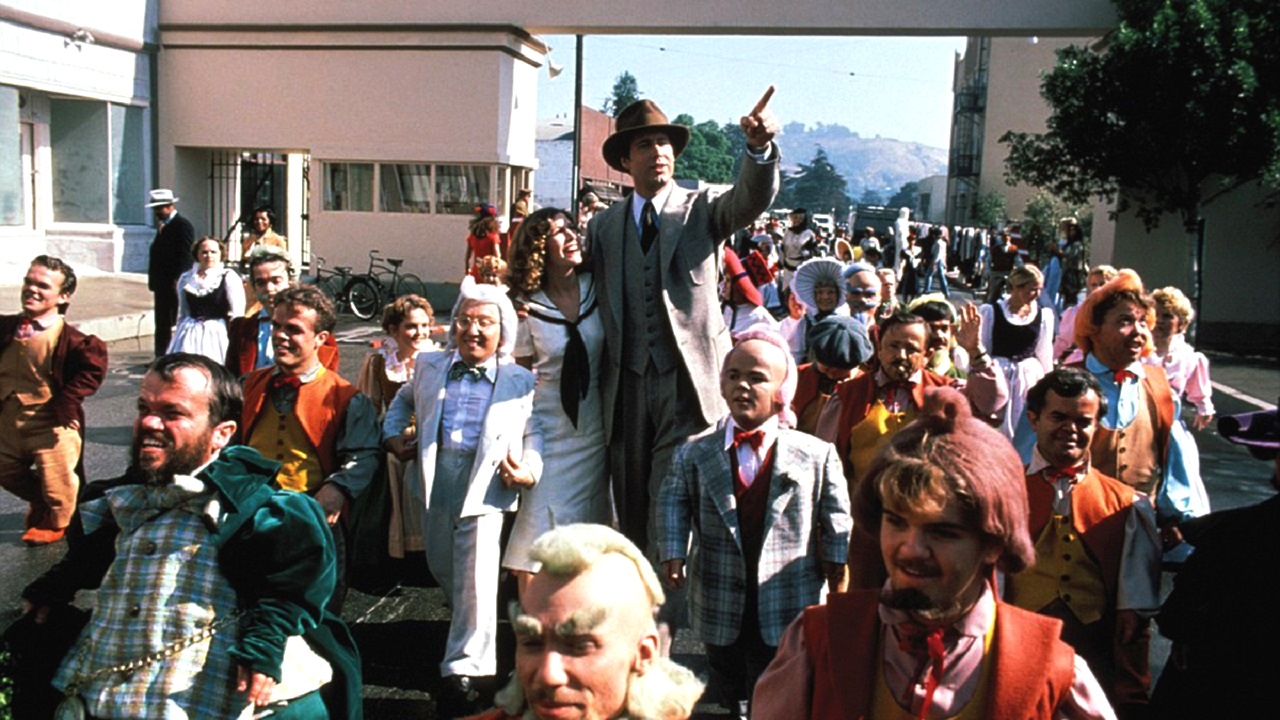
The entire film is premised around an hysterically-paced series of confusions, encounters and mix-ups between the various parties in the hotel. Everything is played as utterly inane slapstick. There is a particularly overblown climactic chase through the MGM backlot, which involves dozens of dogs, pursuit by a horsedrawn carriage, runaway horses and vehicles, people running past swimming pools and through women’s dressing rooms, even the interruption of the shooting of Gone with the Wind (1939) where the Nazi dwarf manages to hide under a woman’s skirt.
Almost every time that a little person appears in a fantasy or comedy film, filmmakers seemingly cannot resist the opportunity to have them taking pratfalls or tumbling over their own feet. Under the Rainbow plays for this like it is on crack – a substantial part of the film involves the little people falling down stairs, running through elevators, swinging on chandeliers or ducking between the legs of or stepping over full-sized people. In fact, the film ends up pandering to a caricature that is insulting – all the little people in the film seem to have no more of a mental age of children that have been left to run riot in a playground without adult supervision.
Everything in the film is an absurd comic caricature. We even get comic Nazis, including a scene where a dwarf SS officer manages to accidentally whang a totally unconvincing Adolf Hitler look-alike in the nuts. Worse though, the film descends to racial caricature – a busload of Japanese turn-up all outfitted in white suits and Coke bottle glasses and clicking cameras wherever they turn. In the lame twist ending, everything is revealed to be a dream of the fame and fortune that dwarf Cork Hubbert hopes to find in Hollywood as he lies unconscious after a fall, where we realise that all the characters he encountered at the hotel correspond to the people at the Kansas mission where he lives.
Even the slapstick inanities of the show manage to dwarf the starring presence of Chevy Chase who remains uncustomarily subdued throughout, only rising to make a few of his smug, ultra-annoyingly quips upon a handful of occasions, which should at least be considered one mark in the film’s favour. Carrie Fisher at least had the excuse that she was in the midst of a drug addiction problem at the time. (For all the Celebrity Sleuth watchers out there, Under the Rainbow does have the prurient interest of seeing a young Carrie wandering around in her underwear for several minutes of screen time). Fisher later claimed that Under the Rainbow was the worst thing she had ever appeared in.
Director Steve Rash had previously debuted with the well regarded The Buddy Holly Story (1978). Subsequently, Rash went onto commit various other crimes against cinema, most notably in making a star out of Pauly Shore in Son-in-Law (1993). More recently he has been directing various direct-to-video American Pie and Bring It On sequels.