
(Le Mur)
Crew
Director/Screenplay – Alain Berliner, Photography – Yves Cape, Music – Alain Delaisieux, Visual Effects – Main Street, Special Effects – Gilbert Kiner. Production Company – Le Sept Arte/Haut et Court/WFE.
Cast
Daniel Hanssens (Albert), Pascale Bas (Wendy), Mil Seghers (Maurice), Michael Pas (Stign), Peter Michel (Ivo)
Plot
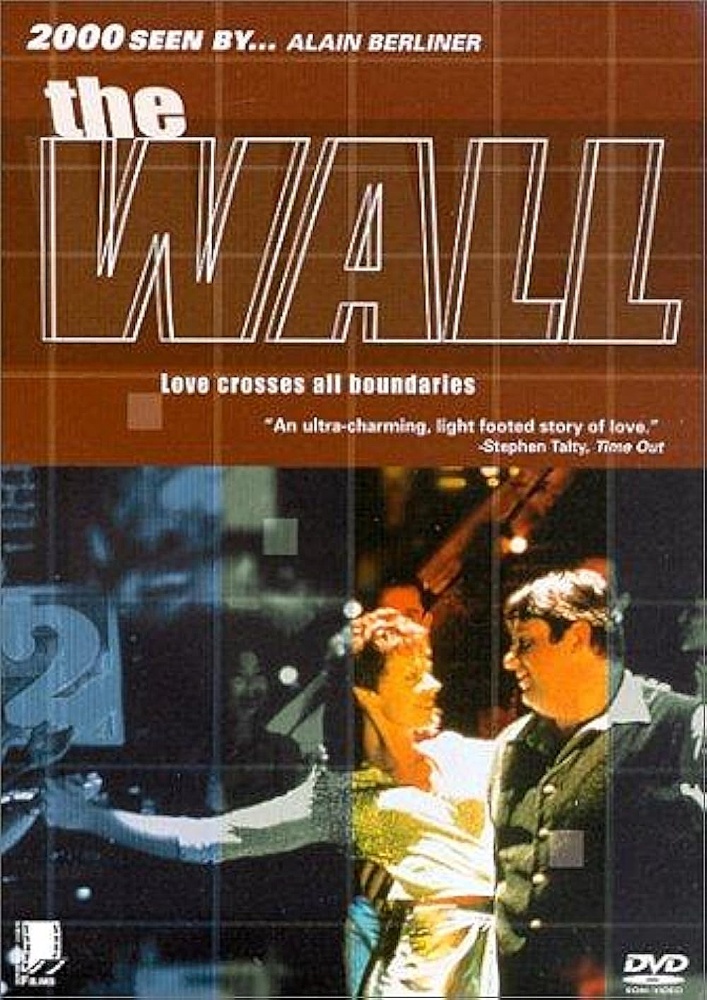
Belgium is linguistically divided between the Flemish people and the French-speaking Walloons. The government has attempted to solve differences by creating a political dividing line between the two territories. Albert, a Walloon, runs a fish’n’chip trailer situated on the border between the two territories. On the last day of The Millennium, Albert meets a Flemish girl Wendy at a party and falls in love with her. He wakes up after the party to find that the government has erected a vast wall between the two territories overnight and that he is trapped on the Flemish side without a visa. The territory has become a totalitarian state where his former friends are now encouraged to turn him in.
While Canada’s Don McKellar delivered a superb human drama about how people meet the end with Last Night and USA’s Hal Hartley delivered a sardonic take on the Second Coming with The Book of Life, The Wall, the Belgian contribution from Alain Berliner, offers a tepid social allegory about linguistic divisions. The crucial failure of Berliner’s contribution is that the film fails to justify its millennial theme. The question that has to be asked of each of these millennial films is how much the story would differ if it were set at any other point in time and the answer here is precisely nil. Secondarily, as a film, The Wall fails to grapple with themes of any significance whatsoever – where McKellar, Hartley and other contributors tackled such weight themes as The Second Coming or the end of the world and how we meet it, Alain Berliner’s contribution is a social allegory of no consequence to anyone who is not Belgian or aware of Belgian linguistic divisions.
Certainly, for a film with a mere 67 minute running time, Berliner tries to make The Wall into many things – social allegory, millennial commemoration, Magical Realism and romance. The social allegory never travels beyond the cliches of dystopian drama and the images of WWII occupation movies. It is a story that remains allegorical at best, never realistic – the wall pops up overnight with the rest of the populace somehow failing to witness anything. Moreover, Berliner, once he has his social fable in place, fails to have anything to say about it – the film ends on the absurdly naive hope that everyone will somehow manage to get along, something the rest of the film has surely demonstrated that they are unable to do.
The film is also peppered with a number of reference to Magical Realism and the Belgian surrealist tradition – people make jokes about Belgium being the land of surrealism and Magritte posters litter the background. The ghost of the hero’s father makes appearances throughout and when the hero and heroine are cornered by pursuers they realize that they are in the land of Magical Realism and simply wish themselves across the other side of the wall.
Unfortunately, this tone of whimsy jars with the film’s use of totalitarian imagery. A dystopian fantasy draws its shock effect from the helplessness of its protagonists against a brutal and mindless ideology but in a film like this where anything can happen, one in fact ceases to care what does happen. Brazil (1985) made a far better ironic contrast between the fantastical desire to dream and the grim realism of a brutal future society. The one area the film does briefly work is in the romance between big, lugubrious Daniel Hanssens and the foxily wide-eyed Pacale Bas – the scenes of he doubling her cheek-to-cheek across the handlebars of a bicycle have a quaint sweetness to them.
Director Alain Berliner previously had a reasonable international arthouse hit with the quasi-fantastical Ma Vie en Rose (1997). Berliner next ventured Stateside with the unsatisfying Magical Realist film Passion of Mind (2000) about two Demi Moore’s on either side of the world dreaming that they are the other. All of Berliner’s subsequent films have been made in Belgium where his only other work of fantasy has been the tv movie The Skin of Chagrin (2010) about a magic donkey skin with wishing powers.