

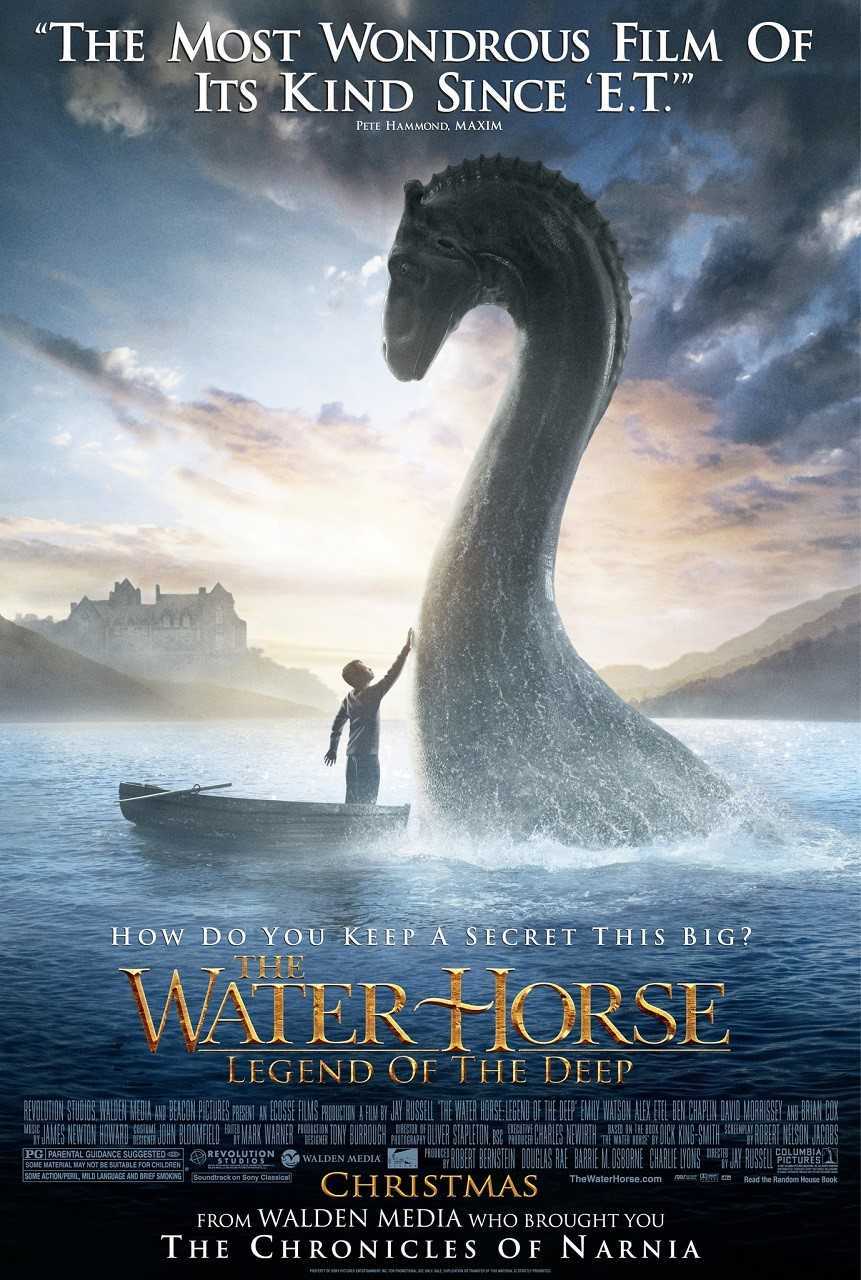
aka The Water Horse: Legend of the Deep
USA/UK. 2007.
Crew
Director – Jay Russell, Screenplay – Robert Nelson Jacobs, Based on the Novel The Water Horse (1990) by Dick Smith-King, Producers – Robert Bernstein, Charlie Lyons, Barrie M. Osborne & Douglas Rae, Photography – Oliver Stapleton, Music – James Newton Howard, Music Supervisor – Denise Luiso, Senior Visual Effects Supervisor – Joe Letteri, Visual Effects – Weta Workshop (Supervisors – Stephen Rosenbaum, R. Christopher White & Erik Winquist), Special Effects Supervisors – David Harris & Steve Ingram, Production Design – Tony Burrough. Production Company – Revolution Studios/Walden Media/Beacon Pictures/Ecosse Films.
Cast
Alex Etel (Angus MacMorrow), Ben Chaplin (Lewis Mowbray), Emily Watson (Anne MacMorrow), David Morrissey (Captain Thomas Hamilton), Priyanka Xi (Kirstie MacMorrow), Marshall Napier (Sergeant Wallace Strunk), Brian Cox (Old Angus), Ian Harcourt (Jimmy McGarry), Geraldine Brophy (Gracie), Joel Tobeck (Sergeant Walker), Bruce Allpress (Jock McGowan), Craig Hall (Charlie MacMorrow), Megan Katherine (Female Tourist), Nathan Christopher Haase (Male Tourist)
Plot
Two tourists enquire about the photo of a creature they see in the pub on the shores of Loch Ness. An old-timer tells them the story behind the photo. In 1942, young Angus MacMorrow found a strange rock in the tidal pools on the shores of the loch and took it home. The rock was in fact an egg that hatched into a small flippered creature. Angus tried to keep the creature hidden in the shed as a detachment of soldiers came to protect the loch from potential invasion by German submarines. As the creature began to grow, Angus took his older sister Kirstie and the new handyman Lewis Mowbray into his confidence. Mowbray believed the creature to be a legendary water horse. Soon Caruso, as Angus nicknamed the creature, grew too big and had to be released into the loch. As there came reports of it being seen there, the military commander Captain Hamilton saw it as a threat to be hunted down.
Films about the Loch Ness Monster have not fared well on screen. There have been the undistinguished and mostly cheap likes of The Secret of the Loch (1934), The Loch Ness Horror (1982), Nessie (1995), Beyond Loch Ness (2001), Beyond Loch Ness (2008) and The Loch Ness Horror (2023). There had been an earlier attempt to conduct the Loch Ness Monster in CGI with the bland Loch Ness (1996). The Loch Ness Monster has tended work better in parodies such as the amusing mockumentary Incident at Loch Ness (2004) and Amazon Women of the Moon (1987), which contained a skit that asked the question “Was the Loch Ness Monster Really Jack the Ripper?”. The most bizarre variation was the Doctor Who episode The Terror of the Zygons (1976), which revealed that the Loch Ness Monster was a giant robot being manipulated by shape-changing aliens disguised as the local Scottish gentry.
The Water Horse certainly obtained some good notices when it opened. It comes from a 1990 book by Dick Smith-King, who also wrote the original novel that became Babe (1995). For an American director, Jay Russell does an excellent job of capturing a sense of World War II period and the flavour of rural Scotland. The background scenes of the loch and surrounding areas are stunningly photographed, even if Scotland is represented by New Zealand for the better part. (Which does lead to some amusement in seeing a number of familiar Kiwi actors cast in supporting parts and attempting to wrestle with Scottish accents).
That said, one must quibble with a few pieces – like David Morrissey’s fears of Nazi submarines infiltrating the loch when in fact Loch Ness is landlocked and some 50 miles inland, or the film’s attempting to give the impression that the legend of Nessie only emerged in 1942, when claimed sightings of the monster have stretched all the way back to 565 A.D.. The photo of the monster, which is correctly cited as being the basis of the modern legend of the Loch Ness Monster, was taken in 1933, nearly a decade before the film’s cited date of 1942. Furthermore, it was shown under detailed examination in the 1990s that the photo was a fake (which is something that the film acknowledges sort of). In addition, one finds it incredulous the film having two tourists turning up at Loch Ness and never having heard the legend of the monster when the entire region’s tourist industry is based around cashing in on the monster.
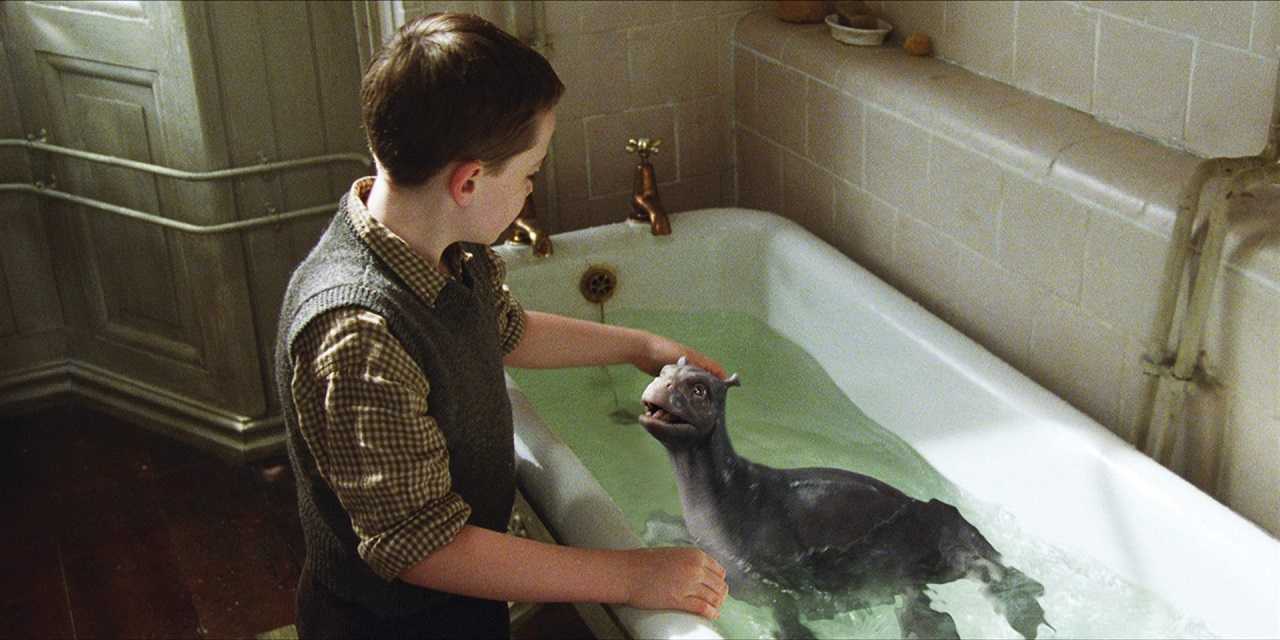
The main problem with The Water Horse is that it falls into predictable patterns. The first half of the show seems to follow the same path as E.T. – The Extra-Terrestrial (1982) in the story of a young boy finding a fantastical creature, taking it home and having to keep it hidden from his mother. This director Jay Russell conducts reasonably well, even if most of the film seems assembled around a series of semi-comedic scenes where the water horse gets loose or needs to be concealed from one or other person. In these parts, The Water Horse is a likeable film – it pulls some heartstrings but is not without charm and earnestness.
However, I feel that Jay Russell tended to lose track of things in the last half, which essentially ended up being run by the Weta Workshop. There are long extended scenes of Alex Etel swimming underwater, riding the creature as though it were an actual horse (which tend to go on for such protracted length that one wonders how the kid doesn’t end up drowning) or of people being spooked by its full-sized appearance. The climactic scenes centre around a set of events that have been dramatically contrived in order to pump up a big drama about the water horse being hunted and shot at by navy ships. (The film does have a surprisingly anti-military theme throughout). The big climax feels like it is there because the film does not seem sure of where to go and so puts on a spectacle show. One cannot help but think the film would have worked far better had it aimed at achieving a more modest climax.
The Water Horse is one of the films from the new US-based family film producing combine Walden Media. Walden Media has so far been behind other films that include The Chronicles of Narnia: The Lion, The Witch and the Wardrobe (2005), Charlotte’s Web (2006), Bridge to Terabithia (2007), Mr Magorium’s Wonder Emporium (2007), The Seeker: The Dark is Rising (2007), City of Ember (2008), Journey to the Center of the Earth 3D (2008), Nim’s Island (2008), Tooth Fairy (2010), The Giver (2014), A Dog’s Purpose (2017), The Star (2017), Dora and the Lost City of Gold (2019) and A Babysitter’s Guide to Monster Hunting (2020).
The Water Horse is directed by Jay Russell, who had previously made films like My Dog Skip (2000) and Ladder 49 (2004), as well as the Disney fantasy film Tuck Everlasting (2002).
Trailer here